Sign in. It’s quick, free and it’s up to you.
An account is an optional way to support the work we do. Find out more.
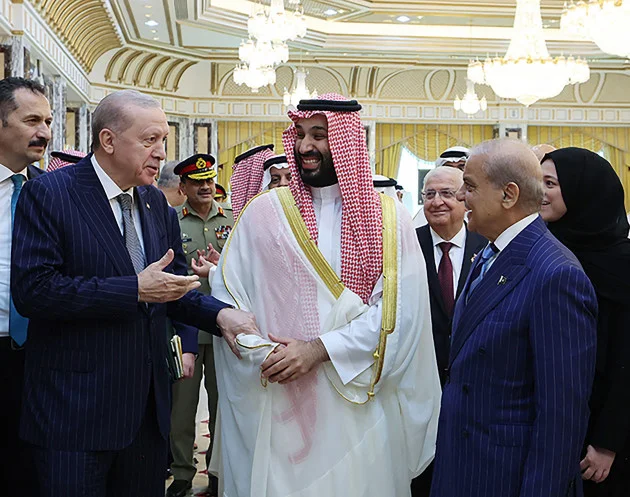
SAUDI ARABIA, TURKEY and Pakistan signed a mutual defence pact today in the holy city of Mecca, which sets out that an attack on one of the three countries constitutes an attack against all of them.
The agreement comes amidst the US-Israeli war against Iran, which has seen Saudi energy infrastructure and airbases hit by missile and drone strikes.
Turkish president Recep Tayyip Erdoğan, Saudi crown prince Mohammed bin Salman and Pakistani prime minister Shehbaz Sharif signed the ”Mecca Joint Defence Agreement” and held up copies of the document for the media this afternoon.
The Saudi foreign ministry said the agreement “is intended to strengthen collective deterrence against any act of aggression, and stipulates that any armed attack against any one of the three states shall be regarded as an attack against them all”.
It also said the agreement “provides for the enhancement of all aspects of defence cooperation among the three states”.
The mutual defence aspect of the deal resembles Article 5 of the North Atlantic Treaty, the basis for the Nato alliance of which Turkey is already a part.
It also follows a similar agreement already reached between Saudi Arabia and Pakistan last September.
Today’s new agreement is likely to anger Israel, whose government has long been at odds with the Turkish government of Erdoğan, who has condemned Israel’s oppression of Palestine for years, and even more so during the genocide in Gaza.
Turkey’s Haberturk television and other media said it is likely to allow joint military exercises and training, technology transfers and the sharing of intelligence.
It remains to be seen what the new three-way agreement will mean for the ongoing Iran war. This week, the Houthis in Yemen have been attacking ships near Saudi ports and also launching deadly attacks against the Saudi-backed Yemeni government’s forces.
Today’s announcement is also a sign that Saudi Arabia is looking to diversify its security relationships, since its alliance with the United States has not kept it free from attack from Iran and its allies during the current war.
Following the announcement today, Turkey said the agreement was “not aimed at any particular country”.
Saudi Arabia said “the agreement does not represent an effort to establish a military axis or a sectarian bloc”.
“Nor is it linked to any nuclear ambitions or arms race, rather it is focused on building sustainable capabilities,” deputy minister for public diplomacy Rayed Krimly said on X.
The “does not constitute a threat to the security of any country in the region”, he added.
Since the onset of the regional war, Saudi Arabia has grown closer to Turkey, Egypt and Pakistan, which have been pushing for mediation and a resolution to the conflict.
Umar Karim, an expert on Saudi foreign policy at the University of Birmingham, said the alignment “is clearly oriented towards Iran and meant to address Iran’s new strategic approach which is geared towards dominance of the broader Gulf region”.
The fact that Turkey and Pakistan border Iran means they could “exercise a different kind of leverage” on Tehran, he added.
Before the signing, a source close to the Saudi military and government told the AFP news agency that although the agreement had been under discussion for a long time, “the latest developments in the region expedite it”.
Andreas Krieg of King’s College London said the deal showed a clear desire to diversify alliances beyond the United States.
“Saudi Arabia, Turkey and Pakistan are not trying to replace the United States,” he said.
“They are building the capacity to protect their interests when Washington cannot or will not do so.”
Riyadh, in particular, he added, “wants several layers of security rather than one American umbrella”, after the shock of the Iran war.
*With reporting from AFP and Press Association *
To embed this post, copy the code below on your site