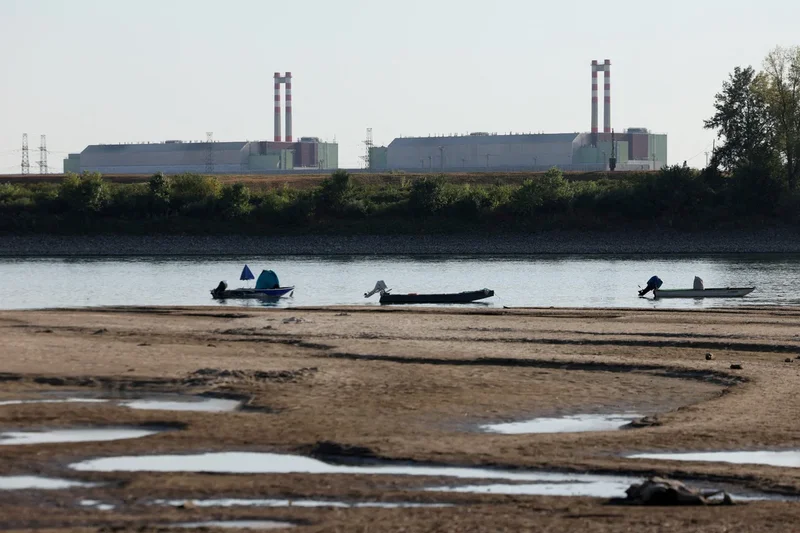
Hungary's Paks nuclear plant continues to face a "difficult" situation, despite expectations of a temporary rise in Danube river levels following rains in Austria. Prime Minister Peter Magyar conveyed this update via a Facebook video on Friday.
The plant has been operating at approximately 10 per cent of its full capacity since late last week.
This drastic reduction is a direct result of a prolonged heatwave and record-low water levels in the Danube, which have severely strained the country's power supply capabilities.
Government working on solving Paks Plant issues
However, Magyar said the situation at the Paks nuclear plant remains "difficult", and that the government was working on solutions at Paks if low water levels in the Danube, which the plant uses as a coolant, become permanent.
Europe, the world's fastest-warming continent, has been ravaged by record-breaking heat and destructive wildfires this summer, with France and Spain particularly hard hit in recent weeks.
Last week Magyar asked companies and citizens to cut back electricity use in the evening hours and dimmed decorative lighting on Budapest's historic buildings to save energy.
Hungary has switched off decorative and non-essential lighting at all state institutions – including its parliament, most of the Buda Castle and Chain Bridge – at night to save energy.
Magyar said on Friday that temperatures were expected to drop and the country's energy and water supply were stable, which means there was no longer need for cutbacks in energy consumption and decorative lighting would be switched on on Friday night.
"We have never seen such national cooperation. According to the first surveys released, nearly all Hungarian families took part in savings and changed their energy and water use," Magyar said.
"We expect the water level to rise a good 20 cm in the next few days, however, as there is no rain expected again from tomorrow, this rise is expected to be temporary," Magyar said. Magyar also said the government will examine what investments were needed to make Hungary's energy and water supply more resilient."
Climate changes is already here, and we need to build a country that can adapt to this," the prime minister said. Magyar said last week that Hungary will develop 4 gigawatts of wind energy capacity by 2030 to diversify its energy sources.