Crackdown on illegal immigration and boomer retirements continued to reduce the labor force, causing unemployment to drop further.
By Wolf Richter for WOLF STREET.
Total payrolls at nonfarm employers fell by 23,000 jobs in July from June, as local government jobs plunged by 57,000, the biggest month-to-month drop of local government jobs in years.
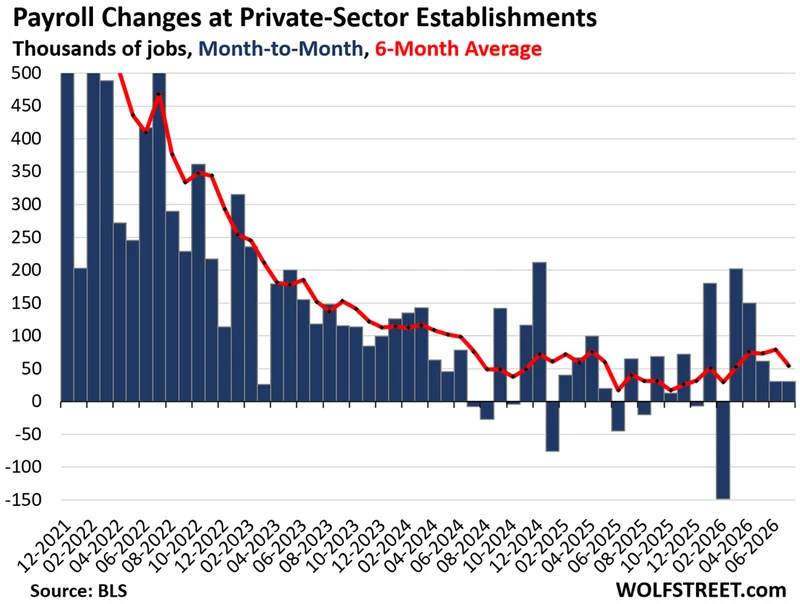
But private sector payrolls rose by 30,000 jobs in July from June, same increase as in the prior month, to 135.59 million, according to the Bureau of Labor Statistics today (blue columns). The six-month average job gain, which irons out the month-to-month squiggles, dipped to 54,000 (red line).
Three major private-sector categories shed jobs:
- Leisure and hospitality (-40,000);
- Retail trade (-19,000);
- Financial activities (-14,000).
All other major private-sector categories gained jobs, including the two categories where many of the tech companies are (Information and Professional and Business Services):
- Construction (+22,000);
- Manufacturing (+5,000);
- Information (+11,000)
- Professional and business services (+18,000).
- Healthcare (+22,000).
Total nonfarm payrolls were dragged down by local government jobs (-57,000) and federal government jobs (-3,000). State governments added 7,000 jobs, the first gain in many months.
Since January 2025, all governments combined have shed 166,000 jobs:
- Federal government jobs: -327,000.
- State government jobs (largely higher education such as state universities): -54,000.
- Local government jobs (largely education and first responders): +94,000.
The six-month average gain of total payrolls, which irons out the revisions and month-to-month squiggles, declined to a gain of 44,000 in July (red line).
The level of total nonfarm employment in July, driven by the drop in government jobs, dipped to 158.86 million:
Labor force declined further. The labor force consists of people who are working and people who are not working but are actively looking for work. It represents the supply of labor.
The crackdown on illegal immigration and the continuing boomer retirements have substantially reduced the labor force. And that continued in July.
The labor force in July dropped by another 264,000 people to 169.09 million, the lowest since the massive up-revision in January 2025 that finally accounted for the surge of immigration in the prior three years (blue segment).
Over the past 12 months, the labor force – the supply of labor – has plunged by 1.32 million people! In prepandemic years, the labor force would grow by about 1 million to 2 million per year.
This continued drop in the labor force has dramatically changed the dynamics of the labor market, leading among other things to falling unemployment, a falling and very low unemployment rate, and a very high prime-age labor force participation rate.
The number of unemployed people dropped to 6.92 million in July, the lowest since January 2025.
The unemployment rate declined to 4.09%, the lowest since January 2025. The unemployment rate reflects the number of unemployed people who are actively looking for a job (6.92 million) divided by the labor force (169.09 million) – and both, the number of unemployed and the labor force have been declining.
Within a 50-year timeframe, the current unemployment rate is low, largely because of the shrinking supply of labor.
The prime-age labor force participation rate ticked up to 83.4% in July, after the drop in June (blue in the chart below).
The three-month average, which irons out some of the squiggles, declined to 83.5%. This range has been the highest in over 20 years.
The prime-age labor force consists of people between 25 and 54 years old. It eliminates the issue of the retiring boomers. When people retire and stop looking for a job, they’re no longer “participating” in the labor force but remain in the population until they die. It’s the surge of boomer retirements over the past 15 years that has pushed down the overall labor force participation rate (not shown here).
Average hourly earnings rose by 0.05% in July from June, and by 3.2% year-over-year.
Inflation has been running hot for months, and this wage gain of 3.2% is now below the rate of CPI inflation of 3.5%, after outrunning CPI inflation over the past three years.
Enjoy reading WOLF STREET and want to support it? You can donate. I appreciate it immensely. Click on the mug to find out how: