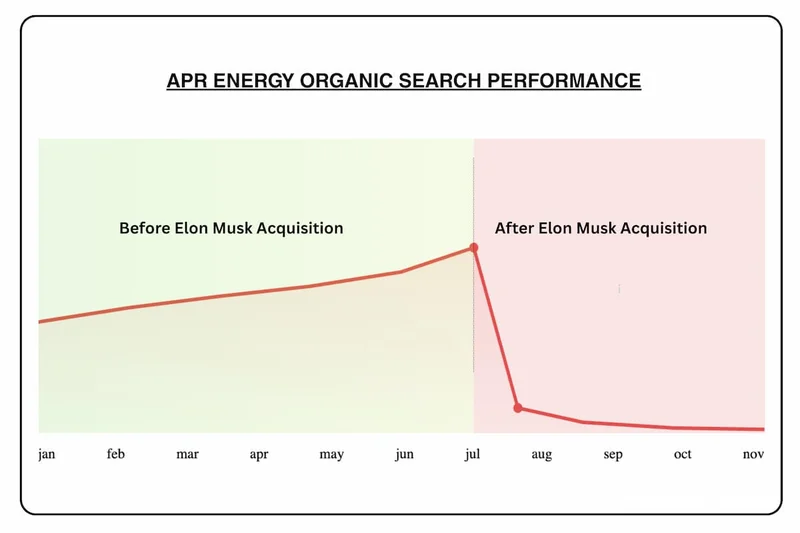
In July 2026, the FTC published a filing that revealed
The acquisition has been
The reasons are likely optics since there’s little upside for Elon Musk to draw attention to the acquisition or business.
Regardless of the reason, the result is that APR Energy’s website is gone, and so is everything it had built in search. For Musk, organic traffic was never going to be the point of this acquisition.
But what if it were?
Imagine that you acquire a new business and need to take it offline while you decide how to best use its assets. Is taking the site completely offline, as Musk did with APR Energy, the right play?
No, and in this piece, I’ll share what to do instead. But first, let’s look at why taking the website down was the wrong play and which competitors stand to benefit from it.
APR Energy’s website had performance worth protecting.
Based on what we know, APR Energy is a company valued at $1 billion. But its organic footprint paints a much more conservative picture. See the snapshot from Ahrefs below.
- 37 DR
- 945 referring domains
- 37 organic keywords
APR energy isn’t an organic powerhouse, but it has a foothold. And for businesses in this position, the play is to double down on SEO efforts: build authority, aim to rank for more keywords, and invest in BOFU content.
On a closer look at organic visibility, we see that APR Energy ranks for two major non-branded keywords: “Genset” and “hybrid solar power plant.” Both are critical for a business in this category because they are informational keywords that can attract the right kind of audience.
However, since being taken offline, the site has practically fallen off Google’s indexing altogether. The snapshot from Ahrefs, taken in late July, tells us that APR Energy leads the SERPs for “genset.” But on Google, it is now invisible.
That means that these hard-earned positions are now up for grabs, and the position has been filled to satisfy searcher intent.
All the organic momentum built by the website is just gone, and that’s the real reason you can’t abruptly take a website offline. Not even to re-evaluate its business position. You’d waste all the effort and resources put into building its visibility and pave the way for the competitors.
Ranking gaps don’t stay empty for long.
In the SERPs screenshots, we already see competitors like Klingecorp.com taking up APR Energy’s valuable real estate.
When sites vanish like this, the rankings typically move to fill the gap. But rankings shift all the time if a site with enough authority publishes good enough content. Based on my research, Aggreko.com is one of those sites.
Aggreko ranks for 100X the keywords (2411 vs 20), has double the DR (69 vs 37), and nearly 50X the organic traffic (41,000 vs 850). They are perfectly poised to scoop up APR’s position.
Interestingly, they don’t have pages dedicated to keywords like "what is a genset” or “hybrid solar power plant” at the moment, even though they cover other aspects of the topic extensively.
A well-optimized information page targeting “genset” from a domain of that authority is an easy win. The same thing applies to every other player in this space.
Even though APR Energy doesn’t rank for many keywords, the few they did occupy are now open. And with the right execution, that gap will be filled.
Four ways to protect search equity after an acquisition.
If you’re acquiring a website, here’s what to do instead of taking it down and losing all that equity.
1. Set up a 503, not a 403
APR Energy set up a 403, and in so doing, signaled that the entire website is inaccessible. The better move would be a 503 (Service Unavailable), which signals temporary unavailability, so crawlers return later rather than de-indexing. This way, you’re not shutting down all built-up search equity.
2. Keep the sitemap accessible
Even with the site down, the sitemap should remain accessible. That keeps Google aware of all the URLs on the site and sets up an uncomplicated return.
3. Keep the top-performing pages live
If the site needs to be taken down for reasons of optics, you can still preserve search equity by selectively leaving the top-performing pages online. In the case of APR Energy, those would be the informational blogs and service pages that rank.
The only reason not to do this is if the team has already decided that the website has no usefulness whatsoever moving forward.
4. Sell the website to a competitor
If the website genuinely has no place in the business’s future, a savvy competitor would gladly buy it up at a reasonable price and feed it into its own organic strategy. They would migrate the performing content onto their website and redirect domains. Unlikely to happen in APR Energy’s case, but it could well be the strategy for your acquisition.
What is the acquired website’s rankings worth?
That’s the big question. In the case of Elon Musk, we can assume that he has no use for APR Energy’s website. It has a small organic footprint, and he can always hire SEO professionals to rebuild it if needed.
But billionaires aren’t the only ones acquiring businesses and websites. If you find yourself in an acquisition, you can follow the four steps above (set up a 503, keep the sitemap live, leave informational pages up, or sell the websites) to keep some of the value you paid for in the website acquisition. The website is part of what you bought, and it should earn its keep.