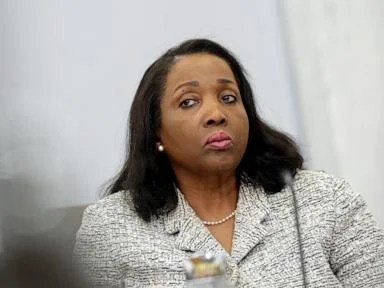
Trump moving forward with attempt to fire Lisa Cook after Supreme Court setback: Sources
The White House demanded she respond to allegations within three weeks.
President Donald Trump is moving forward with his attempt to remove Lisa Cook from the Federal Reserve over unproven allegations of mortgage fraud, sources say, in a move that is likely to spark a new legal battle over the independence of the central bank.
In a letter this week, the White House notified Cook that the president was "considering" removing her from her role on the Federal Reserve Board of Governors and demanded that she respond to the allegations within three weeks, sources familiar with the letter told ABC News.
The move follows a Supreme Court ruling in June that upheld limits on the president's attempt to remove members of the Federal Reserve stemming from the institution's historical independence.
In a 5-4 decision, Chief Justice John Roberts said Cook was entitled to notice and an opportunity to respond to the allegations before she is removed "for cause." But the Supreme Court did not take a position on the underlying allegations against Cook and effectively left the door open for Trump to attempt to remove her.
"Only after Cook has had the opportunity to respond to the charges made against her ... may a final decision be made," Roberts wrote. "And only then can the courts assess the validity and sufficiency of such charges."
Following the decision, Trump signaled on social media that he would "take appropriate action immediately" to remove Cook from her position.
"The Cook Lawsuit, having to do with her suitability in sitting on the Board of the Federal Reserve, was sent back by the Supreme Court on a strictly procedural basis, we will take appropriate action immediately to make sure that someone who has committed wrongdoing will not be making vital decisions concerning the Welfare of the United States of America!" Trump wrote on June 29.
Trump appears to have followed through with his vow this week by formally initiating the process to remove Cook for "gross negligence" based on the allegations of mortgage fraud, which remain untested in court. Citing the Supreme Court's ruling in June, the letter signaled that Trump was carrying out the steps prescribed by the justices.
While the letter -- which sources say was signed by Deputy Chief of Staff Dan Scavino -- alleged that Cook committed crimes that could be punished up to 30 years in prison, Scavino argued that her conduct constituted negligence that calls into question her trustworthiness as a Federal Reserve Governor, even if the allegations do not amount to a crime.
"These allegations are as baseless now as they were a year ago when President Trump tried to remove Governor Cook and interfere with the independence of the Federal Reserve," Cook's attorney, Abbe Lowell, said in a statement to ABC News. "No matter what President Trump tries to do next, this much is clear under the facts and Supreme Court precedent -- there is no valid cause for removing Governor Cook. As we did before, we will challenge this latest pretext and preserve her position and the historic role of the Fed."
Cook has denied wrongdoing and has never been charged with any crime. She was confirmed by the Senate in a 50-50 vote that required then-Vice President Kamala Harris to break the tie.
"This was never about mortgage documents signed years before I became a Federal Reserve governor. It was an attempt to remove me on a manufactured pretext because I refused to bow to political pressure and continued to set interest rates based only on what would best serve the American people," Cook said in a statement after the Supreme Court's ruling.
Trump initially sought to remove Cook from the Federal Reserve Board of Governors last August, as the president escalated a broader pressure campaign to push the central bank to lower interest rates.
The allegations against Cook stem from two referrals made by Bill Pulte, a fierce ally of the president currently serving as the director of the Federal Housing Finance Agency as well as the chairman of Fannie Mae and Freddie Mac. In those roles, Pulte has made multiple criminal referrals against several of Trump's critics, including New York Attorney General Letitia James, Sen. Adam Schiff.
Pulte briefly served as Acting Director of National Intelligence, during which he fired a third of his office and sparked bipartisan concern about his lack of national security experience and willingness to target the president's political opponents.
Last year, the Department of Justice launched an investigation into Cook based on Pulte's allegations that she falsified bank documents to obtain favorable loan terms. Ed Martin, the U.S. Pardon Attorney and director of the DOJ's "Weaponization Working Group," also sent a letter to Federal Reserve Chairman Jermone Powell urging him to remove her from the job.
"At this time, I encourage you to remove Ms. Cook from your Board. Do it today before it is too late! After all, no American thinks it is appropriate that she serve during this time with a cloud hanging over her," Martin wrote.
Trump attempted to fire Cook days later based on the allegations, sparking an ongoing legal fight over the legality of the for-cause removal. Both a federal district judge and the U.S. Court of Appeals for the District of Columbia Circuit refused to allow the firing.
"Cook is one of seven members of a Board that is, by design, not intended to be susceptible to policy pressure, let alone tasked with implementing the President's agenda," U.S. District Judge Jia Cobb wrote.
In a 5-4 decision, the Supreme Court narrowly upheld those rulings and reiterated the Federal Reserve's unique role in overseeing the economy and its structural independence from the executive branch.
"Any change in that scheme must come from Congress, not the courts," Chief Justice John Roberts wrote. "That is why we cannot accept the Government's contentions in this case. To do so would allow the President to remove a member of the Federal Reserve at any time, for any reason, without any notice before, and without any judicial check after."
Trump's new effort to fire Cook is likely to reignite the legal battle over the Federal Reserve's independence, as courts are likely forced to weigh the allegations against Cook or whether Trump met the legal standard to remove her.
"The ultimate question of whether the President can remove Cook for cause will depend in part on the underlying facts. In this opinion, we have not addressed the facts, as they have yet to be found or analyzed under the relevant legal standards," Roberts wrote in June.