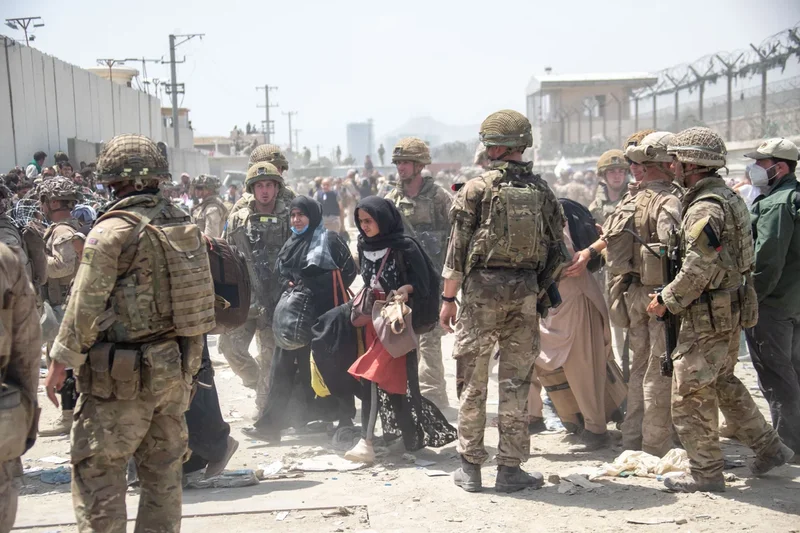
Thousands of Afghans promised sanctuary in the UK may remain at risk from Taliban attacks, the Ministry of Defence has admitted – but the UK still won't help them flee Afghanistan.
Among those likely in danger are former special forces commandos, who served alongside UK special forces units in Afghanistan, who were wrongly abandoned after the Taliban take-over, while others still waiting were made vulnerable when their personal details were exposed in a catastrophic MoD data breach.
Around 7,000 Afghans have already been accepted to resettle but are either stuck in Afghanistan or trapped in third countries, as of 9 June 2026, because the UK stopped evacuation support in June 2025 – just before news of the data breach was made public.
Instead, anyone who wants to come here must now make their own way to Pakistan, where they will be housed and scheduled for flights to the UK. While some families have been able to make that journey themselves, with figures showing hundreds escaped between October and December 2025, campaigners have warned others cannot afford to travel, creating a “two-tier system”.
Now, internal documents reveal that the MoD admits that Afghans awaiting relocation may be vulnerable to Taliban attacks and live in fear of persecution, while those known to have worked with Western forces “likely remain at higher residual risk”.
A February 2026 MoD review, seen by The Independent, from the commander of Operation Lazurite, the programme launched to settle Afghans in the UK, reported that families may be at enhanced risk if they try to get travel documents to leave the country.
In a summary of conversations with other government departments, Major General Ben Cattermole, the operation commander, said that “the risk to individuals who may be eligible… remains real, albeit diminished”. It continues: “It is selective and localised… and primarily contingent on visibility of the past association with UK forces”.
It acknowledges that those who helped foreign militaries face fear of retribution, Taliban surveillance, and door-to-door searches, as well as social ostracism and the inability to work.
The summary added: “While there is no evidence of mass reprisals or organised purges, the potential for arbitrary detention, intimidation and targeted violence persists, especially where local commanders act autonomously or where individuals are publicly known to have worked with foreign militaries”.
Maj Gen Cattermole concluded that recent targeting and killings of Afghans “may well be the result of recent transgressions, rather than their previous affiliation” to the UK government.
While Maj Gen Cattermole was considering the situation between November 2025 and January 2026, a recent report from the United Nations mission in Afghanistan said that killings of former Afghan security personnel were continuing. It documented eight deaths and 29 cases of arbitrary arrest or detention between April and June this year.
The UN said that former military personnel continue to be at risk when forcibly returned to Afghanistan, and gave the example of a former army officer who was deported from Iran to Herat on 10 April and went missing the same day.
News outlet Afghanistan International reported in July that the Taliban was compiling lists of hundreds of former security personnel in Kandahar, Helmand and Uruzgan and had begun to surveil them. A source said that the Taliban’s intelligence service was collating information, including their names, fathers’ names, phone numbers, and addresses, to ensure former security personnel did not pose a threat.
The MoD assessment, which emerged during recent High Court litigation, admits that the wealth of biometric data available to the Taliban on former government officials may put them at “enhanced risk” if they seek to leave the country, or travel through border posts.
But it also revealed that between 1 October and 31 December 2025, 60 families – around 224 people – were able to flee Afghanistan to Pakistan, the majority by getting on flights.
The review shows that the MoD is tracking the names and details of those reported as detained by the Taliban and cross-checking it against those offered resettlement in the UK, but the number of matches for the period October-December 2025 has been redacted as confidential.
The document says it has drawn upon expertise across government to inform the risk assessment, including external stakeholders and other sources – such as The Independent’s reporting, which is referenced.
It also stresses the need for regular reassessments of the situation, something the influential defence committee of MPs has called for.
Professor Sara de Jong, from the Sulha Alliance, which supports Afghans who worked for the British army, said the government must to more to help those left stranded.
“As the government wants to complete Afghan resettlement within this Parliament and recognises ongoing risks for Afghans associated with the UK, it would make much more sense to step up relocation support rather than cancel it. Especially as the geopolitical situation with Pakistan means Afghans have fewer ways out and fewer resources after almost five years living in fear under Taliban rule,” she said.
She added that while the review, which cites her research, details the number of people who managed to self-move, it is “silent on the number who are unable to do so, and so can only give a partial picture”.
In a recent report on the MoD data breach, MPs called on the department to publish a clear policy for Afghans who cannot safely, lawfully or afford to move to a third country.
But the review warns that, without help from the UK, the movement of people out of Afghanistan and into accommodation in Islamabad will be hard to control.
The government previously used a third party provider to evacuate Afghan families eligible for relocation to the UK from October 2021 but that stopped in June 2025 “when it was paused ahead of the lifting of the super-injunction” used to keep the MoD data breach secret.
The pause was maintained after the closure of the land border between Afghanistan and Pakistan and because of the operational risk of those helping people escape, documents show.
However MoD officials have been exploring further ways to help Afghan families flee. This is being investigated “as a priority”, a ministerial brief from March 2026 says, giving hope that the department may be able to take some action to support those still waiting. Options floated seemed to include giving payments to those eligible to help fund their journey to the UK.
An MoD spokesperson said: “We continue to see no evidence of the systematic targeting of eligible persons because of their previous affiliation or because they have applied for the Afghan Resettlement Programme. Likewise, for those affected by the 2022 Afghan data incident, the independent Rimmer Review concluded that while there may be a residual risk to individuals associated with the former Afghan government, it is highly unlikely that merely being on the dataset would be grounds for targeting.
"The UK has operated exceptionally generous Afghan resettlement schemes and our ambition remains to conclude these schemes well within this Parliament."