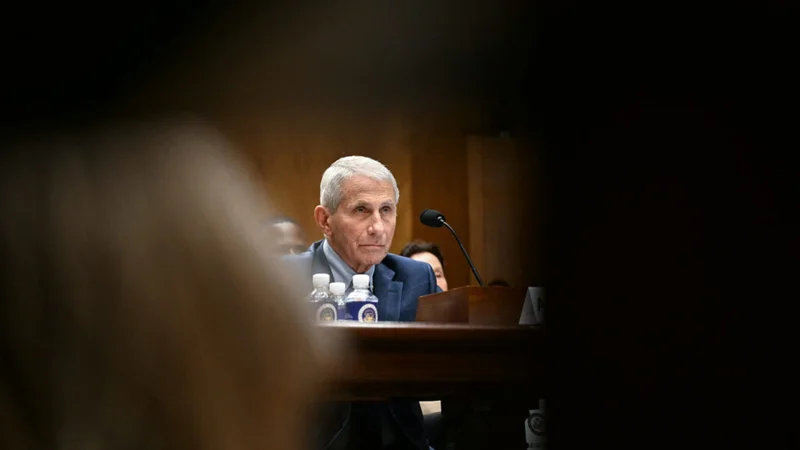
The Senate committee hearings last week on the origins of the Covid-19 pandemic presented a master class in political distraction from what is important for the nation’s public health. And Thursday the committee held Anthony Fauci in contempt of Congress for invoking his Fifth Amendment defense to a committee chaired by someone who has already said Fauci “should go to prison.”
The Covid-19 pandemic originated in Wuhan, China. The Chinese government vigorously suppressed information about the epidemic in the first weeks and months. It dragged its feet on alerting the international community to the threat. It frustrated the World Health Organization’s attempts to discover basic facts about the transmissibility of the virus, denying the rest of the world crucial weeks to prepare. And once the virus had escaped China and spread to Europe and then North America, it covered up the initial facts about the epidemic, silenced whistleblowers, and prevented investigations into the origin of the virus by refusing international investigations, locking WHO representatives in their hotel rooms on the specious theory that the virus had been imported from abroad. It then denied international access to scientists in Wuhan, their laboratory records, and the records of local public health authorities. Countries that demanded an open investigation were threatened with economic retaliation.
But who is the bad guy? Well, apparently that is Fauci, at the time the leading U.S. public servant vastly knowledgeable about infectious diseases and longtime respected adviser to presidents of both political parties. The issue of the origin of the Covid-19 virus is still salient because knowing the source of any epidemic is useful in predicting, and ideally preventing, the next one. But Fauci does not have the answers there. Only China does — and Covid-19 was not even the first time it obfuscated investigations into a coronavirus.
In the 2002-2004 outbreak of SARS (a virus related to Covid-19), 66% of deaths occurred in China or Hong Kong, but deaths occurred in a total of 29 countries. The first cases emerged in Guangdong province in 2002, but the Chinese government did not report cases to the WHO until 2003. State media was forbidden from reporting on the epidemic, and details of hospital admissions and deaths were suppressed. Meanwhile travelers exported the virus internationally, notably to Canada, where 43 people died, and Singapore, where 33 people died.
After this experience, China strengthened its public health capacity and professed a new openness to reporting of potential epidemics. However, 18 years later, confronted by the emergence of the epidemic in Wuhan, the government reverted to type, suppressing information and silencing doctors who sought to alert the authorities and their communities to a respiratory disease that was overwhelming the capacity of hospitals to treat victims. As part of the crackdown, information on who was infected during the first weeks of the epidemic was suppressed and then hidden from view.
In this information vacuum, pandemic experts were left speculating about the origin of the disease. The first SARS outbreak had eventually been traced to the practice of selling civets (a cat-like mammal) in live animal markets in China. The civets had probably been infected from horseshoe bats that live in caves in southern China. The other SARS-like infection of humans discovered this century, MERS, also appeared to involve transmission to humans from an animal reservoir — in that case, camels.
So, historically, these viruses were due to “spillover” from animals, and in early 2020 at the start of the Covid-19 pandemic a reasonable assumption was that this was another example and an animal reservoir would be found. The linkage of many early cases in Wuhan to the “wet” market, a euphemism for a live animal market, still flourishing 18 years after the Chinese authorities had said they would limit the sale of wild animals for food, seemed a logical source. However, 8 miles away the Wuhan Institute of Virology was known to be conducting experiments on SARS-like viruses obtained from bats 800 miles away in Southern China. Hence the “lab leak” possibility. In addition, employees of the Wuhan Institute traveled to the bat caves and may have returned home carrying the virus.
If any cover-up has happened, the real culprits are those in the Chinese government who denied the international community access to the information on what experiments were being conducted in the Wuhan Institute of Virology, when the first cases occurred, what the epidemic curve was in the first weeks, and when it became apparent that human-human transmission (initially denied) was occurring. To blame Fauci for not knowing these answers makes as much sense as blaming a detective in Washington, D.C., for not solving a murder in Wuhan, China, when denied access to all the witnesses and evidence. To conflate the issue of the origins of the virus with the subsequent Covid-19 public health policies like mask mandates is to mix apples and oranges.
If members of the U.S. Senate committee were serious about the origins about Covid-19, they would admit that the answer will probably never be known unless China comes clean about the facts in the first few weeks of the outbreak. If the committee was serious about protecting the health of U.S. citizens, it would be concerned that it is a high probability that the next pandemic will emerge from the same country, China, due to its animal husbandry practices. Persecuting (and prosecuting) Fauci for trying to answer questions about the virus source in 2020 when we were all misled by the Chinese government is a sideshow. And while the world remains at risk of the next pandemic, the Washington Band Plays On.
David Hunter is the Richard Doll professor of epidemiology and medicine at the University of Oxford.