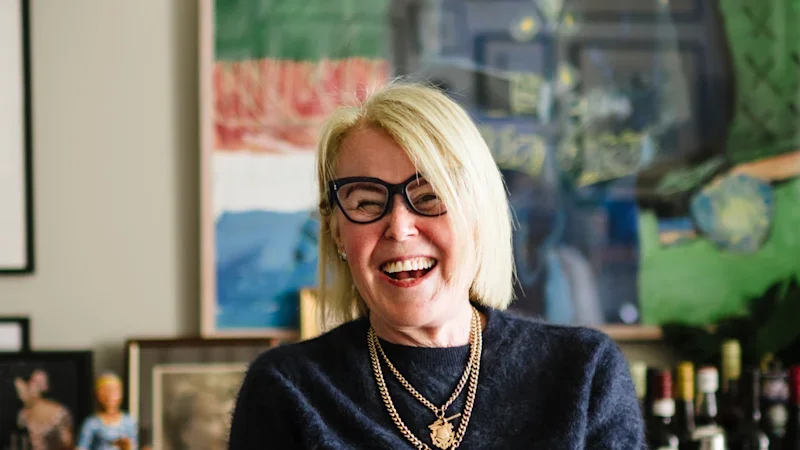
It was a time of fear and panic. A mysterious illness was spreading, and young, gay men were rapidly falling sick.
Felicity Young, aged 24 when the HIV epidemic emerged in Queensland in the 1980s, describes a state gripped by hysteria.
“It terrified the shit out of people,” recalls Young, now 66.
In the kitchen of her apartment in the Brisbane suburb of Newstead, Young traces the early years of HIV.
A stack of archival material – Condoman comics, AIDS campaigns from the ’80s, policy manuscripts she wrote while living overseas – sit within reach.
The sunlit morning retrospective has been prompted by Young’s recent decision to retire from HIV advocacy after 40 years.
“When I first started as a volunteer, I didn’t know that it would be this arc,” she says. “But it has been a privilege.”
Young was living in nearby New Farm when a New York native visiting Sydney became the first person in Australia to be officially diagnosed with AIDS, the condition caused by human immunodeficiency virus, in 1982.
In the NSW capital, the virus emerged on the coat-tails of the women’s and gay liberation movements. Queer communities and activists winning the fight for same-sex acceptance were primed to mobilise against HIV.
It surfaced in Queensland in a vastly different social climate.
“In those early days, it was really difficult because the Joh Bjelke-Petersen line was morality. Gay men are, I don’t want to say the word, but scum, basically,” Young says.
“[He felt] that they were deserving of the disease.”
Before it had a name, HIV was colloquially referred to as the “gay plague” or “gay syndrome”. Hospitals in New York diagnosed Wrath of God Syndrome (WOGS), and medical researchers coined Gay-Related Immune Deficiency (GRID) to pathologise the illness affecting mostly young, gay men.
When HIV reached Queensland, Bjelke-Petersen, the longstanding ultra-conservative premier, decried the virus as a moral failing rather than a public health issue.
“There were calls to remove gay men from society [and] put them on an island, like the whole leper approach,” Young says, referencing plans to resurrect Moreton Bay’s former leper colony on Peel Island.
“When Queensland was being forced by the federal government to do something about HIV, Joh didn’t want to do anything.
“He said: ‘Morality is what’s going to save us. Abstinence is going to save us. This is a punishment from God.’ ”
In 1984, Queensland’s then health minister, Brian Austin, announced three babies had died after receiving blood transfusions contaminated with HIV. The father of one urged the donor, a gay Brisbane man, to suicide.
Bjelke-Petersen seized on the tragedy to stoke moral panic.
In this fraught climate Young, a newly graduated social worker in her mid-20s, met two men infected with the virus while working at Wolston Park Hospital, instigating a decades-long career in HIV advocacy.
Young was assigned two locked wards at the hospital in 1986: Osler House, a maximum-security unit for women deemed “criminally insane”, and Pearce House, a high-security ward for violent men with mental illnesses.
“For some reason, someone thought it was a really good idea to put a 26-year-old inexperienced woman inside this locked ward,” Young says.
The HIV-positive men were admitted to the hospital in 1987. Driven by fear and misinformation, they were excluded by hospital staff and approached “like lepers”.
“I thought, it just doesn’t seem right that you would treat people like this, particularly in a healthcare setting, that you would further marginalise and discriminate against them,” Young says.
She rang the Queensland AIDS Council, a grassroots organisation formed despite bureaucratic indifference. With their support, she ran educational sessions on HIV for the hospital.
“Did it dampen down the hysteria? I’m not really sure, but we did our best.”
That same year, Young volunteered on the Grim Reaper campaign. While aimed at raising awareness, the commercial was later criticised for contributing to violence against the LGBTQIA+ community.
“The campaign terrified everybody,” Young says.
“They would run the ads and then there’d be a phone number you could ring up … [people would call asking] ‘Can I get it from a coffee cup?’ or ‘My neighbour is gay, should I move out of the building?’
“Just fear, fear, fear. I don’t think I ever took a call from anybody who was actually at risk.”
Bjelke-Petersen resisted calls for safe-sex education and the instalment of condom machines in public facilities, and prohibited funding to the Queensland AIDS Council. But pressure from the federal Labor government to act against the spread of HIV was mounting.
Young describes Mike Ahern, Bjelke-Petersen’s health minister, as a more progressive person whose hands were tied. His federal counterpart, Neal Blewett, found a solution by granting funds to the Mater Hospital, run by the Sisters of Mercy.
The hospital’s Sister Angela Mary Doyle helped to funnel the money to the Queensland AIDS Council, a move that led Blewett to later describe the Sisters of Mercy as “the most altruistic of money launderers”.
“The whole thing about Joh was morality and God, and yet you had the Catholic Church [doing this],” Young says.
“Angela Mary and her leadership were compassionate. They saw sick people who needed care … There’s always people on the margin, people inside, people outside, working.”
Young left Wolston Park after two years and began working for the state government as a health promotions officer.
Inside a repressive government, she got to work slowly. By the late 1980s, infections were growing among drug users and sex workers, and like Doyle, Young began moving money where it was needed.
Bjelke-Petersen resigned in 1987 and was replaced by Ahern, who allowed a clean needle pilot out of a methadone clinic in Fortitude Valley.
“We did a lot of work with the police department to lay off people who were getting needles and syringes, and likewise with condoms,” Young says.
“There are always practical people and people who appreciate the greater good is to do exactly that. As an advocate, you’ve got to learn to work all of those channels.”
The role brought Young to the frontline of fighting the virus, to people whose health was deteriorating rapidly.
“I remember young, gay men – beautiful, handsome men – wasting, getting very, very thin, very quickly, becoming very frail,” she says.
“Getting pneumonia was really common, so hacking coughs, moving into hospital or hospice care and then dying really quickly.”
Young married Graham Neilsen, the doctor tasked with writing the scripts for needles and syringes in the Fortitude Valley methadone clinic.
When the pair moved to Sydney in 1990 for Neilsen’s studies, Young, then aged 30, was appointed the executive director of the Australian Federation of AIDS Organisations, now Health Equity Matters.
“Sydney was more progressive … but there was still nothing to blunt the disease because there weren’t effective treatments,” she says.
“Prevention was condoms only, and clean needles and syringes.”
In 1995, Young and Neilsen moved to Indonesia to continue their work in HIV advocacy. There, the government saw HIV as a Western disease that did not pose a threat to Indonesian citizens.
“It was like banging your head against a brick wall,” Young says.
The pair moved between countries where prevention and health policy was falling behind the devastating pace of the virus for the next 30 years: South Africa during the Mbeki denialism years, Thailand, Cambodia, Papua New Guinea and Fiji.
“Gay men and drug users are always hard to find when it’s highly illegal … but there’s always that underground movement to tap into,” Young says of the cultural and political barriers she’s faced.
“What I’ve tried to do is divert power and therefore resources and move it to communities, because I actually believe that the people closest to the epidemic are in the best position to drive the response.
“[It’s] people moving money, moving power, bringing people in who are on the outside, having people on the inside.
“Advocacy is like a pincer movement. Everyone’s kind of working.”
The walls of Young’s apartment are lined with art collected from her international postings, vignettes of the worlds she tapped into while fighting the spread of HIV.
In 2024, Young was appointed an Officer of the Order of Australia (AO) for her work developing Health Equity Matters’ international programs and her distinguished service to public health.
This year, she made the difficult decision to retire from her longstanding position.
She finds a framed cover from a 2011 edition of The Economist, the headline daring to posit “The end of AIDS?”.
“I had the foresight to think, I’m going to frame that because this is my life’s work, and it’s saying it’s almost over,” Young says.
Fifteen years later, HIV is far from eradicated, with South Pacific nations Fiji and PNG in the grip of a fast-moving epidemic. Young says it proves how relentless the virus is, with HIV rising in communities on the back of the international drug trade.
Back home, Queensland, like other Australian states and territories, has committed to working towards the virtual elimination of new HIV transmissions by 2030, with a focus on prevention, testing and treatment. But even in progressive nations with robust healthcare systems, barriers mounted by political ideology and access continue to present challenges.
Last year, the Queensland government brushed aside calls to introduce a needle-exchange program in the state’s prisons, after reports up to 300 prisoners may have been exposed to HIV. The LNP’s calls for abstinence – “there should be no needles in prisons” – bore the familiar hallmarks of a former government’s refusal to engage in effective public health measures.
“This isn’t about ‘safety’ or condoning drug use, even though that is how it is often framed,” Young says.
“The fight against HIV is fundamentally about human rights … [and] prisons are where human rights arguments get tested the hardest.
“Health interventions cannot succeed without first addressing the social and political structures that deny people their dignity and equality.
“We make progress when we treat people as people – not problems to be solved, but individuals deserving of respect, support and opportunity.
“What I am proudest of, beneath all of the achievements and milestones, is having understood and advocated for this truth: that every gain in HIV prevention, treatment and care began with a fight for human rights.”