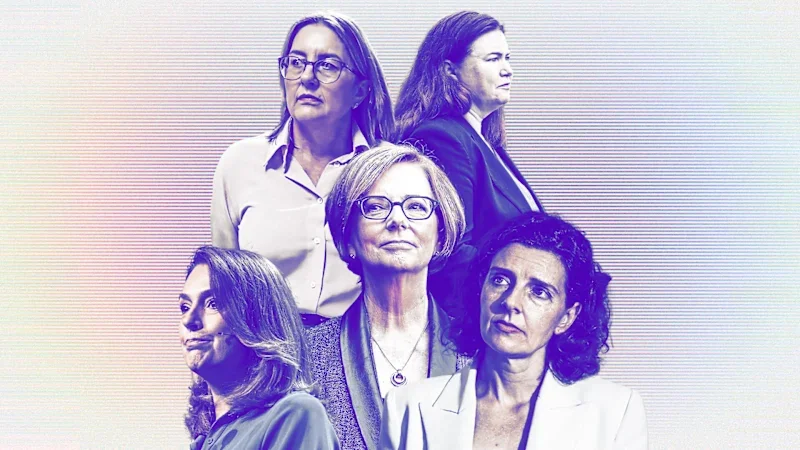
When Animal Justice Party MP Georgie Purcell picked up her phone moments after she was elected to Victoria’s upper house in 2022, one of the first messages she read was from a man calling her a whore on social media platform X. Purcell says the barrage of online hatred and harassment – from sexist slurs about how she looks or what she wears, to death threats and threats of sexual violence – has not relented in the four years since.
“Having a lot of followers is amazing for the issues I champion, and it shows people are looking for something different in politics. But there’s a really perverse side to it – it opens me up to a higher volume of abuse,” she says.
Purcell is far from alone. New research from nonpartisan not-for-profit organisation Women for Election this week found nearly 90 per cent of female politicians had experienced online abuse or intimidation, and more than half of those surveyed were reconsidering their positions in public office.
Three-quarters believed online abuse of women in politics had increased in the past two years, and the harassment was worse for politicians from multicultural backgrounds, LGBTQ women and young women. The research unleashed a tidal wave of anecdotes from councillors and MPs and underscored a string of incidents allegedly targeting women in politics in NSW and Victoria.
Women for Election chief executive Licia Heath says Australia has made strides in the number of women being elected to all three levels of government. However, the jump in representation has been accompanied by a surge in online abuse and threats that is risking women’s safety, deterring them from public office and undermining democracy.
Compounding the phenomenon, female politicians say, is the seemingly tacit acceptance that online abuse is simply part of the job, the reticence of major parties to stamp it out, and the lack of accountability for perpetrators.
Heath says the rise in online violence experienced by female politicians in Australia mirrors a global trend.
“There is mounting evidence that online abuse is increasingly leading to offline violence,” she says.
“We do not have to wait for a woman to be killed in public office, like has happened overseas, for us to get in front of this issue and start putting safeguards in place.
“How many death threats should we take before we take it seriously? Is it two? Is it 50? Is it 600? Because that’s what some of these women are experiencing.”
In the last decade, three British MPs have been killed. Two were women, including Ann Widdecombe, who died last month after an intruder allegedly struck her 21 times with a hammer.
The issue was thrust into the spotlight in NSW this month when Agriculture Minister Tara Moriarty said a series of threatening remarks towards her on the Facebook page of the Shooters, Fishers and Farmers Party “crossed a line” and she reported them to NSW Police.
NSW Opposition Leader Kellie Sloane deactivated her X account after receiving violent threats when she criticised a neo-Nazi rally outside NSW Parliament House last November, while the independent Wentworth MP, Allegra Spender, was allegedly harassed online after condemning the same protest. A 31-year-old man was later charged with allegedly asking members of a neo-Nazi Telegram channel to “rhetorically rape” Spender.
In April, Cumberland Council’s first Muslim and female mayor, Ola Hamed, had her car torched in western Sydney. Last week, police charged a Central Coast man, 43, for allegedly using a carriage service to threaten serious harm to Gosford MP and Paralympian Liesl Tesch.
Tesch on Friday said it was “a little bit surreal when there’s an arrest made based on something that’s online – but this is the new reality of holding people to account”.
“It really makes you think about the value we get from all this social media,” Tesch told ABC Radio. “The [anonymity] just emboldens faceless people who really do cause harm.
“I’ve got a thick skin … but what happens to young people, vulnerable people and community advocates who just get battered by the division this is causing across our community?”
Asked about the alleged threats to Tesch this week, NSW Police Minister Yasmin Catley acknowledged online attacks were escalating: “It is becoming commonplace for people to think they can, behind a screen and in front of a keyboard, make threats to people, including MPs.”
In Victoria, a controversial mobile billboard that depicted former premier Jacinta Allan alongside the slogan “ditch the witch” in July was widely denounced as sexist and misogynistic – including by former prime minister Julia Gillard. Gillard remarked that she believed conditions for women in politics had advanced since the same slogan was used against her in office 15 years ago, but that social media “continues to be a toxic sewer” and she was “saddened to see that improvement cast aside, and this tired old trope resurrected”.
Heath says abuse directed at politicians is not new, but women are targeted more often, and the abuse is more personal and sexualised. She says remarks directed at male politicians tend to relate to their policy positions, while attacks on women frequently focus on their sexuality, threats against their children, rape threats, murder threats, or the use of AI “nudification” apps.
Purcell says she has been taunted as a “pig”, “feral mother” and “slut” partly because she “challenged the status quo of what a politician should look like and act like in the past”, and has been open about her experience of sex work and abortion. She says her policies challenging largely male-dominated industries, such as racing and shooting, had also proven a “toxic combination” for misogynistic online abuse and threats.
“I don’t mind criticism, but the abuse isn’t about my decision-making or my policies; it’s about me as a person: my physical appearance, my partner [federal MP Josh Burns], and that I’m not good enough as a mother.
“For MPs there is this idea that it’s just part of the job, and if you can’t handle the heat, get out of the kitchen.”
Purcell says she has started using Social Protect, an app that uses AI technology to detect and delete abusive comments in real time. It removed more than 11,000 comments from her social media accounts in the past several months alone.
The Women for Election report found 65 per cent of female politicians had personally experienced or witnessed AI-generated abuse, including deepfakes or manipulated content, and 98 per cent believed it would get worse. Heath says the “permissive nature” of social media means perpetrators often go unpunished, which enables other abusers to pile on, and the threats intensify. She says AI is increasingly enabling perpetrators to harass women online to an “industrial scale”.
“It’s not rape threats in the comments, it’s 6000 rape threats from different accounts over one night. AI is scaling the abuse much faster than our democracy or our legislative framework has been able to address,” she says.
Hamed says female politicians in NSW are being put at risk of harm by an outdated requirement that candidates in local government elections publish their home address on electoral material. She says this should be scrapped. In Victoria, candidates can instead list a post office box.
Former Victorian upper house MP Fiona Patten says online abuse often spills into real-life harassment and threats, deterring women from speaking up, and also taking a toll on staff and families.
“We had campaigns where people were ringing up our office shouting ‘whore’ or ‘f--- you’ on our phone, and they would ring every minute. In the end, we couldn’t answer our phone at all.
“I’m a free speech advocate, so it was absolutely anathema to me to do things like close off social media comments. But people just felt like they had such permission to be so verbally and violently abusive.
“It’s a really wicked problem. It has a chilling effect, a silencing effect.”
NSW Animal Justice Party MP Emma Hurst says her office has been inundated with death threats and rape threats after social media campaigns targeting her and her party. She alleges a Shooters, Fishers and Farmers Party MP made a joke alluding to “putting me on a spit at their next Shooters party barbecue”, while “someone made another comment online saying to ‘step on me hard’. He liked that comment and wrote back underneath it ‘will do’.”
Hurst says it is frustrating that women are having to change their behaviour to mitigate safety risks, noting she’s had a security sweep at her apartment and installed a duress app on her phone. But she says there is no mechanism in state parliament to address the problem or prevent the abuse.
“I’ve been in politics for seven years and I haven’t seen any change in that time. It can feel like a very lonely place to speak out about this sort of thing. It really does lead to a feeling of helplessness.
“I’ve been told by major parties when I’ve reached out to them they’re not really going to back me up on this because they need to work with the whole crossbench.”
“It leads to a feeling there’s a tolerance towards this behaviour towards female MPs. It sends a message to any woman wanting to stand for public office that if you speak up, abuse and threats might be part of the job, and that’s tolerated broadly – and the reality at the moment is that’s absolutely true.”
The relentless attacks caused Hurst to rethink whether she would contest the March state election, but she has decided to run “because I just don’t feel like the solution can be ‘shut up and deal with it’.
“This has to be taken seriously. There have to be avenues for women in parliament who are targeted like this to take action, and we need authorities, police … but also the major political parties, to really take this seriously.”
Early this week, NSW Police Commissioner Mal Lanyon said online perpetrators often used fake profiles or false identities to post abusive comments, and police had to work closely with victims and examine the nature of the online threats.
“In NSW the majority of offences require an intent, so if someone’s threatening or posting a comment that would be a threat, we need to make sure there’s an intent for it,” Lanyon told ABC Radio.
“But there are Commonwealth offences that we regularly [use to] prosecute people for inciting people online to harass, menace or be offended.”
Asked whether existing laws in NSW were suitable to deal with the scale of violent, misogynistic threats targeting female politicians, given police are required to demonstrate intent to charge alleged perpetrators, NSW Attorney General Michael Daley told ABC Radio: “I can’t answer that question, really. I haven’t had a conversation with Mal Lanyon about that … because it’s never been raised with me by him.”
“We’ll keep a watching brief of these sorts of issues but … police do a pretty good job of triaging them and keeping on top of them.”
Heath wants to shift the onus for reducing online abuse by ramping up pressure on technology and AI platforms to create safer online environments – rather than encouraging women to change their behaviour. She says banning fake social media accounts would be a start, as would more resources for the eSafety Commissioner, who fields many of the complaints and sometimes refers them to police or tech companies.
An eSafety spokesperson says staff regularly hear from women and girls who have been targeted with online abuse such as deep fakes, doxxing and death threats, and AI means online risks are becoming more fraught for females. “This raises serious and troubling questions about women’s safe and equal participation in public life.”
“We continue to call on Big Tech to prevent the weaponisation of their platforms and services so that all Australians can participate safely and fully online,” the spokesperson says.
Heath says the domestic and international factors driving the surge in online abuse were “starting to poke a hole in the bucket faster than I can fill it with female candidates”. If women are scared to run for election, Australia will have a dearth of smart, capable women serving as elected officials across all three levels of government.
Purcell says women feeling too scared to run for public office due to the risk of being abused, harassed or threatened is “fundamentally bad for democracy”.
“Every day, I have women say they would love to do what I do, but they couldn’t cop the abuse,” she says.
“If we allow this to go on, and we accept it, we’re minimising the voices and experiences of some communities in parliament. Our constituents are suffering from this as well because they’re not getting the best representation,” Purcell says.
Patten worries the rise in abuse will “homogenise the people willing to enter politics”.
Heath warns political parties, authorities and tech companies to act, warning online attacks on politicians typically escalate in the lead-up to elections – which are due to take place in Victoria in November and NSW in March, followed by the federal poll by 2028.
“When competent women are sitting in council chambers, state parliaments, federal parliaments, research shows the political tone improves, collaboration across the aisle improves, corruption decreases, and there’s a greater trust in our institutions when women are in those places,” Heath says.
”Women MPs have been shown to be more visible in their electorates than male MPs; there are fewer wars.
“We need to get this right now. Representative democracy is at risk. This is a wake-up call.”