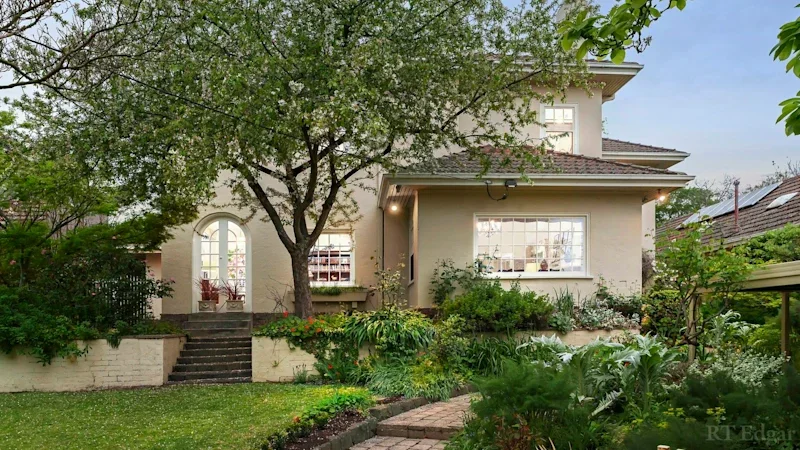
Suburbs in Melbourne’s inner east have experienced the biggest fall in home values since their recent highs at the end of last year, with homes in some suburbs falling by more than 12 per cent.
Deepdene, a small suburb nestled among the prime inner-eastern suburbs of Kew, Camberwell, Balwyn and Hawthorn, has dropped the most from its cyclical peak, with values in the area down 14.1 per cent, or $367,139, since September 2025, new Cotality data shows.
Other suburbs where median home values have also plunged include Canterbury (down 12.9 per cent, or $323,058), Mont Albert (12.6 per cent), and Toorak, down 12.4 per cent, or $190,353, since April 2025. The data combines houses and units.
Cotality head of research Gerard Burg said the upper end of the Melbourne market has had the biggest drops in this downturn.
“We’ve seen much larger percentage decreases in the top-25-percentile properties’ markets … once you get into this higher echelon, you have fewer buyers who can access this type of market to begin with, with the compounding impact of the demand-side factors that have driven this downturn,” he said.
Burg said while the decline in prestigious areas was large, in most of these suburbs “the downturn had started earlier than the cyclical peak for Melbourne as a whole”.
“Some of the demand-side pressures were really kicking in late last year,” he said.
“I think affordability is one of the key factors … plus the investor story coming out of the budget. We’ve been describing it as just layer upon layer that has built up.”
Buyer’s advocate Emma Bloom said a drop in buyers from China has had a major impact on the home values of Melbourne’s inner-east.
“It’s the first time ever we’ve seen more Chinese vendors than we have buyers, which is directly related to all the taxes that the government has brought in,” she said.
“The Chinese market has also collapsed in China, so it’s much harder for people to get their money out ... and that’s had a big flow-on effect to those inner-east suburbs in particular.”
She highlighted the low supply of homes for sale and “angst” between buyers and sellers.
“No one is selling and no one is buying – the buyers won’t buy because they know they have to sell in the same market and they’re too afraid to do that, and the sellers won’t sell first because it’s a down market and they’re not going to get the prices they think they’re going to get to be able to move on and upgrade or downsize,” she said.
While Bloom is still getting inquiries from buyers, she said they don’t have the confidence to act due to interest rate rises, global uncertainty and the upcoming Victorian election, which “is really putting a huge freeze on our market”.
“People are just waiting to see and praying for a change of government, and I think that might give a bit more confidence,” she said.
Downsizers are not willing to sell their most valuable asset in a down market, Bloom added, while upsizers are also stuck.
“If they’ve got a $3 or $4 million dollar property … and they thought they’d get $3.5 to $4 million and they’ve got under $3 million, that’s a big drop, that’s a million plus that they’re not going to have in their pocket even though they feel they may have bought well,” she said.
Jack Desmier of Fletchers Canterbury said fringe suburbs such as a Mont Albert North or Balwyn North tended to “drop off more rapidly than your Mont Alberts and Balwyns when there’s a bit of uncertainty in the market”.
“The core suburbs tend to be where there’s a bit more amenity, easy access to transport. So just being a little bit closer to the central hubs of the suburb, buyers are happy to pay a premium,” he said.
While inquires to sell and buy are down, Desmier said both parties are still out there, but just acting more cautiously.
“A lot of people who don’t need to sell are happy to run with off-market campaigns at the moment, maybe test out the properties without having to invest in a full marketing campaign,” he said.
“There are also still buyers out there, so introducing them to properties and seeing if there is the potential price out there where the vendors would be happy to sell is still happening. Others are saying to keep them on the books, maybe we’ll revisit in 12 months.”
Desmier agreed with Bloom that stock was down compared with this time last year when the market was stronger.
And while there are more properties in the pipeline for spring, he’s not sure how it will go.
“Everyone was predicting that this year would be going up and up and up, but it was not to be,” he said.