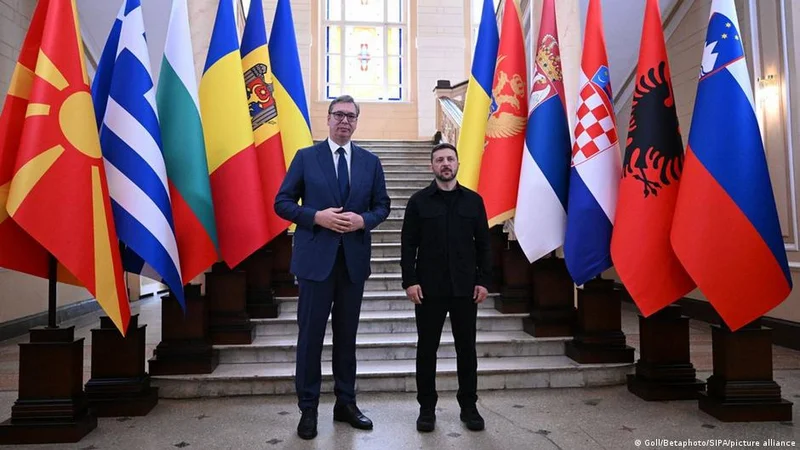
Ukrainian President Volodymyr Zelenskyy and Serbian President Aleksandar Vucic have met several times in the past, often on the sidelines of multilateral conferences, and most recently on July 15, 2026, in the Ukrainian capital Kyiv.
On Friday, Zelenskyy arrived in Serbia for his first official state visit to the country.
The talks, however, are likely to require careful political balancing. Despite Russia's ongoing war against Ukraine, Serbia remains widely regarded as Europe's most pro-Russian country.
There have recently been several signs of closer ties between Belgrade and Kyiv. Ukraine's First Lady, Olena Zelenska, visited Belgrade two years ago. But a trip by the Ukrainian president has been postponed several times.
For Vucic, who has ruled Serbia with an iron fist for the past 14 years, the visit is a balancing act ahead of crucial parliamentary elections. A student-led protest movement plans to field its own electoral list, with a realistic chance of seriously challenging Vucic for the first time. The president has been accused of corruption and of exerting control over the media and judiciary.
According to opinion polls, the majority of Vucic's loyal supporters side with Russia and oppose Serbia joining the European Union. Pro-government media outlets, such as the tabloid Informer, have openly backed Moscow in the war.
Nevertheless, Vucic has portrayed Zelenskyy's trip as an ordinary state visit, saying: "We have several important issues to discuss. One is Ukraine's and Serbia's path toward Europe; the second is our bilateral and energy cooperation."
Observers expect the meeting to prove mutually beneficial. "Zelenskyy welcomes anything that comes across as a kind of slap in the face for [Russian President] Putin," political analyst and pollster Djordje Vukadinovic told DW. "That also applies to the European Union, which certainly played a role in making this meeting happen."
At the same time, Vucic wants to "present himself as being as open to cooperation as possible with the EU," especially after seeing what happened to Hungary's Viktor Orban. "Brussels still has enough carrots and sticks at its disposal in this part of the Balkans, and Vucic cannot afford to draw criticism from Brussels ahead of the next election," Vukadinovic said.
Serbian-made artillery shells
Zelenskyy may also be looking to secure Serbian munitions. Large quantities of Serbian artillery shells have already been delivered to Ukraine through intermediaries, despite Serbia's pro-Russian stance and opposition to anti-Russian sanctions. The Financial Times newspaper estimated that the value of military goods delivered to Ukraine totaled €1 billion ($1.15 billion) in 2024.
Christopher Hill, a seasoned US diplomat, who recently ended his career as ambassador to Serbia, spoke candidly about how he had brought the Ukrainian military and Serbian defense industry together.
"The US began supporting the purchase of significant quantities of Serbian ammunition, which we knew Ukraine urgently needed," Hill told German daily Frankfurter Allgemeine Zeitung. Countries such as the Czech Republic and Poland officially bought the weapons before transferring them to Ukraine.
According to the newspaper, discussions are also taking place behind the scenes about building a joint drone factory using Ukrainian expertise, Serbian workers, and investment from the United Arab Emirates. Zelenskyy's team has reportedly already inspected potential locations in secret.
"Ukraine is trying to expand its circle of European partners, including those countries that have not imposed sanctions on Russia," Srdjan Majstorovic of the Belgrade-based think tank European Policy Centre told DW. "At the same time, Serbia has a defense industry whose products matter to Ukraine's war effort."
Flip-flopping between Russia, EU
Although Serbia continues to promote the narrative of an "Orthodox brotherhood" with Russia, the Kremlin has increasingly signaled its dissatisfaction with Vucic. This is particularly evident in the context of Russian gas deliveries, one of Russia's most powerful sources of leverage.
Recently, Serbia has only been offered short-term gas contracts, which has increased economic uncertainty and undermined Vucic's economic model, which aims to attract foreign investors through cheap labor and low energy costs.
That is why some observers say Serbia is forced to flip-flop between Moscow and the EU — by far Serbia's most important trading partner.
Yet political analyst Vukadinovic disagrees. "Superficial observers categorize Vucic's moves as either 'pro-EU' or 'pro-Russia,' but both approaches are equally dishonest — Vucic is looking to spot the greatest threat and how best to benefit, with the goal of holding on to power forever."
Vucic finds himself in a precarious situation. The student protests — which began in late 2024 following the collapse of the Novi Sad train station canopy which killed 16 people — have made the outcome of the upcoming parliamentary election, expected to take place this fall, completely unpredictable. The protesters accuse the government of corruption and incompetence. Some opinion polls even place the movement in the lead.
Vucic's critics therefore fear large-scale efforts to manipulate the election, for instance, through gifts to voters, exerting pressure on public-sector employees, or "importing" voters from Republika Srpska, the Serb entity of neighboring Bosnia and Herzegovina.
EU accession talks
EU criticism of Vucic has so far been both restrained and at times contradictory. While the European Commission has recommended moving ahead with Serbian accession negotiations, some EU member states oppose this due to concerns about democratic deficits in the Balkan country.
"It is quite possible that Zelenskyy's state visit and Serbia's cooperation with Ukraine will be used by some EU member states and the European Commission to push ahead with Serbia's accession talks, especially now that geopolitical considerations risk overshadowing rule-of-law criteria," Majstorovic said.
Yet Vucic also holds a trump card that he regularly plays to his domestic audience whenever he meets Zelenskyy on the sidelines of international summits.
Ukraine, like Russia, has never recognized the independence of the former Serbian province of Kosovo. This fact plays well with Vucic's voters.
This article was translated from German