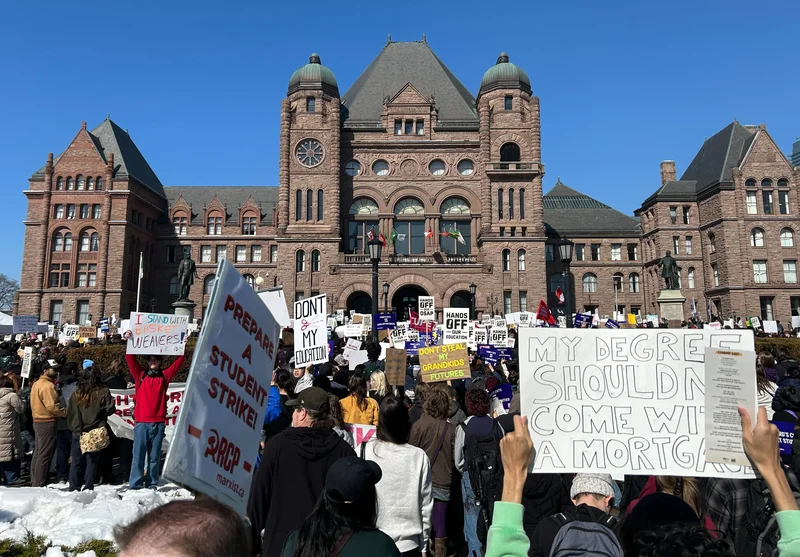
The provincial government’s changes to the Ontario Student Assistance Program (OSAP) took effect on Aug. 1, leaving policymakers worried that postsecondary students could end up with more debt when they graduate.
What exactly are the changes to the OSAP program and how will they affect students? Here’s what you need to know.
What is OSAP?
Introduced in 1966, OSAP provides financial aid through loans and grants for students to fund postsecondary education.
Permanent residents, citizens and protected persons are eligible for OSAP, and the funding usually covers tuition, rent and study materials.
When applying, all students are automatically considered for loans. Loans are interest-free until six months after graduation.
A number of factors determine how much money students are eligible to receive in grants and loans, including marital status, distance of the institution from their primary residence, income, family size and course load.
What changes have been made to the program?
The Ontario government announced on Feb. 12 it would invest $6.4-billion over four years into the postsecondary sector and raise annual operating funds to $7-billion.
The province also said it would lift a seven-year tuition fee freeze, allowing some universities and colleges to increase tuition up to 2 per cent over the next three years. The removal of the tuition freeze means tuition could increase by up to $200 a year for some undergraduate programs.
Annual domestic undergraduate tuition in Ontario typically ranges between around $6,000 to more than $7,000 a year, according to Universities Canada, which represents institutions of higher education across the country. Based on a tuition of $6,500, a 2-per-cent increase would work out to $130 more in fees in the first year.
At the same time, the government also said it would start providing financial aid through OSAP, mostly in the form of loans, rather than grants. The reform caps the grants a student can receive at 25 per cent of their provincial funding, down from a current maximum of 85 per cent. It could result in students taking on an additional $3,500 in annual loans that could have previously been provided as non-repayable grants.
Five career colleges, which offer vocational and career training programs, have also been disqualified from being eligible for OSAP loans, because of concerns raised about the school’s enrollment practices. The colleges are the four locations of the Academy of Learning and Citi College of Canadian Careers.
Why were these changes made to OSAP?
The Progressive Conservative government said the move is needed to rein in ballooning costs for OSAP and to bring Ontario in line with student assistance plans in other provinces.
Premier Doug Ford has described the financial aid program as “unsustainable” and said that the changes were meant to “protect” the postsecondary sector to avoid campus closures
“Folks, it was in the red, it was just not sustainable and the sector was telling me it was not sustainable,” Mr. Ford said back in February. “If we continued going we would be closing down colleges and universities.”
After Ontario froze domestic tuition in 2019, postsecondary institutions increasingly relied on international student tuition to make up for limited revenue. But when the federal government capped international student permits in 2024, many Ontario colleges and universities lost a major source of revenue, and it led to suspended programs, layoffs and campus closures.
How are the OSAP changes affecting students? Are there other resources that can be leveraged for financial assistance?
The changes were met with student protests across the province, amid concerns they would leave some with large amounts of debt.
Advocates highlighted immigrant and refugee students as groups that might be disproportionately affected by this change. Statistics Canada data shows that poverty levels among recent immigrants and refugees are nearly two and a half times the rate of people born in Canada.
One resource that could be leveraged is the Student Access Guarantee, a partnership between the Ontario government and public universities and colleges. Provided by postsecondary institutions, this financial help is intended to provide additional financial aid in instances where OSAP doesn’t fully cover program costs.
The Ontario Learn and Stay Grant, which assists underserved and growing communities to fill workplace gaps in high-demand professions, and supports students in northern, southwestern and Eastern Ontario by covering tuition and other educational costs. To qualify, you have to work in the region where you studied for a minimum of six months for each school year supported by the grant.
Colleges and universities also offer in-house scholarships and bursaries to students based on financial need or merit, as well as work-study programs that allow students to work part-time during the school year.
With reports from Erica Alini and Mostafa Al-A’sar