- See more Daily Mail on Google - save us as a Preferred Source
On the promenade overlooking the main tourist beach in the tiny Spanish enclave of Ceuta in Africa, a Sudanese teenager in a tattered T-shirt prays on his knees to Allah at three in the afternoon.
He arrived from neighbouring Morocco ten days ago, swimming miles to the beach, and now hopes for a free pass to Europe where, he says, he will work hard, make a new life, but never relinquish his Muslim faith.
After a six-year, 2,700-mile journey from his village, Abdelhadi Ali, a slim 18-year-old, is now in touching distance of the EU.
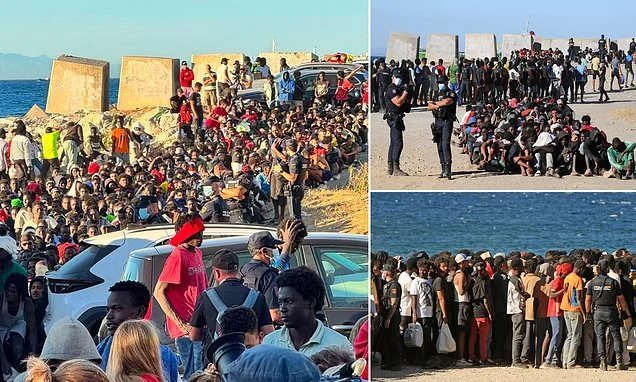
He, like 60,000 others from across Africa, broke into Ceuta – an hour's boat ride from the Spanish mainland – during an orchestrated border invasion at the end of July.
It has huge implications for society in the EU and Britain, which are already reeling from repeated waves of uncontrolled immigration over the past decade.
Many of the adults who arrived in Ceuta with Abdelhadi have reluctantly returned to Morocco after being frogmarched out by Spanish border guards or leaving of their own accord in the face of a hostile reception from terrified, and devoutly Christian, locals.
Entire families hid in their houses for days, only emerging to throw stones at what they called an 'Islamic armada' of young men and boys who ran amok, breaking into private properties and looting supermarkets, which are now guarded by the army, as they searched for food and water.
But a deceitful narrative is being peddled by politicians, including our own new Prime Minister, that this crisis is over. The truth is it's only just beginning.
The Red Cross and the Sur Sur organisation distributing aid in the Spanish enclave of Ceuta
Migrants, some topless, play football on the beach while others rest and sunbathe
Huge numbers of migrants, pictured on August 6, gather on Benitez beach in Ceuta
This week, to my horror, I have witnessed a migration catastrophe unfolding in Ceuta, with a multitude of children, some only 11 or 12, at the heart of it.
For make no mistake, between 2,000 and 4,000 young north African and sub-Saharan boys have not budged an inch since arriving – and have no intention of doing so.
They have become pawns in a migration disaster sparked by families sending their children to find a better life in Europe, spurred too by an avalanche of social media messages flooding Africa that encourage the young to up sticks and leave via Ceuta, which is seen as a gateway to Madrid, Berlin or London.
Over two days in the enclave, which covers just seven square miles, I spoke to 50 of the young arrivals, who all said they are going nowhere but onwards to Europe.
They are sleeping on pavements, doorways, in the hills and even under beach umbrellas.
At the only industrial estate, there is now a shanty town where youngsters run up and down alleyways in which they have built shelters from old beds and upturned bathtubs draped in sheets or blankets to shade themselves from the sun.
Outside the main police station, I watched hundreds of children on Wednesday and Thursday sitting pathetically in rows on the street as they waited in the vain hope that the Spanish authorities would give them the paperwork necessary to allow them to board ferries to mainland Spain.
But with Spain's Left-wing prime minister Pedro Sanchez enjoying a summer holiday on Lanzarote, in the Canary Islands, there has been no indication from the political establishment in Madrid that they will be granted their wish.
Two masked police officers stand guard as migrants queue for food and aid given out by the Red Cross
Migrants form a line started by a police officer as they wait to receive support from charities
Abdelhadi Ali, 19, who travelled from Libya to Ceuta was spotted praying on Benitez beach
Sanchez was the first politician to peddle the myth that 98 per cent of the 'invaders' had gone back across the border into Morocco.
This line was later parroted by Andy Burnham, who quoted Sanchez in a speech as he stood on the White Cliffs of Dover last week, before he, too, departed on holiday.
Nothing could be further from reality. This is a humanitarian disaster unfolding in real time, which also threatens the national security of Europe.
Spanish intelligence services say ISIS jihadis from across war-torn Africa have been caught among the tens of thousands who seized the chance to enter Ceuta.
I met a Moroccan-born thug of 31, calling himself by the pseudonym Mamoud, one of the many thousands who swam into Ceuta.
He spoke English with a London accent because he spent ten years in England, much of it in prison, and now wants to return.
We spoke at a petrol station near the port, where he told me that he had travelled across the Channel on a lorry as a young teenager.
After being placed with foster parents, he spent time 'inside' for two convictions of grievous bodily harm and various other offences.
This boastful ex-jailbird says he left the UK voluntarily ten years ago 'because they were going to throw me out anyway'.
He adds: 'I spent more time locked up than living free in your country. But I miss England. This is my chance to go back.'
This extraordinary invasion has its roots in Pedro Sanchez's announcement last January of an amnesty for all illegal foreigners living in Spain.
It was pushed through by royal decree, ostensibly to solve a worker shortage and boost the economy.
Hordes of migrants wait in line together as police officers keep order on the Spanish enclave
Hamza, 17, travelled from Tangiers, Morocco and swam across the border into Ceuta
Adam who is 14-years-old swam in on Monday, days after the initial incursion to the enclave
But the move went down badly with the voters, who reacted by routing socialist candidates at an election a few weeks later in the bellwether region of Aragon.
Since the amnesty, 1.2 million north Africans (mostly Moroccans and Algerians), Latin Americans and sub-Saharan illegals in Spain have taken advantage of the Sanchez deal, sending a message ricocheting across the world that the country is now an open door to Europe.
'When one member state acts alone over migration, the whole European bloc is put at risk,' Right-wing politicians in Brussels said in a statement.
If they were angry then, today they are apoplectic over the Ceuta disaster and call it an Angela Merkel Mark 2 in the making, a reference to the former German chancellor's decision to open her nation's borders to Syrians fleeing a civil war in 2015.
Naturally, Merkel's unilateral and inexplicable decision provoked the biggest wave of inward migration into Europe since the Second World War.
In came 1.2million strangers during one year, many of them not Syrians but chancers from elsewhere.
It is an influx that has turned a nation that was once post-war Europe's economic powerhouse into a near basket-case, as it struggles to support people who lack the skills to find employment and have to be supported by the state.
The numbers of migrants entering Germany is still more than one million annually (a total swelled by thousands of Ukrainians given sanctuary from the war in their homeland).
As a result, the face of Europe has been changed for ever, as many move to other countries, often choosing to take a Channel boat to Dover.
Now tiny Ceuta lies in the crosshairs of another migration surge thanks to its highly insecure land and sea border with neighbouring Morocco.
Ever since January's amnesty, social media posts on TikTok and Instagram have been advertising ways to get to Europe from Africa using Ceuta as the stepping stone.
Traffickers have been offering 'pay when you arrive' deals couched in snappy Arabic-language slogans, which offer 'swimming partners' or jet-ski rides.
Red Cross aid workers prepare supplies for a group of migrants sitting down awaiting instructions
Saifedine Armrani, 15, from Sudan, only told his parents his wherabouts when he called them from Ceuta
Adil Cheddad, 20, who was found on a street corner with his 25-year-old brother said they want to move to London for a better life
In mid-June – six weeks before the main migrant invasion – an online video captioned 'Ceuta is calling' attracted 1,370,000 views in north Africa within a few hours.
Another piece of footage claiming arrivals would easily be transferred to Spain, both officially by the Sanchez's authorities and illegally by smugglers, was watched by 646,053, many of them impressionable youngsters.
The scene was set. But if social media was the push factor here, the pull factor was in full swing, too.
Many of Europe and the UK's powerful refugee charities, backed by socialist politicians, oppose strict national borders.
Reputable freelance journalist Charlotte Gill reported this week that £700million in taxpayer funding is handed annually to British charities which support a borderless world or new safe routes for migrants who want a new life in the West.
They include outfits such as the Refugee Council, Migrant Help and Refugee Action. 'They don't need democracy or to win at the ballot box,' Gill pointed out in an online broadcast. 'They are very powerful.'
Andy Burnham, in his Dover speech, also promoted 'safe routes' for migrants to stop traffickers controlling the Channel boat crossings.
John Swinney, the hard-Left First Minister of Scotland, went even further, offering safe passage for all the thousands of Ceutan arrivals.
Both are on the same page as Sanchez, who vigorously opposes a 'Fortress Europe'.
This week on Ceuta, I saw the result of this socialist dream: utter chaos. Spanish police, wearing face masks as a guard against infection, marshal the endless queues of migrants on the main Benitez beach as Red Cross teams in fleets of white vans distribute food and water.
Ambulances are on hand to test for HIV, hepatitis and tuberculosis, and ferry the sickly to the island's 249-bed hospital, which is now so overstretched it is turning away locals.
'We were very scared,' said 21-year-old student nurse Javier who lives with his parents in central Ceuta.
Moussef Elrmromi, 15, and three young friends, two aged 19 and one aged 17, pictured at an electric vehicle charging station
Two young Moroccan men wearing a Gucci cap and a PSG football short pictured smiling together in Ceuta
'Now all our public services are collapsing. The hospital, police station, all overwhelmed by strangers we didn't invite in.'
The enclave's mayor Juan Jesus Vivas – who has called for the immediate expulsion of all the arrivals and 'real' EU border reinforcement to protect his beleaguered people – begged the European Parliament for more emergency help on Tuesday.
He admits he has no inkling of how many would-be migrants remain in his enclave, as he does not have the manpower to count them.
What we do know is that 900 are inside the main migration camp. Tents have been erected in the grounds to house the overflow, while a further 2,000 are living rough nearby.
Thousands more are sleeping in doorways, in gardens, in parks, anywhere they can find to lay their heads.
On the outskirts of the ferry port, I meet a 15-year-old called Moussef Elrmomi from Tangier in Morocco. He is an orphan who was sent by his grandmother 'who wanted him to have a life in Europe'.
Moussef is with three friends, one aged 17 and the other two 19, who are living in a forest in the hills. 'We are all here because our families told us to come,' says Moussef, speaking through a translator.
'We are not going back. This is the chance of our lifetimes. There is nothing for us at home.'
He says they have eaten nothing for two days and he and his friends are delighted when I hand them a packet of cheese biscuits.
But, more pitiful, still, was the sight of Saffiedine Amrani, 15, who was born in Sudan and is now sleeping on the Ceuta foreshore under a beach umbrella.
He left home a year ago to head for Europe with his parents' blessing. He is completely illiterate, unable to write his name in either Arabic or English, and has never been to school.
'I called my father on my mobile when I had swum in,' he says, his voice full of misplaced hope.
'I said I was now nearly in Spain. They are praying for me.' It's enough to break the hardest heart.
Moroccans Hamza, 17, Adil, 20, and 14-year-old Adam swam in on Monday, days after the initial incursion, belying the official story it is over.
'Our friends are still coming. There is no border really,' said Hamza, posing for his photo near the sea.
'It is easy. Some of the swimmers have wet suits so they float. At low tide I know some boys have waded here. The barriers are nothing.'
At the port, where I catch a ferry back to Algeciras on the Spanish mainland, I ask a police officer what he thinks. 'Ceuta will never recover from this,' he says.
'These Arab and African children will now be sent to Spain, even to your country. But more will come. We are the new back door to Europe.'