- See more Daily Mail on Google - save us as a Preferred Source
Britain's debt mountain could be a staggering £12 trillion, far bigger than initially thought, according to analysis by campaigners.
It was reported this week that the UK's public sector debt had topped £3 trillion for the first time as the Government borrowed billions more to pay for welfare spending and higher interest payments.
But campaign group the Taxpayers' Alliance (TPA) has revealed this figure did not include hidden liabilities, such as unfunded state and public sector pension commitments, PFI contracts and nuclear clean-up costs, which it estimates were worth an extra £8.6 trillion.
As a result, the group said the true size of the national debt was in fact £11.7 trillion, equivalent to £168,184 for every person in the UK.
Analysis by the TPA calculated that even if £1 million was paid off every hour it would still take 1,334 years to clear the balance.
Shadow Chancellor Mel Stride warned last night: 'Every pound borrowed today is largely taxation deferred and will have to be paid off further down the line.
'The scale of what we are passing on should give any Chancellor pause for thought. [Chancellor] John Healey's first Budget is a chance to show he understands that.
'However, on the evidence we have so far, families should brace for more borrowing, more taxes and a bigger bill for future generations.'
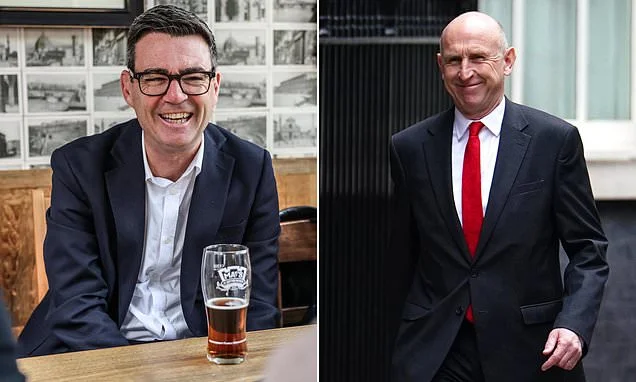
John Healy arriving in Downing Street, London, for a Cabinet meeting during Kier Starmer's premiership
Prime Minister Andy Burnham laughs as he visits the Hare Inn in Harlow, Essex, on July 23
The huge debt pile presents an even greater challenge to Mr Healey who has pledged to make 'fiscal discipline' the priority in his first Budget on October 28.
John O'Connell, chief executive of the TPA, said: 'Public sector debt is out of control but adding inevitable bills, like unfunded pension commitments, reveals the true extent of the debt we are passing down to our children and grandchildren.
The new Chancellor needs to curb these commitments for the sake of generations of future British taxpayers.'
Britain's rising debt also threatens to derail the ambitions of Prime Minister Andy Burnham who has attempted to build positive momentum with a flurry of new spending announcements, including scrapping VAT on energy bills, cutting business rates for pubs and introducing a £2 cap on bus fares.
Mr Burnham previously pledged to stick to the fiscal rules introduced by Rachel Reeves, but said he also wanted to use 'flexibility' to find more ways for spending, such as offsetting borrowing against investments.
The move would allow the Government to borrow as much as £9billion extra a year while still technically sticking to the fiscal rules.
But it will still add to the debt pile and increase the state's interest bill, which is expected to surpass £130billion this year, according to the Office for Budget Responsibility.
Bond markets are also uneasy that Mr Burnham may abandon fiscal discipline to fund his policy goals.
Last month City money manager Rathbones said it had sold some of its UK government debt, with boss David Coombs adding there were fears Mr Burnham could 'do a Truss', in reference to how former premier Liz Truss caused Britain's borrowing costs to soar following her uncosted mini-Budget in 2022.