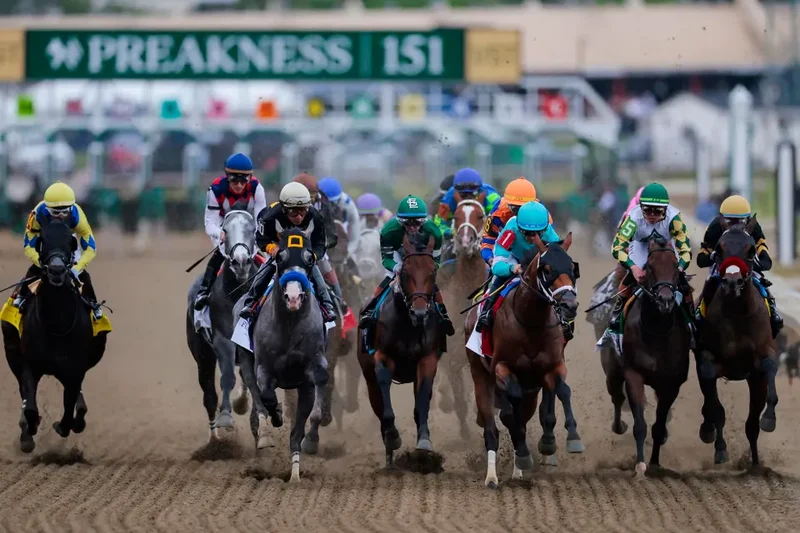
Three of the last five Kentucky Derby winners, including the last two, skipped the Preakness Stakes amid concerns about the two-week turnaround, intensifying pressure on horse racing to modernize the Triple Crown.
This week, the sport’s most powerful institutions offered competing solutions—and exposed how divided racing is over its future.
Churchill Downs Incorporated and the New York Racing Association Monday unveiled on Monday a new $5 million championship series for 3-year-old thoroughbreds built around six races, including the Kentucky Derby and Belmont Stakes.
Conspicuously left out of the plan was the crown’s middle jewel, the Preakness Stakes.
Two days later, Maryland moved the Preakness to Sunday, May 23, 2027, giving Derby horses an additional week of recovery but creating just a 13-day turnaround before the Triple Crown’s third jewel, the Belmont Stakes. Maryland also extended the race’s NBC Sports agreement through 2032 in a deal that will reportedly double its media-rights revenue.
The moves were intended to strengthen thoroughbred racing’s premier events. Instead, they highlighted a fractured industry whose leading organizations are pursuing separate commercial strategies while competing for the same horses, viewers and bettors.
" A lot of people know that horse racing is struggling to keep market share among sports fans and gamblers, and this is a symptom of that,” longtime racing writer Ray Paulick, publisher of the Paulick Report, said. “It's almost an ‘every man for himself’ kind of a thing, instead of working together."
A New Series Without The Preakness
The fight over racing’s evolution started with the announcement of the Thoroughbred Championship Series. The series, launching in 2027, will feature six races stretching from May through September, including the Derby, Belmont, Matt Winn Stakes, Jim Dandy Stakes, Travers Stakes and a series championship at Churchill.
Churchill Downs, Belmont Park and Saratoga Race Course will host the series, which will be televised on FOX adn NBC. Horses will earn points based on their performances in the selected events, making them eligible for a share of the $5 million prize pool.
But the absence of the Preakness, the longtime middle leg of the Triple Crown, was raised questions, particularly because of its timing. Four days earlier Maryland exercised its right of first refusal and matched Churchill Downs’ $85 million offer for the intellectual property rights to both the Preakness Stakes and it’s distaff counterpart, the Black-Eyed Susan Stakes.
“I can't be convinced that had that deal gone through and Churchill owned those IP rights, that they wouldn't have included the Preakness," Paulick said.
Why Racing Struggles To Coordinate
The competing announcements reflect the challenging structure of American horse racing.
Unlike other major sports leagues, thoroughbred racing lacks a central governing organization for scheduling or media strategy. Races are operated by separate entities under state jurisdictions, leaving each organization to advance or protect its own commercial interests.
“There are different companies that run each of these races and jurisdictions,” Bill Knauf, president and general manager of the Maryland Jockey Club Inc., said. “You obviously have the entities looking out for themselves.”
That structure makes coordination difficult, even with the Derby, Preakness and Belmont dependent on one another to preserve national relevance of the Triple Crown, the sports’ most recognizable product.
Maryland’s Plan
While Churchill Downs and NYRA were building their series, Maryland was actively pursuing its own strategy.
Gov. Wes Moore announced Wednesday that the Preakness would be changed to extend the time between the first two Triple Crown legs from two weeks to three, and move the race from Saturday to Sunday to create a destination weekend of racing. The Maryland Jockey Club also renewed its media rights agreement with NBC Sports through 2032, keeping the race on NBC and Peacock. Financial details were not disclosed.
"The shift and the movement of the weekend has been in the works for quite a long time, and we’re focused on that,” Knauf said.
A Derby-Style Economic Engine
Maryland’s investment in racing extends beyond improving participation in the Preakness.
The state is spending $400 million in the redevelopment of Pimlico Race Course, home of the Preakness, while attempting to turn the weekend into a bigger tourism, entertainment and economic-development property.
“When you look at the overarching tourism impact, it’s a smaller economic-development strategy than it should be,” Mark Anthony Thomas, president and CEO of the Greater Baltimore Committee, said. “Our goal over the next year is to change that.”
Solving One Scheduling Problem Creates Another
Knauf said the Triple Crown was forced into changes by modern training techniques, which require horses to have longer breaks between races. Since 1969 the races have been staged over five weeks—the Derby on the first Saturday of May, the Preakness two weeks later, and the Belmont three weeks after that.
The connections of 2025 Derby winner Sovereignty and 2026 champion Golden Tempo both said they skipped the Preakness because they preferred a longer recovery period between races.
“We all felt that three weeks after the Derby was the right amount of time for the [training] window and for the integrity of the Triple Crown,” Knauf said.
The new schedule, however, means there just 13 days between the Preakness and Belmont, which could keep trainers from pursuing the Triple Crown’s third jewel. That puts the scheduling decision firmly in the hands of Belmont operator, NYRA.
"It’s ultimately Belmont's and NYRA’s decision as to what they view for the future of the Belmont,” Knauf said. “It's really not something we can answer."
A Threat To The Triple Crown?
The decision to host a racing series without the Preakness was met with criticism by longtime racing observers.
"Where I object is that they're building something new, but taking something away, and I'm not sure that it's a net gain,” Paulick said. “If you're making the Preakness irrelevant, you're never going to have a horse going for the Triple Crown again. They can say, 'Oh, we haven't touched the Triple Crown.' But when you're incentivizing owners and trainers to run in other races and not the Preakness, then you're hurting the Preakness."
NYRA responded in a statement that the 2027 Thoroughbred Championship Series establishes a “foundation for growth,” and it is open to expanding the series to include new partners or additional races.
The association, however, rejects the idea that the new series diminishes the Triple Crown, arguing instead that it is designed to extend the attention generated by the three-race series deeper into the season.
“The new series builds on the success of the Triple Crown and adds to it: more world-class racing, more stories to tell and a stronger foundation for the sport’s future,” David O'Rourke, NYRA President & CEO stated in an email.
O’Rourke, however, did not answer questions about why the Preakness was excluded from the series or whether NYRA would consider moving the Belmont Stakes from its June 5 date.
Those unanswered questions underscore the larger challenge facing thoroughbred racing, specifically how much tradition drives the future, especially in a sport led by separate organizations pursuing their own interests.