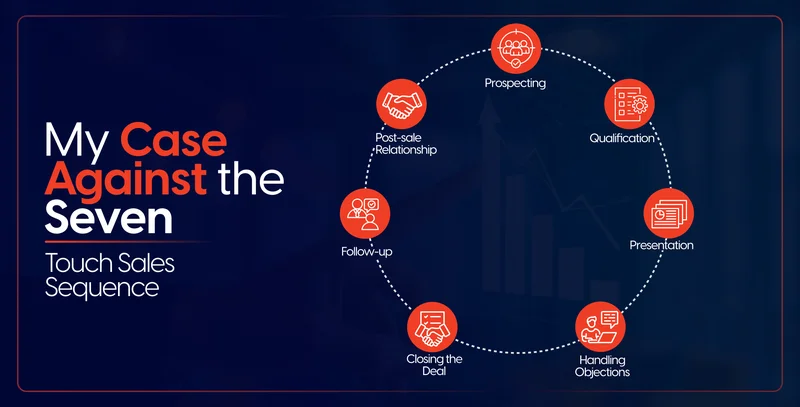
It is repeated so often that it has stopped sounding like advice and started sounding like physics. If a prospect hasn't replied yet, the answer must be another touch. If that doesn't work, perhaps the cadence is wrong. Or the subject line. Or the call to action.
Very few people stop to question the underlying assumption. Should every prospect really receive the same sequence in the first place?
I don't think so. In fact, I think one of the most accepted ideas in modern sales has quietly become one of its least useful. This isn't an argument against following up. Businesses lose opportunities because they give up too early all the time. Persistence still matters. But persistence without context isn't persistence, it's repetition. And those are two very different things.
The Rule Made Sense Once
It's worth acknowledging why the seven-touch sequence became popular. For a long time, sales teams had almost no visibility into what buyers were thinking. A prospect downloaded a brochure, maybe they answered a call, maybe they disappeared. The CRM didn't tell you much beyond whether someone replied or not. In that world, persistence was one of the few variables salespeople could actually control.
So businesses standardized it. Create a sequence, train everyone to follow it, measure completion rates, and move on to the next lead. It wasn't perfect, but it was practical.
The problem is that many of those playbooks survived while the buying process completely changed.
Buyers Don't Move in Straight Lines
People like to imagine buying decisions as a funnel.
Awareness>Interest>Consideration>Decision
That’s not always the case. According to research by
I've lost count of how many times I've bookmarked a product, forgotten about it for three weeks, then returned because the timing was finally right. Not because the product changed, but because my situation changed. Maybe the budget opened up, maybe another tool disappointed me, maybe the pain I had been ignoring became impossible to ignore. None of those things would have been visible inside a traditional sales sequence.
From the salesperson's perspective, I simply went silent. Silence gets interpreted as rejection far more often than it should, but silence is an incredibly ambiguous signal. Sometimes it means "not interested", sometimes it means "too busy", sometimes it means "I need approval", sometimes it means "this isn't urgent today", and sometimes it simply means life happened. Treating all of those situations exactly the same is where modern sales starts making expensive mistakes.
Activity Became the Goal
Somewhere along the way, sales organizations started confusing activity with effectiveness. We celebrate metrics like "I completed my sequence", "I hit my outreach quota”, "I sent 80 emails today", etc. None of those numbers tells us whether the right people were contacted at the right time. Imagine a doctor proudly announcing they prescribed medication to every patient in exactly the same order because that's what the protocol said.
We would immediately question the approach. Different patients need different treatments. Yet in sales, we often accept the equivalent without hesitation. We optimize for consistency because consistency is easy to measure. Judgment is much harder.
The Hidden Cost Nobody Talks About
how fast to how intelligently you continue the conversation.
Every unnecessary follow-up consumes attention. Attention is one of the rarest resources inside a sales organization. Every minute spent chasing someone who clearly isn't ready is a minute that isn't spent helping someone who is.
Sales leaders usually ask, "How many leads do we have?" I think the better question is, "How much attention do we have?" Because those two numbers rarely match. When lead volume grows faster than sales capacity, treating everyone equally doesn't become fair; it becomes inefficient.
Ironically, trying to give every lead the same amount of attention often means your best opportunities receive less attention than they deserve.
Not Every Lead Is Actually Cold
One phrase I've always disliked is "cold lead." It assumes temperature only moves in one direction. Hot becomes warm. Warm becomes cold. Cold becomes dead. But buying intent doesn't behave that way. Someone who ignores you today may become your easiest customer next month. Someone who eagerly responds today may disappear forever tomorrow. Intent changes, circumstances change, and priorities change.
The seven-touch sequence assumes every buyer should be moving forward on your timeline. Most buyers don't even organize their own lives that neatly. Why would they organize their purchasing decisions that way?
We Built Systems Around Calendars Instead of Behavior
Think about how most follow-up software works.
Day 1. Day 3. Day 7. Day 12. Day 20.
Almost everything revolves around time. Very little revolves around behavior.
What if the prospect visited your pricing page yesterday? What if they opened your proposal six times? What if they compared three different products over the weekend? What if they forwarded your email internally? What if they haven't engaged with anything in two months?
Those situations shouldn't receive identical follow-up. Yet surprisingly often, they do. The calendar decides, not the customer.
The Real Job Isn't Sending More Emails
People often ask how AI will change sales. The conversation usually turns toward writing emails faster, generating better subject lines, or personalizing outreach automatically.
Those are useful improvements. But I think we're solving the wrong problem. The bottleneck isn't writing another email. Writing emails has never been particularly difficult. Deciding whether someone should receive an email in the first place is the harder question.
That requires judgment, understanding context, recognizing patterns, and separating temporary silence from genuine disinterest. Technology should help us make better decisions before it helps us communicate faster; otherwise, we're simply automating noise.
Every Prospect Deserves a Different Next Step
One of the biggest flaws in standardized sequences is the assumption that every prospect eventually reaches the same action. Another email, another call, or another LinkedIn message. But maybe that's not the right next step.
Maybe they need educational content. Maybe they need a case study. Maybe they need space. Maybe they need someone different from your organization to reach out. Maybe they need nothing at all.
One of the hardest lessons in sales is accepting that action isn't always progress. Sometimes restraint creates more trust than persistence. That idea feels uncomfortable because it doesn't produce an impressive dashboard. There isn't a KPI for "emails wisely never sent." But prospects notice the difference.
We Measure the Wrong Success
Ask a salesperson how they're performing, and you'll often hear numbers related to effort. Calls, emails, meetings, and touches.
Ask a business owner how they're performing, and you'll hear different numbers. Revenue, retention, lifetime value, customer satisfaction, etc.
These perspectives drift apart when activity becomes disconnected from outcomes. The seven-touch sequence is easy to audit because everyone follows the same playbook. But easy to audit isn't the same as effective.
The best salespeople I've met rarely sounded robotic. They didn't follow rigid scripts. They adapted, listened, sometimes they waited, sometimes they followed up immediately, and sometimes they recognized that no amount of persistence could solve a problem of timing. That kind of judgment doesn't fit neatly into a template.
Maybe We Need Better Questions
Instead of asking, "Have we completed all seven touches?", what if we asked:
- What changed since our last conversation?
- What signals are we missing?
- Why might this buyer be waiting?
- Does another follow-up actually help them?
- Is this the right time for this conversation?
Those questions are harder. They require curiosity instead of compliance. But they also move us closer to understanding buyers as people instead of entries in a CRM.
Persistence Isn't the Enemy
I want to be clear about one thing. I'm not arguing that businesses should stop following up. Some of the best deals I've ever seen happened because someone politely reached out again after months of silence. Persistence absolutely matters. But persistence should be earned through observation, not dictated by a spreadsheet.
Following up because the calendar says it's Day 14 isn't a strategy; it's a habit. The difference may seem subtle, but I don't think it is. One treats buyers as participants in a sequence while the other treats them as people making decisions in complicated, unpredictable lives. That's a distinction worth preserving.
Because the future of sales won't belong to the companies that automate the most follow-ups. It will belong to the companies that know which follow-up actually matters. And perhaps more importantly, which one doesn't.