Singapore’s only sake brewery is in Jurong, making pulut hitam sake and winning recognition in Japan
Reuben Oh and Yumika Yamamoto overcame the challenges of brewing sake in Singapore to create distinctly local expressions now served at Michelin-starred restaurants, recognised in international competitions and supported by a growing community.
In an industrial estate in Jurong, inside a building filled with seafood suppliers, there’s a tiny space that fights its way through the heat, humidity and pong of fish to brew Singapore’s first and only sake.
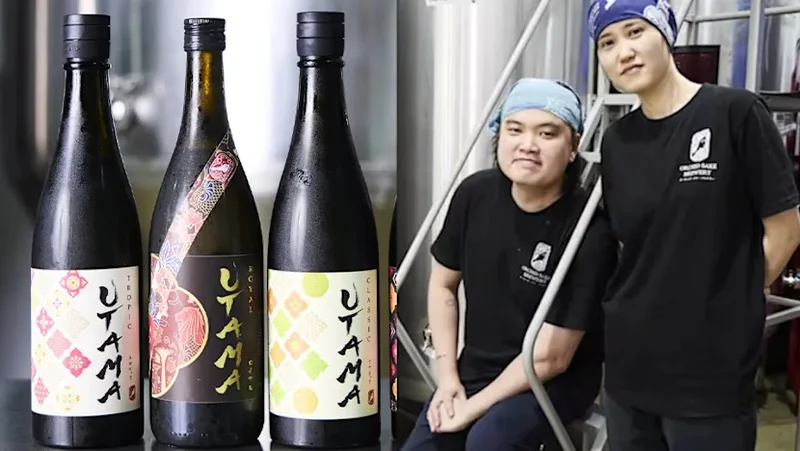
Orchid Sake Brewery is one of a kind, for obvious reasons. Small but mighty, it has already made its mark. Its sake is paired with fine food at Michelin-starred restaurants like Labyrinth and Sushi Kimura Plus, and goes equally well with bold plates at places like perpetually-booked-out Smalls and laid-back SG Taps. It has picked up awards at multiple competitions, including a gold at the Tokyo Sake Challenge 2026. Since brewing its first batch in November 2024, Orchid Sake Brewery has seen demand grow so strongly that production has tripled compared with last year.
The outfit is run by Singaporean Reuben Oh, together with Yumiko Yamamoto, who moved from Japan to Singapore nearly three years ago to join Oh’s sake making start-up.
Yamamoto is the head brewer, with eight years of experience, particularly in Nara and Shimane.
Oh is the brand’s mastermind, marketer and everything else. In his previous job as a sake distributor, he spent three years travelling around Japan, acquiring bottles from small, family-owned breweries and selling it to large retailers here. After visiting close to 400 breweries, Oh began thinking about making sake himself. “I realised I wanted to do the same thing,” he said.
Back then, however, Oh was convinced sake could not be brewed in Singapore. “I said the water wasn’t good enough,” he recalled. “But, while I was travelling in Japan, I realised there were breweries in Tokyo and Osaka. I don’t believe their water is any better than ours – it’s city water, not from deep in the mountains of Nagano or something. I realised then that it was completely possible. There were even people brewing during the summer. I realised temperature control exists and water control exists.”
Using Japanese Kitashizuku rice from Hokkaido, Orchid Sake Brewery makes both traditional and locally inspired styles. Its Classic is clear, clean, fruity and floral, while Tropic is fresher and more acidic, with notes of umami, tropical fruit and flowers. Oh said Tropic pairs particularly well with Southeast Asian food, from Peranakan dishes to Hokkien mee.
There are multiple layers to Orchid’s story: One, doing what was thought impossible; two, successfully transplanting tradition; and three, building on centuries-old foundations to forge a new and unique identity with a specific sense of time and place.
For Oh, the project is also a way of representing both Singapore and Japan in a bottle. “She’s Japanese and I’m Singaporean – it makes sense,” he said.
MAKING IT WORK IN SINGAPORE
Although Oh, who had previously worked as a sommelier, had the background to get the project off the ground, he was unprepared for just how difficult brewing sake would be. “I didn’t know how hard it was until I tried it for myself,” he said.
The crucial step was finding the right water source. Orchid’s water is piped in from Johor Bahru, as it has a higher mineral content, Oh said. After filtering out the chlorine and fluoride, it’s good to go.
The expensive equipment needed was also a hurdle. But Oh, as it turns out, is a master of bootstrapping. Taking over the space previously occupied by a brewery, he simply repurposed the beer brewing tanks by cutting the tops off for open fermentation. Instead of a costly fune or rice presser, he uses jerry cans filled with water to press the moisture out of the rice. And in place of a koshiki or steamer, which would have cost up to S$40,000 (US$31,230), he uses bamboo dim sum baskets in a “MacGyver-ed” rig that cost just S$1,600.
Then, there’s the koji making, the most finicky part of the process. In this step, there’s very little sleep to be had as the mixture needs to be stirred every three to four hours. It’s all done in a dedicated temperature- and humidity-controlled room, closely supervised by Yamamoto.
“I had always wanted to make sake and koji abroad,” said the Nara native, whose sake journey was kick-started by an interest in koji.
“My first job was as a teacher,” she told us. “I did that for three years, and then I became sick due to stress. So, I started to study about food and health. That’s when I discovered koji.” She took a koji making workshop, and then decided she wanted to make it professionally.
Oh had originally had another Japanese brewing partner; when he left, they had one remaining batch of rice. It was Yamamoto who suggested brewing it out of respect for the ingredient. From that batch of sake that almost didn’t get made, the Orchid brand truly came to life.
“As Yumika progressed in her brewing strength, we started experimenting more and more,” Oh told us. Exploring regional rice varieties was a natural next step.
One of the things they found was that adding black pulut hitam rice sourced from small farms in Sarawak to the base mixture about 25 days into fermentation allows them to create a sake that is creamy, sweet and resonates with a local audience.
“We reach out to people through their own nostalgia, familiarities and comfort,” Oh said. That’s the idea behind Orchid’s range of craft sakes, which includes one made using cold-steeped osmanthus flowers, and one that incorporates dried roselle produced by local growers.
Umami and rice as base flavours is something that connects palates across this entire Southeast Asian region, Oh said, allowing for the possibilities of creating custom styles for other countries like Thailand and Vietnam. “That's what we plan to do eventually, throughout the region.”
A SAKE FOR SINGAPORE
Needless to say, there are challenges. The biggest one is hygiene, Yamamoto shared. “In Singapore it’s always summer and humid, so I have become sensitive about cleaning. We have to keep the air-conditioning on all the time, to prevent mould on the walls.”
Keeping the place cool is one of the biggest expenses, Oh added. “Every single bit of cashflow that we have now is spent on keeping this place up and running… it’s a constant balance.”
The workload is relentless. “We work every day – there’s no off-day,” Oh said. Beyond brewing, the couple conduct sake appreciation and sake-making courses at their home in Jurong West.
Demand for their sakes currently exceeds production capabilities. One significant achievement is that they’ve been able to convert non-sake drinkers. “Eighty per cent of our customer base are not even sake fans,” Oh said.
The community they’ve built is extremely supportive. Last year, when Oh and Yamamoto could not afford the S$400 entry fee for the Tokyo Sake Challenge, a supporter offered to sponsor them because, as Oh put it, “she believed in us before anyone else did”.
Another friend hand-carried their entries to Japan. “We didn’t even have a bottle-cap sealer or proper bottles. Half of the entries leaked into his bag,” Oh recalled. Despite the mishap, Tropic – then only the second batch they had made – won a silver medal. “That award really helped get us recognition,” he said, paving the way for further investment and crowdfunding.
By Christmastime, Orchid sakes will be stocked in Lotte Duty Free stores, Oh shared.
With more capital, they will be able to acquire better equipment, which will improve the precision of their brewing methods and increase their brewing capacity.
"We can honestly say for a fact that every batch we make is better than the last,” Oh said. “That's how fast we're going. I want to focus on that and, at the same time, expand the team and also expand the customer base.”
And, there’s a clear vision, he added. “We want to make sure we represent our customer base properly and build it up. We want to be like Tiger, essentially — to be a representing force for a country.”