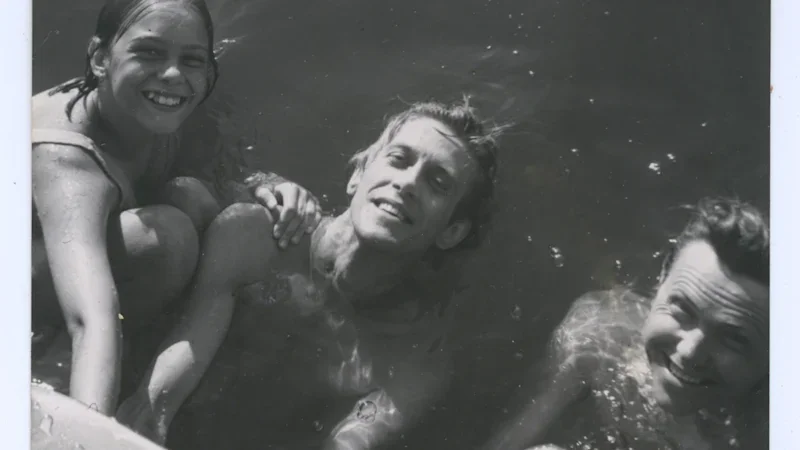
Driving along the expressway up to the Blue Mountains under heavy grey clouds, the end of one of Robert’s poems came to me: “This blustery wind/brings rain – just/short hairs/ on a barber’s sheet,/marking the windscreen”. I thought too that barber’s sheets in the 1970s, when I first met Robert, were usually white, but now it’s reversed, the sheets are black and my hairs are all white.
Palings Record Store 1975. Robert and I were flicking through album covers, rows of them arranged in boxes alphabetically. I looked right towards D and noticed a young woman pull out Bob Dylan’s Blonde on Blonde and frown in concentration at the album notes. “She looks like a nice girl,” I said to Robert. “Wait a sec,” he replied. I looked across and soon he was standing next to her with one hand in the pocket of his tapered John and Merivale jacket, the other elegantly gesticulating. He was smiling, relaxed, and a couple of times she looked shyly in my direction. Robert walked with her back to where I’d been standing. “Marguerite would be happy to go on a date with you.” I shook her hand, blushing.
The next weekend I drove 20 kilometres to her family home in Elanora Heights, where she introduced me to her father, the minister at a local church. We had an early dinner in Chinatown, and I drove her home by the 10pm curfew. A few days later I received a neatly written two-page letter saying how much she’d enjoyed our date. It was signed, “Yours in Dylan, Marguerite”. From time to time I remember that letter, and it pains me to recall that I never wrote back.
In the mid-1970s Robert met his life partner Dee, who had a daughter, Harriet, two years old. Dee was working as a hairdresser then and saved up her money to buy Robert a teal grey Olivetti Lettera portable typewriter, the epitome of elegant Italian design. He loved this small machine and sometimes took it out with him on the ferry to Manly to work on his poems. He sat there for hours, he told me, traversing the harbour back and forth, on a single fare. Forty years later Robert finally started writing on a computer, but soon the tremor from his Parkinson’s disease made it too hard to manage the sensitive keyboard. His old Olivetti had been given away by then, so I lent him my Hermes Portable typewriter. He was confident it would provide a solution – he could pound its keyboard with his shaking hands. Last week I took it back home again. I don’t think he ever used it.
Robert never drove and he loved to be a passenger on a car journey or on a train heading north, watching the landscape pass by out the window. He had a white scar on his nose which he sometimes hid with one hand, the result of a bad car accident he told me, from when he travelled up to Queensland in the 1960s with landscape painter Lance Solomon. Another time he said the accident was in Sydney and that he’d woken up in hospital and refused a blood transfusion, in unconscious deference to his Jehovah’s Witness family. A few times in the 1970s I drove Robert up along the Pacific Highway to Coffs Harbour, where he’d grown up, and where I’d first met him, in my cousin Diana Wood Conroy’s house on a bush block north of Bellingen.
One summer afternoon, as we looped through the tall eucalypts outside Bulahdelah, the windows of my EJ Holden down (no air-conditioning), Robert pulled out a notebook, screwed up his face and started writing. The cicadas outside were extremely loud – it was one of those bumper years. He shouted across to me, above the din, “The cicadas sound like someone pouring shells onto a huge pile of shells.” He was always jotting down similes and thoughts in that book, and I’d read some of them, printed, later, worked into a poem. His first few books had many poems about journeys, homecomings, almost baroque in their excess of descriptive detail. I loved them.
As a child Robert had heart disease and wasn’t expected to live into his 20s but, against his doctors’ predictions, he survived, the hole in his heart grew over. I feel that the outpouring of poems written following this recovery represented his joy at being alive. Sometimes he was criticised for just being a descriptive writer but in my view, his level of observation and looking was, in itself, an unwritten philosophy. In later years Robert grew to dislike the use of similes in these early works and changed most of them into metaphors. He reworked other things too, made numerous refinements, he thought. Robert’s old friend, the poet Jamie Grant, and I doubted this was an improvement. “You’re a different man now,” I told him, “with a different voice. I don’t go around repainting all my pictures from the 1970s and 80s.” He disagreed and defended his editing eloquently, citing Walt Whitman’s constant revision of his opus Leaves of Grass. Once, as I sat next to Robert at a friend’s funeral, he whispered to me that he was itching to edit the words of Abide with Me.
We were both autodidacts, browsers, with no tertiary education.
When I first met Robert he’d already had a book of poems published, Introspect, Retrospect (Lyre-Bird Writers 1970), which he told me he no longer liked and would steal from libraries, to destroy. After he died Dee and I found a copy of this slim, blue, saddle-stitched paperback in his desk drawer, every page of type covered in a spiderweb of pencilled corrections.
On weekends we often went walking and drawing together, carrying our A3 cartridge paper pads into the bush. Dee and Harriet would usually come too and we’d catch the train or cram across the bench seat of my Holden ute and head up to the Blue Mountains, Cowan or along West Head Road for a bushwalk. Afterwards we’d stop at a milk bar and drink cool vanilla malted milkshakes out of battered aluminium containers. At Bundanoon we rented old back-pedal brake bikes near the station and hid them in the bush before walking down to the edge of the cliff face. One day we made a pilgrimage to D. H. Lawrence’s house in Thirroul, Wyewurk, where he lived in 1922 and wrote the novel Kangaroo. We went down steps to the rocks below the house, where Lawrence and his wife Frieda would have gone swimming, and started drawing, looking south. An elderly man came up behind us to watch and after a while said: “Drawing are you? It’s a great sport!”
Fisher Library 1979: A book entitled Gout and Goutiness in the medical section, marked the place to turn left, down the corridor to the Fine Arts section towards the books you’d never see in a bookshop, in German, French and Italian about Caspar David Friedrich, Corot, Gericault, Paula Modersohn-Becker and many more. Robert had recently worked there and had a borrowing card which he rarely used, preferring usually to reshelve these wonderful books after we’d looked at them. Sydney University’s Fisher Library Stack, the section where books were kept for post-graduate use, was our Nirvana. We were both autodidacts, browsers, with no tertiary education. Robert was nine years ahead of me in his reading and life experience and I was trying to catch up.
He often lent me poetry books from his own shelves: Elizabeth Bishop, William Carlos Williams, Thomas Hardy, Edward Thomas, D. H. Lawrence, Philip Larkin, with a pencil tick on the contents page to mark the ones he liked best. I once said to him (perhaps ungratefully) that I’d rather not see these ticks, I wanted to discover what I liked by myself. He was offended. I guess in some ways I was his protégé in those days, a role from which I slowly withdrew. In the 1970s he liked coming over to view my latest paintings and drawings and was always confident in his opinions, telling me what he thought was an advance and what was a backward step. “This one’s a real breakthrough!” he’d say with excitement.
I recently re-read some letters he wrote to me then, in which he expounded his theories: “To be an expressionist is essentially a linear talent. To try and be an expressionist with colour leads to terrible excesses…” I didn’t always agree, but he had a very good eye. Sorting the good from the bad, in writing, art or film was not a trivial matter for Robert – it was life or death, with no middle ground. He was always making lists of best artists, best films, and the reverse. After he died Dee and I found, written in one of his notebooks from the 1980s, a list: “Worst painters consistently given a lot of wall space: Renoir, Chagall, Georgia O’Keeffe.”
Royal National Park 1982. We stopped for a break at Wattamolla and sat on some rocks near the sea, pulling out our wrapped lunches, a Granny Smith apple in each one. We’d started our journey before dawn at Central Station – our goal was to walk from Bundeena to Otford in one day, 28 kilometres. Robert took a bite from his green apple and dipped it in the sea and then another, and dipped it again. On that hot day the salty tang was great. “My father used to do this,” he said. We walked on, refreshed, looping over headlands where the path was cut deep into the headland like a WWI trench and through the palm forest above Burning Palms. The sun was getting low and Robert checked his watch and saw that we’d have to speed up to get the next train from Otford, to avoid an hour of waiting in the dark on the platform for the next one. So we started jogging along the narrow track. “Keep your eyes about you,” he shouted back to me, and I knew his meaning was not to watch out for trip hazards but to keep observing things as much as we had when walking slowly – the shape of the angophoras, the lichened rocks and the arching eucalypts, all rushing past us.
After 50 years of shared experiences, there was no need for him to put on a good show, or impress me.
Robert rang up and asked if he could help our oldest son Felix with his HSC English. He’d just finished editing (with Geoff Lehmann) a big anthology of Australian poetry and now had some free time. The allotted poet that year was Gwen Harwood. Felix and I cycled over to the Rose Bay flat and laid out seven poems by Harwood on the pine dining table, worn pale on one side by Robert’s writing arm. For nearly two hours he patiently analysed them with Felix, line by line, succinctly and in plain language. As we were leaving he confessed to me that he wasn’t previously much of a Gwen Harwood fan, but “now I like her a lot better.” A few years later Robert himself was selected as poet for the HSC English students and a slim paperback of his selected poems, entitled Coast Road, was printed in a large edition. Robert chose my painting Morning, Scotts Head for the cover – houses by the sunlit sea.
Robert was diagnosed with Parkinson’s disease 20 years ago and the illness increasingly clamped down on his body and his mind. He never complained about having got it but railed against its restrictions. I visited more regularly. I think he felt comfortable with me there. Old arguments were put aside and our friendship entered a new phase of honesty. After 50 years of shared experiences, there was no need for him to put on a good show, or impress me. By 2024 he often left a sentence hanging in the air, unfinished. I could sometimes guess where it was going, and, if not, I valued the fragment. Some days I slowly translated the text from his French art books.
If you live long enough it isn’t death you fearbut what life can still do.
(from Robert’s poem about his mother, In Dying Light)
A few weeks before his death, Dee had caught the flu and so I went in to the Waverley nursing home, Illowra, to feed Robert his lunch, small spoonfuls of the soft, aged care food. He ate more dessert than mains. It was hard for him to move or speak by then, so I tried to amuse him with anecdotes from our mutual past: the greasy breakfasts we’d been served in 1974 at the People’s Palace in Brisbane (I ate both), the afternoon we’d been dive-bombed by swallows above the water reservoir near the Thames, the boat trip to Den Haag to see Vermeer’s View of Delft.
After a while Robert shook his head, said, “No more, thank you,” and pushed my hand away; “Tom… I’d like to ask you a favour”. I leaned in to listen as he gathered energy for the next sentence. “Could you hail me a taxi to Central Station? I need to take the train to Bellingen.” “The train doesn’t go through Bellingen,” I replied, “We’d have to get someone to pick us up from Coffs Harbour, or Urunga… and today’s North Coast train has already left the station.” I rolled the food tray away towards the window and, while my back was turned, he swung his thin legs away from the bed. Before I could catch him, he’d launched himself forward and crashed to the floor.
As a teenager Robert’s favourite piece of descriptive writing, he told me, came from Robert Louis Stevenson’s Treasure Island – the scene where Jim Hawkins shoots the murderous Israel Hand. The sailor falls dead into the shallow sea and sinks slowly until his body lies huddled on the bright sand. “Sometimes, by the quivering of the water, he appeared to move a little, as if he were trying to rise.”
On Robert’s last day I ran across the park from the bus stop not expecting to find him still alive. He’d not eaten or drunk anything for five days and his last words to Dee were a few days before. “I’ll see you, soon,” he’d said. As I ran I remembered his admonition, “Keep your eyes about you”, so I slowed down and noticed the art nouveau elegance of the tree trunk shadows as they spooled past me. The carers had given Dee a fold-out bed pushed next to Robert’s and for the past two days she’d been holding his thin, veined hand and reading to him, while he gasped for air – Chekhov stories, the Constance Garnett translations he preferred.
In a bookshop before Christmas I found a single copy of Coast Road in their poetry section. I placed it face-out, covering a stack of books by a popular author who I knew might have topped Robert’s list: “Worst writers consistently given a lot of shelf space”.
What else is happening in the book world?
- Is Nolan’s The Odysseybetter than the book? Well, it’s complicated
- Aussie novelist Mag Mason shares her experience of growing up in a religious sect
- Happy 100th birthday to the world’s most loveable teddy bear
- Is Helen DeWitt the literary messiah we’ve been waiting for?