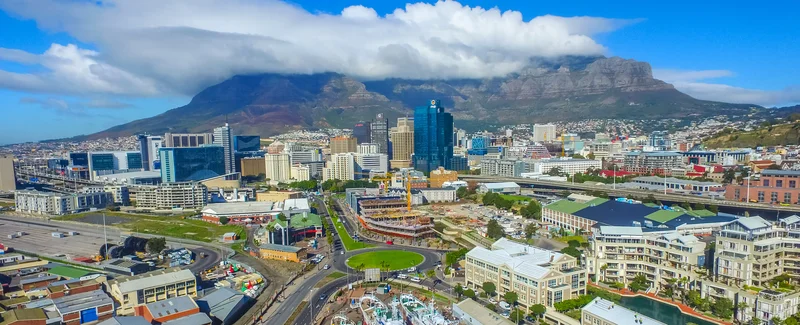
Twenty-five years ago, the Cape Town City centre was, in the words of Central City Improvement District (CCID) board member and property owner Tamra Capstick-Dale, "fragile". Fragile is what you call something in intensive care, not something you'd stake a decade of rent roll on.
Fourteen editions of the State of Cape Town Central City Report later and nobody at the launch used the word. Few South African city centres recover from where ours was and fewer hold on to the recovery.
Last week I attended the annual State of Cape Town Central City 2025 report at the FNB Portside tower in Cape Town.
Year after year, the city centre has been steadily proving that a downtown can be pulled back from the brink and kept there. In the early 2000s, landlords were sitting on half-empty buildings, and businesses were downscaling and relocating to the suburbs and the northern nodes.
Plenty of South African city centres went that way and never came back. Cape Town also nearly did.
Instead, a group of property owners agreed to tax themselves on their own buildings and partnered with the City of Cape Town to form the Cape Town CCID. It's a not-for-profit private-public company, funded by the landlords whose buildings sit inside its 1.74km² footprint of the city bowl. The job is to keep the city centre clean and safe.
The logic is basic yet effective. If you look after the surrounding area of your asset, you will make your building a desirable place to work and live in. Your asset is worth only what someone is willing to pay to occupy it. And indirectly, the value of your asset will increase that being the capital growth. I wish more metros would grasp the concept and execute similar systems.
Twenty-five years and 14 years of reporting later, property investment in the inner city hit R12.8 billion in 2025/26, up 41% on the previous year's R9bn, spread across 29 completed, under-construction, planned and proposed developments.
Executive mayor Geordin Hill-Lewis and Western Cape Premier Alan Winde have started calling it "Boom Town".
According to the Sapoa Office Vacancy Survey for Q4 2025, the inner city's office vacancy rate sat at 10%, the second lowest of any city centre in South Africa and below the national rate of 12.8%.
Johannesburg metro came in at 15.8% and Durban at 12.1%.
Vacancies went above 16% during the pandemic and the city centre has clawed it back faster than any other major node in the country.
Beyond the vacant office floors, we are seeing developers build new office space. Six commercial buildings sit in the city centre's office pipeline, worth a combined R2.38bn.
Two are done, including the renovation by Growthpoint of Ninety One valued at R600 million and a heritage renovation of 93 Bree Workspace by Neighbourgood valued at R32m, with three more under construction, among them two further Neighbourgood heritage renovations on Loop and Buitengracht Streets, both valued at R25m.
The most recent premium-grade commercial showstopper is still to come; she's big and she's shiny.
Introducing The Matrix, Boxwood Property Fund's planned R1.7bn development will add more than 27 000m² of office space, a retail component and 570 parking bays to the city centre by 2029. The central city accounts for 308 217 jobs, the second highest of any city centre in the country after Johannesburg, out of a footprint of 1.74km².
Private sector employment in the city centre has grown by 23% since 2014 and unemployment across greater Cape Town fell to 19.8% by the last quarter of 2025, the lowest of any metro in South Africa for a third-consecutive quarter.
The administration sector has been the single biggest driver of the growth, climbing from 10% to 18% of city centre employment over the past decade, followed by hospitality and trade. The city centre closed 2025 with 3 547 businesses trading within its borders, up 257 on the year before and the highest number on record. Retail and entertainment venues alone grew to 1 495, led by 27 new superettes, 22 new hair salons and 22 new jewellery designers and manufacturers, alongside 10 new cannabis stores and lounges, a category up 71% in a single year. Coffee shops and cafés number 94, which sounds like a lot until you remember this is a city centre with the highest concentration of independent coffee roasters in the country. Coffee shops have also become the new "meeting room", with many office workers making use of the spaces outside the office to chat strategy with colleagues and maintain relationships with clients.
Over the past five years, 22 new residential buildings worth R5.1bn have added roughly 3 260 flats to the housing stock, bringing the total to 7 675 residential units.
Median sectional title prices have climbed 53.5% since the pandemic, sitting at just under R1.9m at the start of this year, with foreign buyers taking advantage of a favourable exchange rate alongside local investors chasing better interest rates.
On the events and conferencing side, the city centre can host formal or informal functions across 60 venues with a combined seated capacity of 83 702 people, everything from CTICC 2's max capacity of 35 435 down to boutique hotel venues seating as few as 30.
Fourteen years of upward numbers happened because landlords, who could have cut their losses, chose to fund an organisation whose job was to make their own buildings worth more by making the whole precinct work better and because the City was willing to show up as a partner rather than just another landlord.
For anyone building a career in this industry and wondering whether property can be a force for good in a city, this report is your annual reminder that it can be if enough people with something to lose decide to bet on one another instead of running in the opposite direction.