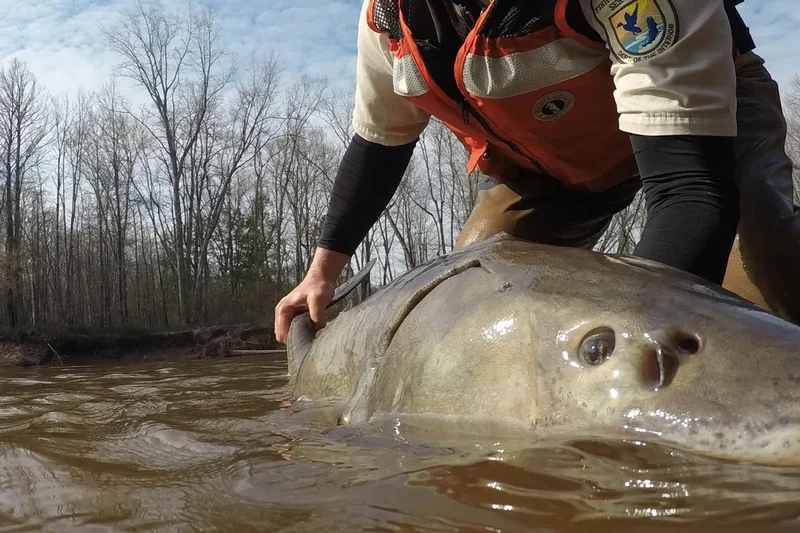
Michigan lake sturgeon were already known as “living dinosaurs” - but they may be a lot older than you might think, according to a new study from Michigan and Wisconsin officials and universities.
Some of the spiny, whiskered females may live for as long as 427 years, the groups found, following an analysis of populations in the Great Lakes.
That’s nearly as long as the lifespan of Greenland sharks. The longest-lived vertebrates on Earth, Greenland sharks can live for up to 512 years while swimming through the dark, frigid depths of the Atlantic Ocean.
And the researchers’ estimate is also hundreds of years longer than researchers previously believed.
Past research capped the age of lake sturgeons - which have been on the fossil record for 150 million years - at 150.
To reach these conclusions, the researchers didn’t actually catch a fish that was that old. Instead, they did some math using 44 years of data on five different populations of lake sturgeon.
The team captured and measured the fish, determined their sex, and marked and released them. Then they would do it again in future years, measuring the growth of fish they had already caught.
Unlike humans, fish continue to get bigger as they age.
Lake sturgeon are already one of the largest freshwater fish in North America, reaching up to 200-300 pounds, according to the U.S. Fish and Wildlife Service.
And some sturgeon can grow bigger than others in environments with more prey, such as small fish and mollusks that they suck up from lake bottoms using their large, extendable mouth.
Using these measurements, the researchers could estimate how low the fish lived and what their growth rate was.
“Simply stated, we used this data to estimate lake sturgeon longevity by asking ‘If a lake sturgeon grows X centimeters per year, then how many years does it take for a lake sturgeon to get to a particular size?’” the department explained in a release.
They related sturgeon growth rate to the size of the fish, finding that males that were 63 inches long could live between 90-279 years and larger 71-inch females could live between 99-427 years.
“We've concluded that sturgeon live far longer lives than initially thought based on looking at growth rings and fin ray cross sections," Edward Baker, manager of the Michigan Department of Natural Resources' Marquette Research Station, told News Channel 3.
Baker noted that less than one percent of the historic population of over two million lake sturgeon remain in the Great Lakes.
Understanding how long these fish live is important for the conservation of their species and habitats, the department says.
Lake sturgeon mature later than other fish and females may not reproduce until they are 15-25 years old. That means strict protections for the species are crucial to ensure their population can rebound.
The sturgeon were nearly wiped out by fishermen in the late 1800s, the station noted. There are still harvests allowed - but last year’s was only six, the department said.
"It sort of reinforces the need to be very restrictive in what we allow in terms of harvesting," Baker said. "It's not a fish that we just allow anybody to go out and catch as many as they want."
But the species is also considered threatened by human pollution, infrastructure and climate change, according to the Center for Biological Diversity.
The non-profit said it was suing the U.S. Fish and Wildlife Service earlier this year after Endangered Species Act protections were denied for lake sturgeon in 2024.
President Donald Trump recently said he’d move to roll back protections under the 1973 law.