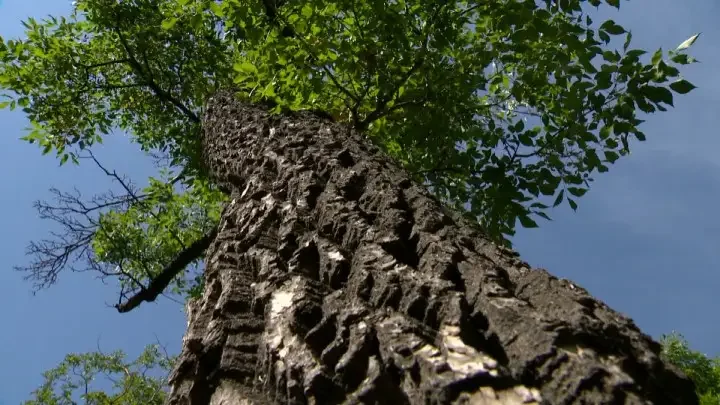
More trees in Edmonton have been infected with Dutch elm disease (DED), two years after the first case was detected in 2024.
The trees in both the downtown area and Delwood neighbourhood mark the 15th and 16th confirmed cases, the city said on Friday.
Dutch elm disease is caused by a deadly fungus that spreads through elm roots and by a specific species of bark beetle that carry the fungus from tree to tree.
The city said the disease poses a significant threat to Edmonton’s urban forest, with approximately 90,000 elm trees making up 22 per cent of the city’s open space and boulevard tree inventory.
Both trees had signs of the disease and the city said it ran tests to confirm their suspicions.
Tree removals, coordinated by the Canadian Food Inspection Agency (CFIA) and the Alberta government, will begin Friday.
Get breaking National news
The city said any elms within 20 meters of the infected trees will also be removed, as part of the city’s ongoing efforts to stop the spread.
The infected elm wood will be disposed of at the Edmonton Waste Management Centre, said the city in a release.
The city said nearby elm trees in the Downtown neighbourhood will not be removed because the infected tree roots were contained, which reduces the risk of DED spreading to other trees.
Both trees were found on city property, within one-kilometer of protocol zones that have increased monitoring and maintenance. The city said ground surveillance and more testing will start immediately in the area.
The new cases come a few days after four others were confirmed: two trees in the Glengarry neighbourhood and two trees in the Rossdale neighbourhood.
- Perseid meteor shower and partial solar eclipse to light up skies next week
- Ottawa firefighters free bird caught in tree, tangled in fishing line
- Metro Vancouver, Fraser Valley under air quality advisory due to wildfire smoke
- Suncor beats quarterly profit estimates on higher crude prices, refining margins
In July, three other cases were detected in trees in the Calder, Northmount and Rossdale neighbourhoods.
Before this summer, the city had confirmed infections in seven trees since the disease was first detected in Edmonton in August 2024.
At that time, the city said it was not possible to determine how the disease ended up in Edmonton, but said DED it is often introduced to new regions through firewood or by importing infected trees.
The city suggests residents help prevent the spread of DED by not bringing firewood from other regions back to Edmonton, removing bark beetle habitat, and calling 311 to report infected trees.
Signs of Dutch elm disease:
• From June to July, leaves on one or more branches of an infected elm tree may wilt, droop and curl. Infected leaves usually turn brown and stay on the tree
• Elm trees infected later in the summer will have leaves that droop, turn yellow and drop prematurely. It is easy to confuse these late-season infections with normal seasonal colour changes
• Peeling back the bark on infected twigs reveals brown staining in the sapwood
For more information, visit the city’s page on Dutch elm disease.
— With files from Karen Bartko and Caley Gibson, Global News