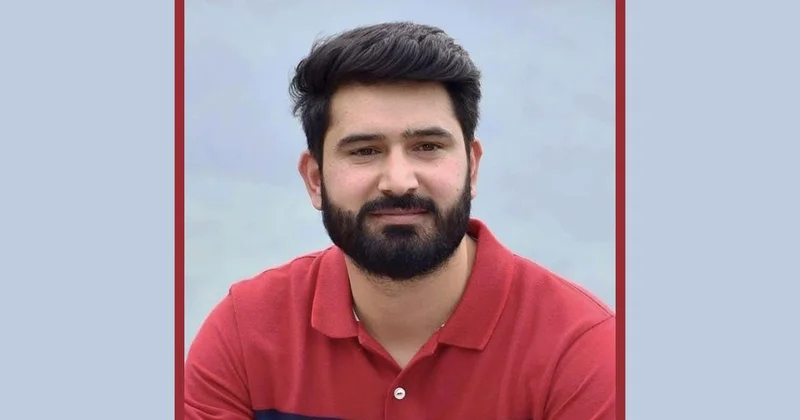
Mudassir Ramzan’s novella The Man from Kashmir opens with an epigraph from James Joyce’s Ulysses: “History…is a nightmare from which I am trying to awake.”
These lines are spoken by Stephen Dedalus in an uncomfortable conversation with his headmaster, Mr Deasy. Deasy rambles on about his own narrow views – British nationalism, religion, and a grand divine purpose moving history toward a predetermined goal. Stephen counters this view by perceiving history as chaotic, relentless, filled with violence and trauma.
Ramzan’s novella may well be read as the history and becoming of young Dedalus. Ahmed – born in a mosque of the fictional town, Poshmarg, and raised within a particular Kashmiri Muslim texture – dies at the end by suicide in a foreign land. In his prehistory and disintegration are the lives and stories of his tribe that finally weigh him down. When Ahmed’s friend Peter asks Rahil about his profession, he replies:
“What does any brown man with a degree in the humanities do in academia? Colonial studies. Postcolonial literature of India and Africa. He had also been working on a book about Kashmir – specifically, the application of postcolonial theory to the region.”
But what should have culminated in the attempt to “express oneself in some mode of art as freely as one can” ends in an existential defeat. Ahmed’s becoming is always relational to the larger political, religious and cultural realities of Poshmarg.
The logic of collectivity
At the very start, The Man from Kashmir establishes a deceptively simple language and tone. This is a novella that demands what Toril Moi calls “the willingness to look and see” – to pay maximum attention to the words on the page until we find ourselves asking, “Why this?” The novella’s vitality, in contrast to other works in Kashmiri Anglophone fiction, comes down to the fact that the author strives toward an idiosyncratic form of expression – a form and language intrinsic to the story he wants to tell – about fractured lives in 1990s’ Kashmir and the question of what constitutes the individual.
Ramzan’s focus on the logic of collectivity is not coincidental. He probes the space between what belongs to the individual alone and that which is ours together. He ventures into the unarticulated, the currents of the flesh and soul that flow blindly, the parts of our being that rise when we are enthused and fall when we are afraid or despairing.
Yet, Ramzan does not offer enough space for each character to flourish in the liminality of their lives. This is reflected in his explorations of shame, for example – in Ahmed’s uncle Farooq’s surrender to self-pleasure, his guilt, his resentment at Fatima’s marriage to a teacher and the subsequent decision to join the revolutionaries. It is, again, evident in the story of Ram and Lalita who elope because of their family’s caste differences. And the same pattern follows when Fatima keeps the report of her cancer to herself and ventures on a pilgrimage to Mecca.
There is no centre in the novella. No single story matters more than another. There is only chaos, hysteria, and violence making confluences. Ram and Lalita’s story appears urgent until it dissolves into other fragmented lives, each outrunning the last. Ahmed, the man from Kashmir, amid this chaos and disruption, becomes, toward the end, a mere witness who is on the precipice of rewriting and challenging the institutionalised narratives. This is not a failure of craft. It is formal fidelity grounding a literary structure that mirrors the shape of a historical and an existential experience.
In WB Yeats’ philosophy, history is cyclical rather than linear, operating on repeating 2,000-year cycles. He visualised these eras as intertwining, cone-shaped spirals called gyres. The widening gyre represents a period of extreme chaos, signalling that one historical age is reaching maximum expansion and collapse. Yeats anticipated the birth of a rough beast, ushering in a new heartless epoch. Ramzan’s novella is exactly the widening gyre made text. The fragmentation, disrupted chronologies, and the dissolution of a single centre are not aesthetic choices but the unfolding of living inside a collapse. And the collapse sticks to the immediate present – the world becomes the here and now; the world becomes the present. Ramzan sees the rough beast already here, in the uniformed men and the jobless future. With Ramzan, the gyre is a description rather than a prophecy of total anarchy and things falling apart.
The prose itself enacts the chaos. The parts “The Unnamed” and “Awakening” reveal a strange translation of oral historiography brought to the page, where violence follows a pattern that is both distant and immediate. Ramzan’s prose simulates the communal and repetitive participation of oral storytelling. The mnemonic device of repetition – early arrival of winter running through the first three parts, the continuity of narrative in the same cold season in “The Widening Gyre” exactly where it was left in “Awakening” part – coerces the reader to look for continuity even as the timelines vary. The result is a fragmentary tale and a temporal dissonance, hinting that only the word there is a tool to make sense of.
Walter Ong, in Orality and Literacy, details how speech fundamentally shapes storytelling. In oral cultures, words are not abstract or static objects but dynamic events. To sustain memory, oral storytelling relies on formulas, repetition and a highly participatory structure. Ramzan’s prose participates in this tradition, refusing to let the stories of a generation become archival in the cold sense. This style mirrors Derrida’s concept of iteration, where repetition acts as a productive force that keeps the narrative emotionally immediate but inherently unstable. For Derrida, a cold archive attempts to freeze a single unchanging meaning. True iteration, however, requires a sign to be uprooted and used again. Each repetition happens in a new moment; it injects fresh life and new context. It keeps the narrative in motion. Because words are iterable, context can never be fully saturated or controlled. Ramzan’s prose is unmoored; the oral idiom breaks free from rigid and overarching narratives. By choosing oral iteration over rigid written structures, the narrative deliberately cuts itself loose from a fixed anchor. It allows the meaning to swing wildly from loose to sudden and tight, almost towards a psychological thrill, in the immediate emotional context.
The oral idiom
The narration occupies this internalisation of the idiom of oral transmission. In oral transmission, there is no single original text; the story exists only in its retelling. Iteration emphasises this absence of origin. Ramzan’s idiosyncratic style bypasses the rigid authority of a fixed authoritative author. Instead, it relies on the conversational space between the text and the reader's affective intensities. The narrative is born anew in the mind of the reader with each reading, functioning exactly like a live spoken-word performance.
This is archival replenishment of a different kind. The people of Poshmarg, who have lived through a period where violence went unreported, find their stories internalising the logic of the Kashmiri oral idiom and attempting recovery through a form grounded in storytelling – realism, humour, irony, shame, livelihood, poverty and resilience. From the 1990s until the abrogation of Article 370 in the novella, these are the keywords of a Kashmiri lived experience that drive the its narrative and form.
There is a rare quality to the prose: it erases victimhood by lending realistic attention to the characters’ individuality, following a verisimilitude that arises from a particular Kashmiri cultural idiom of living. Moreover, Muslim idiomatic expressions and formulaic religious phrases are deeply woven into the narrative. Ramzan reveals those facets of violence that directly attack and erode individuality – psychological abuse and symbolic violence that systematically strip a person’s worth, autonomy and identity.
In the section titled “The Widening Gyre”, a Kashmiri Hindu named Ram says, “One day the world is at peace, the next day it’s filled with blood.” It is a metaphorical description of the gyre’s rhythm. The discussions circle money, marriage, the rich building new houses, azaadi and revolution being left for the poor. The gyre is not only a historical structure in this novella, but a spiritual one too. For Yeats, the widening gyre was cosmic – the birth and death of civilisations and the movement of the divine through time. Ramzan’s gyre is smaller and more intimate. It lives in the brisk evening walk conversation between Ram and Gul and in Gul’s mother asking him where he had been.
I was born in the last year of the 20th century. The stories Ramzan has brought to paper are the ones I have only ever heard, and even struggled to construct into a narrative. Yeats saw the rough beast from a distance – or, in a way, announced it. Ramzan seems to write from within the beast’s shadow. This novella attempts to testify against what has remained unrecorded in the annals of history.
Ramzan’s use of sectional epigraphs which are not borrowed from literary or cinematic sources lends a mythic atmosphere of grief and resilience which in turn creates a pathetic fallacy where the effect is cinematic. In a narrative that seeks to humanise a state reduced to headlines, these poetic refrains refuse to let the characters’ pain be erased or flattened.
He writes with a tenderness that brings the question of the soul to prominence again in the unbearable weight of being here, now, in the shadow of the beast. This tenderness dominates the parts of Ram and Lalita’s narrative. When Ram’s body lies on the grass waiting for the rain to wash the blood away, there is no awakening in this nightmare. There is only the widening gyre, a dissolving centre, a witness who cannot bear to be one, and the dull ordinariness that follows. And yet, in Ramzan’s telling, this is not mere despair. The soul, battered but not erased, persists in the smallest gestures.
The Man from Kashmir: A Novella, Muddasir Ramzan, Bloomsbury India.
We welcome your comments at letters@scroll.in.