Gurgaon over many centuries was little more than a small rural hamlet in the periphery of the towering city of power Delhi. Across the ages possibly its best known resident was Hemu Vikramaditya, a general in the army of Sher Shah Suri who defeated the forces of Humayun and later Akbar. Gurgaon gained some modest standing only as the customary resting place for Akbar’s entourage when they marched to Amber.
Its fortunes altered after Independence. Badly singed by the fires of the Partition riots in 1947-’48, Gurgaon was substantially emptied of its Muslim population. But in the city of wealth and opportunities that Gurgaon metamorphosed into in recent decades, Muslims converged in droves. Yet they still struggle for dignity and rights in a habitat that they still find riven – under its skin-deep glitter – with prejudice and indifference.
Gurgaon began to transform when in the 1970s Maruti Suzuki opened a car manufacturing unit here. General Electrics was the first American company to establish its office here in 1997. Other companies, both Indian and international, followed in throngs.
Today it houses, in glittering glass and steel highrise towers, Indian offices of 250 Fortune 500 companies. Its smoggy skyline flaunts myriad skyscrapers containing offices, malls, condominiums and luxury villas. Gurgaon has become the 56th largest city in India by population and eighth by wealth, with the third-highest per capita income in the country. Its per capita income in 2020 was Rs 4.6 lakh, nearly three times the national average of Rs 1.3 lakh.
Gurgaon, renamed Gurugram in 2016, drew throngs of migrant workers from India’s vast rural interiors. Just between 2001 and 2011, Gurgaon’s population grew by 74%. We do not have census figures since then, but it is evident that the explosion in numbers (and wealth) has continued.
The boom in construction, eateries and offices in Gurugram transformed it into a powerful magnet for the most impoverished residents from India’s rural hinterlands in Uttar Pradesh, Bihar, Madhya Pradesh, Bengal, Assam and elsewhere. They found employment in factories, call centres, hotels, malls, street retail, construction and domestic work. Wages for unorganised workers were oppressively deflated, but still higher than what they would have earned in the villages and towns from where they had migrated.
The gleaming veneer of what is often called India’s Millennium City promised to the workers almost as a necessary corollary an assured cosmopolitanism, an escape from the communal and caste oppression that beleaguered their lives in their villages and towns.
But how wrong were these expectations. The last decade has exposed particularly Muslim residents of Gurugram to a repeated battery of hate politics, to organised communal prejudice, violence and exclusions. It is evident that India’s glittering hub of information technology, industry and finance near Delhi has submitted without resistance to the majoritarian politics of loathing, resentment and fear.
No place to pray
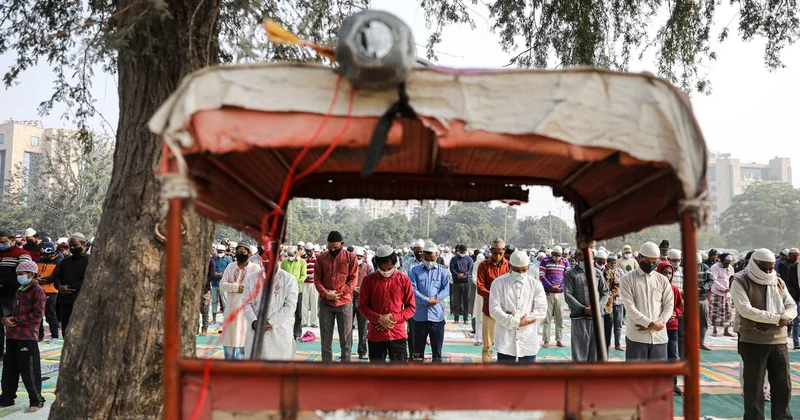
One troubling tinder box in Gurugram has been the often violent and always humiliating prohibitions of the congregational prayers of Muslim men on Friday afternoons. Hindutva formations have for many years since 2018 violently blockaded the Friday namaz of Muslim residents with cultivated prejudice, organised aggression and popular mobilisation, aided often stridently by the state administration.
After the Partition exodus of Muslims, only small numbers of Muslim residents had lived and worked in Gurgaon for several decades. The small neighbourhood had been emptied out of most of its Muslim residents in 1947-’48. Of the mosques that remained, an estimated 19 old mosques were occupied and repurposed by the Hindu residents for functions as diverse as dwellings and storage rooms for cow dung. Thirteen mosques were still available for community worship, many very small, but these were enough for the highly depleted Muslim population.
But the population of the city exploded in the 2000s, and many of the new migrants to Gurugram were Muslim. Circular migrants are not captured by census enumerators, and estimates of the numbers of Muslim workers in Gurugram are disputed. The 2011 census found that the Muslim share in the population of Gurgaon was 4.5%. Whatever the actual numbers, what is indisputable is that the 13 mosques that had provided adequate space indoors for the Friday prayers suddenly fell woefully short.
Recognising this quite early – even as the Muslim migrant population was only beginning to burgeon – Muslim leaders and organisations approached the state administration for allocations of land and the necessary clearances to build new mosques on these plots. However, the state administration stonewalled all such demands. Had they consented, mosques would have been accessible to the devout in every neighbourhood, forestalling the need to Muslims to offer their prayers in open spaces.
This was an unapologetic display of partisanship, because in this same period, the Haryana Urban Development Authority or HUDA allotted land and permitted the construction of 22 Hindu temples, 20 Christian churches, and nine Sikh Gurudwaras.
The acute shortage of mosques in Gurgaon was aggravated because 19 vintage mosques dating back to before 1947 continue – until the time of writing – to be under illegal occupation of Hindus in Gurugram city, with encroachers making and storing buffalo and cow dung cakes inside some of them. These mosques stand on waqf land. The wakf board has been making efforts unsuccessfully since 1977 to remove encroachments from these mosques in Gurugram.
For the devout Muslim, the Friday prayers are a religious injunction. Islamic teachings including in the Quran recommend congregational prayers for Muslims on Friday afternoons: the Prophet is said to have described the Friday prayer as the Haj of the Poor, symbolic of brotherhood and equality. But even for many less observing Muslims, it is a cultural congregational space, in the way that the Sunday church is for many less practising Christians.
Because the older 13 mosques could not accommodate the swelling numbers of Muslim residents, and the government did not enable the building of more mosques, they had no option except to pray in open spaces. Muslims had been congregating in open spaces since the 2000s to offer namaz, with no significant vocal opposition. The open spaces were mostly not public parks but places like parking spaces, dumping yards and shrublands. Until the organised protests started in 2018, these weekly prayers continued uneventfully in around 150 sites in various parts of the city (which was by now rechristened Gurugram).
Obstructing namaz in open spaces
From 2018, a collective of Hindutva affiliates under the banner of the Hindu Sanyukt Sangharsh Samiti, began a campaign to embargo the gathering of Muslim men for Friday prayers in open spaces of Gurugram. These included the Vishwa Hindu Parishad, Bajrang Dal, Hindu Kranti Dal, Gorakshak Dal, Hindu Jagaran Manch and the Shiv Sena.
The Hindutva organisations gathered under the banner of the Sanyukt Hindu Sangharsh Samiti justified the stoppage on several grounds. Traffic troubles were the least of these. They described the disruptors as “patriotic” and the men who offered prayers criminal-minded, Bangladeshi and Rohingya refugees, a threat to Hindu women and girls in the area, people who shout slogans against the country in the guise of prayers and men eager to illegally occupy open government lands.
These troublemakers were backed by some panchayat members who threatened to organise religious havans at the same time and venues as the Friday prayers. The Hindutva zealots blocked the prayers in a variety of other ways as well.
Most degrading was when they threw cattle dung on the patch of ground where the prayers would be held. Elsewhere the volunteers of the organisation gathered at the precise time when the prayers were scheduled to recite slogans and Hindu prayers raucously. The namaz is always conducted mostly in silence, and the namazis were shouted out by the belligerently competing “prayers”.
Another innovation was to collect young teenaged boys and sometimes older men to play cricket precisely on the grounds that were customarily earmarked for the congregational namaz and precisely on Friday afternoons. And sometimes the namazis were physically pushed away from the prayer sites. One of the leaders of the anti-namaz campaign Dinesh Bharati threatened to open gaushalas at prayer spots unless the practice is forbidden across Gurugram, Delhi and eventually India.
The restraint of the namazis
“Musalmano ka dil dukkha [Muslims were heartbroken],” said Saleem after the protests. “Some have either left Gurguram or are planning on leaving. However, throughout the agitation, we didn’t let things escalate. In no video will you see Muslims getting angry and retaliating. When right-wing people come and create problems, we tell the imams not to conduct namaz. We don’t want conflict. We don’t want to fight,” said Saleem.
But when Saleem and Mohammad Adeeb, former Member of the Rajya Sabha, filed complaints against the hate speeches of the likes of Dinesh Bharati, the police instead filed an FIR against them for “disrupting communal harmony” and “trying to grab land”.
One remarkable feature of this systematic blocking of prayer by Hindutva mobsters and volunteers indeed has been the consistent absence of resistance or public protest by those who are blocked from their weekly prayers. The agitators would often arrive in __jeeps____ __to the namaz venue and shout abusive slogans. The police force present would often do nothing to stop the sloganeering and threats, and instead asked the namazis to disperse. Sometimes the imam leading the prayers would be hectored and even pushed to the ground.
I wrote in 2018 that there were “unprecedented scenes of people offering namaz getting up midway and running away in the face of slogan-shouting” in many crowded spots.
This was the norm. Whenever faced with such mayhem, if the police did not intervene for them, people who had come for the prayers would quietly fold their mats and leave.
There were private factories where for years, Muslim employees had been allowed to pray in the parking lot or any other open space. Even this was stopped by police or government officials, without explaining why or with what powers they were enforcing this ban. Again through all of this, not one instance of Muslims resisting or retaliating was reported. There was anguish and confusion, but no retaliatory confrontation or violence.
Just to cite one report, I describe the scene reported by the Guardian of one of these embargoes on prayer imposed by a hectoring mob. Hannah Ellis-Petersen reporting from Gurgaon in December 2021 describes one of these protests, involving a car park outside sector 37 police station in Gurgaon, which she said was a “litter-strewn patch of concrete” that has become a religious battlefield. It was a Friday afternoon. A mob of saffron wearing men screaming “Jai Shri Ram” gathered.
The leader Dinesh Thakur declared, “Conducting namaz in the open is land jihad. It’s an international conspiracy. They do namaz outside, then they build a shrine, then they build a mosque and then inside the mosque they are harbouring terrorists and weapons and they are a threat to the nation. I will not stop my fight until this becomes illegal.”
Residents also joined the protests. One of them was Ravinder Kumar, a 45-year-old software engineer and joint secretary of Gurgaon’s Sector 47 residents’ welfare association. “So many unknown people were coming here for namaz, and it created an environment of fear,” he said “Afterwards they wander into our park, and we are worried they could be here for theft. A few days ago an AK47 rifle was seized from a Muslim in Gurgaon by police. We don’t want such things in our area.” But he conceded to The Guardian that so far no incidents of crime had been committed by anyone coming for Friday prayer.
People cry out “The Muslims are here.” And the mob began to charge. The leader Dinesh Thakur ran to Shehzad Khan, the Muslim imam leading the prayer, shouting “no namaz here”. The police pull him away.
”The Muslims filed silently into the area for namaz, heads down and clutching their prayer mats”. The slogans became more frenzied. Among these was “Desh ke gaddaron ko, goli maro saalon ko” “shoot the traitors”. They recited Hindu prayers and songs to drown out Qur’an readings. They had spread cow dung at the sites. The police tried to hold back the mob so that the namaz could continue.
The imam then led a prayer for Hindu-Muslim harmony. “Muslims are as much citizens of India as Hindus. Our forefathers have also sacrificed for this country,” he said. “Guide us, Hindu and Muslim brothers, to remain united in a bond of brotherhood.”
Those protesting against namaz at another parking lot in Sector 47 claimed that they wanted a market built on that spot. Now, reporters found, the lot stands empty, barring a solitary car.
Failed efforts for a reasonable compromise
The police, instead of meting out stern criminal action against the mobsters, repeatedly brought Muslim leaders to the table to “voluntarily” consent to reducing the numbers of sites for Friday worship. The same absence of assertion and resistance characterised the negotiations by Muslim leaders who elected to parlay with the local authorities.
I recall that in solidarity meetings which I joined in Gurugram in 2018, I had advised against this kind of yielding to police pressures that seemed to me a slippery slope of unreasonable compromises. The Constitution guarantees the right to worship as integral to the democratic freedoms of Muslim citizens.
If there is a prohibition on public worship, then it must apply to religious performances for people of every faith. Instead the same BJP administration, for instance, allows the blocking of highways for weeks for the Kanwan Yatris to trek. It is those violently preventing your right to worship who are breaking the law, I said to them.
The district administration invited people it chose to join what it styled as negotiations between Hindu and Muslim residents of the city. The problem was that the Hindus who were invited were hotheads from communal formations, not the large numbers of peaceable residents of the city who – I imagine and hope – believed in goodwill between communities. I met several of the Muslim negotiators who were invited. These were mostly well-meaning young, educated Muslim professionals and entrepreneurs. They believed that their educational capital gives them both the right and the responsibility to represent the working class members of their community.
In these meetings, they went to the table acutely conscious of their political, economic and social powerlessness. These leaders felt that rigidity by them would make both Muslim entrepreneurs and workers more vulnerable. They feared that state or mob violence would wreak havoc in the lives of highly vulnerable migrant Muslim workers.
It was in these negotiations that they consented to bring down the sites for Friday prayers from 150 to around 30. They were assured by the administration that permissions would be restored once the communal climate cools. This never happened.
Instead, at the time I write this, Friday namaz is permitted only at six sites. This is precisely the slippery slope that I had feared. And the government has still not permitted the construction of a single new mosque.
Those with cars or bikes drive to the sites, however distant, and there are sometimes four shifts of prayers because of the surge of worshippers. But many are too poor to pay for public transport to distant prayer locations during their short lunch breaks. Clerics call upon devotees to offer namaz at their “homes, offices, factories, jhuggis”. Only people “who have no other choice” should come, they counsel.
Many of the sites that have been ceded by the administration are open spaces with no tree cover, making it physically very demanding for the worshippers. These “public spaces” where Muslims offer namaz are random lands in front of shops, or dumping grounds where they work as cleaners. These aren’t public parks or “prime locations” that Hindus allege are being ‘hijacked’ by praying Muslim groups. The 13 mosques are now running several shifts for the Friday prayer.
For the devout Muslim, the location of prayer sites far from their place of work creates further complications. Soban Usmani explains, “The mosque is more than an hour away from my office, so I can’t travel in the 30-40 minutes of lunch break that I get.” Since Islamic rules forbid missing more than three consecutive Friday prayers, the best he can do is to take the day off every third Friday to offer namaz at the mosque.
Just six open sites for prayer
By all means, we do need a public debate about the blocking of roads, often for several days, for festivities (mostly Hindu), the building of shrines in public lands (I saw in my South Delhi colony a temple on public land grow from a stone to a grand structure), the use of public offices for festivals of only one religion and indeed the Rashtriya Swayamsevak Sangh drills in public parks. But selectively attacking one practice is only feeding a toxic communal agenda.
All of these years later, Muslims are still restricted to their six sites for prayer. There is now no protest and little conversation about this today; it is as though the Muslim residents of Gurugram have learnt that they must live in a situation in which their government and their neighbours wilfully deny them their constitutional rights.
Some see in this the restoration of peace. But what appears to be “peace” is actually a thin camouflage for one more triumph of majoritarian politics and of the rule of the mob – that too in the country’s National Capital Region. The tried and tested template has been deployed with mounting regularity in recent years across the country.
It goes like this: left to themselves, Hindus and Muslims live together peacefully. Majoritarian Hindutva organisations incite communal trouble by entering Muslim spaces with taunts and provocative slogans, sometimes brandishing weapons. If Muslims are provoked, a communal skirmish ensues. If instead they maintain restraint, this is interpreted jubilantly as evidence of their weakness and defeat. Both ways, society is split wide open and the Bharatiya Janata Party reaps rich electoral harvests.
The disgraceful role of the state administration
Through all of this, the role of the state administration has been disgraceful. In 2018 itself, it should have dealt firmly with the troublemakers bent on fomenting communal hatred, and defended the freedom of worship of the Muslim citizens. Instead it took no stern action against the mobsters who organised the violent protests and incited the crowds with provocative slogans. The administration went further. It __put up boards____ __on disputed spaces where vigilantes had disrupted the prayers, declaring that these were government lands in which the status quo should be maintained.
The chief minister Manohar Lal Khattar signalled his sympathy with the demands of those who disrupted the prayers when he said that namaaz should be read in mosques or Idgahs rather than in public spaces. What he deliberately overlooked was that Muslim migrants who build, clean and run the city are too poor to be able to build mosques, and they also lack the political clout for land allocations and official permissions. And that the alternative is congregational prayers in the open in which working class and white-collar workers rub shoulders as they pray together.
If the administration thought it necessary in public interest that some sites of public worship should be closed, they should not have acted after namaz sites were overrun by inciting mobs. They should then have instead called the Muslim leaders, discussed their concerns with them; they should have passed legal orders after due process for each of the sites that they wished to see closed, giving reasons, after giving a notice to worshippers and a chance to present their points of view.
The actions of the administration were quite the opposite. The district administration and police preferred to defend the Hindutva mobsters instead of upholding their constitutional duties toward their Muslim compatriots who were violently being deprived of their fundamental right of freedom of worship. They overlooked that this is a mischievous and dangerous ploy to divide communities, and it seemed to have worked because they allowed it to. They actually helped secure one more victory for the majoritarian mob.
Some rays of light
In this gathering darkness of prejudice, some rays of light did penetrate in 2018. A small businessman Akshay Yadav opened his shop floor to the Muslims for the Friday prayers. Five Sikh gurudwaras in Gurugram took the brave decision amid the hatemongering of 2018 to open their gurudwaras for the Friday prayers of their Muslim brothers.
Six Muslim leaders led by former Rajya Sabha MP Mohammad Adeeb visited the gurudwara to express their immense appreciation of the gesture by the Sikhs, and were felicitated with orange scarves. Daya Singh, the spokesperson of the gurudwara committee, spoke of the importance of communal harmony.
This initiative by Sikh leaders however ignited vociferous opposition from the Hindutva groups. Some of their activists distributed to the Sikh devotees copies of a book about the ninth Sikh guru, Guru Tegh Bahadur, who was beheaded in 1675 by the Mughals.
The Sikh leaders held their ground. But before the next Friday when prayers were first scheduled, the Muslims decided to not use the gurudwara premises for their Friday prayers. They did this to protect them from possible violence from the Hindutva group members.
One Muslim leader said that a million Muslims would offer namaz in the hearts of their Sikh brothers in gratitude for their gesture of solidarity.
But where is upmarket Gurugram?
Tina Das in The Print observes caustically that “the ‘suburb on steroids’, with neighbourhoods called Beverly Park, Nirvana County and Wellington Estate, now has street groups cheering Nathuram Godse. RSS shakhas grew inside the condominiums, only this time transformed as Sunday 10 am chai baithaks…”
Through the years of repeated hooliganism of Hindutva mobsters targeting fellow-citizens who were peacefully gathering for prayer, I never encountered an instance of organised protests or resistance by the young professionals working in the many highrise shining corporate offices.
Why did they not feel compelled to protest the Gurugram incidents? Why did it not trouble them that these were rampageous provocations by belligerent Hindutva mobs protected by a supine administration? Why did it not outrage them that the hectoring mobs and the state had joined hands against weekly prayers by mostly working-class migrant Muslims who had no other covered spaces for worship?
Could they for instance not emulate the luminous example of the gurudwaras? I may be foolish, but allow me to fantasise for just a moment. Could not the resident welfare associations of each of the gated colonies pass a resolution to open the parks in their colonies on Friday afternoons for their Muslim brothers to pray with dignity and peace?
I am grateful for the research support extended to me by Syed Rubeel Haider Zaidi.
Harsh Mander, peace and justice worker and writer, leads Karwan e Mohabbat, a people’s campaign in solidarity and support to victims of hate violence. He is a visiting faculty in the South Asia Institute, Heidelberg University. His recent books are Under Grey Smoggy Skies: Living Homeless on the Streets of India’s Cities; and A Matter of Life and Death: The Unfinished Journey to Secure Healthcare for All.
We welcome your comments at letters@scroll.in.