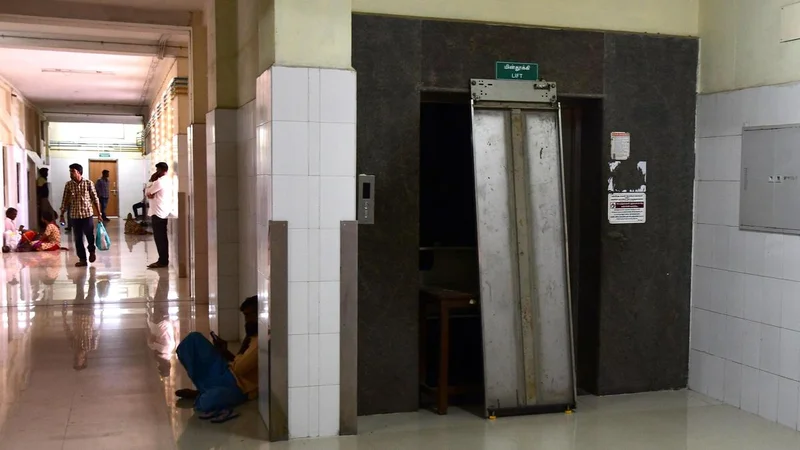
In the last one year, how many times have you or a family member got stranded in a lift in your residential building?
Of the 1,540 responses from Chennai residents that LocalCircles received to this question, 48% said they were fortunate not to get stuck; 25% were unfortunate to have that unsavoury experience once or twice.
Just like elevators in public spaces and mass transit facilities such as MRTS stations, those at apartment communities can show their malfunctioning machine side, frustrating residents. When an elevator malfunctions in any setting, private or public, and causes a safety threat to users, who are the entities one pins the blame on?
Going by a recent Supreme Court ruling, the manufacturer, the maintenance agency and the owner of the premises are jointly liable for any breach of the safety of lift users.
A pan-India study by community social media platform LocalCircles found 33% had no confidence in the safety of lifts installed in their building. Close to 32% of the respondents from Chennai said the lift in their community was maintained by the lift manufacturer via annual maintenance contract (AMC); another 37% said lifts were maintained by a third party via AMC; 20% said no regular maintenance, only repairs based on issues.
Although the Tamil Nadu Lift Rules Act, 1997 got amended this year, accountability is still raised only after a lift malfunctions or an accident happens. Many lifts continue to function without license renewal.
Challenge in inspection
In fact, identifying lifts functioning without a valid licence is a big challenge faced by the Electrical Inspectorate, a department under the Government of Tamil Nadu. Besides other functions, the department is responsible for issuing of permission for lifts and escalators to be installed and for the renewal of licenses.
As per the Tamil Nadu Lifts and Escalators (Amendment) Act, 2025, which came into effect in February 2026, license for lifts has to be renewed once in five years.
V. Ramakrishnan, chief electrical inspector to the State Government, says they previously used to send reminders to buildings for renewal, but now that the process is “auto generated” they stopped.
Renewal process can be done online and must be initiated three months before it expiries. The average fee for renewal and penality for late payment is a small sum, a reason why many buildings ignore it.
The renewal process is important to identify defects and take up preventive steps before a compliance report is submitted
“It is not possible to keep inspecting buildings that have not renewed their licence as there are hundreds of buildings with this facility, but based on complaints we do random checks,” says Ramakrishnan, adding that the public can bring it to the department’s notice.
Recently, when passengers were trapped in a lift at Puzhuthivakkam MRTS station, the department sent out its team to inspect it.
Besides shortage in manpower, the Department is often faced with issues among residents in apartment associations who derail the process for renewal.
The official says that very recently at an apartment in Chennai the secretary of the association had applied for renewal but the president called to complain that the exercise was taken up without approval of a majority of residents.
“In apartments, there is conflict among residents as those on the ground floor do not want to pay for lift charges and renewal, so we are asked to intervene,” he says.
For complaints and other issues, email ceig@tn.gov.in and ceig@tn.nic.in
Case study from a gated community in Manapakkam that allots five percent towards lift maintenance
Casagrand Irene, a gated community in Manapakkam with 295 flats spread across 15 blocks and 13 villas, has ensured lift-related complaints are kept to a minimum by paying a premium for the maintenance of lifts.
“We spend 4-5 percent of our total revenue in lift maintenance, which translates to around ₹ 10.5 lakh annually,” says Lebbaeus Denis, secretary, Casagrand Irene Owners Welfare Association.
Under a contract with Schneider Electricals, the Association has signed up for Diamond Category Annual Maintenance Contract (AMC), which is the highest in the plan, gold and silver being the other two categories.
In the diamond category, all spare parts including battery come under unlimited warranty. Every year, the company also undertakes a pre-maintenance schedule in which they replace most of the parts in the functioning of the lift. Besides, what is mandated by the manufacturer, once in every two years the Association replaces the batteries as well, especially in blocks where lifts see more wear and tear.
“There are two batteries in one lift, each costing ₹13,000. The life a battery lasts three years but as a precautionary measure we schedule the replacement a little before the cut-off time,” says Denis.
Besides checks every month, the community just needs to raise a complaint in a software and in three hours the technical team arrives to fix the issue.
As in many communities where owners of flats on the ground floor complain about paying for an amenity they rarely use, this community has faced this situation. With villas also dotting the community, they have a big voice against spiralling bills on lift maintenance.
Denis feels that expenditure will keep coming but Associations need to find alternative revenue streams. “We have allotted space for digital ads kept outside the lift that give us ₹ 6 lakh revenue a year, this way we are incurring a more manageable expense on lift maintenance and at the same time ensuring residents have little to complain about,” says the secretary.
Published - August 08, 2026 10:56 am IST