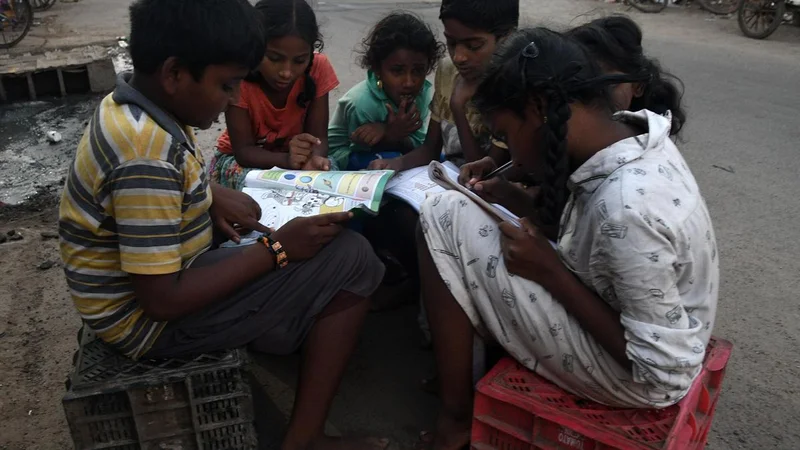
“Miss, idooo nange barodilla(Miss, I don’t know this),” said a class 6 student, who lives in a nearby shanty on the road. The text in front of him was a class 5 English poem. He had technically passed, despite failing to score passing grades in Math, Kannada, Urdu, and English. His younger sister, heading into class 4, pulled up a chair beside him, eager to get a headstart on English. I found the same problem with her. I began explaining the meanings in Hindi and Kannada, hoping to bridge the gap between what they knew and what was on the page. They looked at me apologetically. They could not read or write in either language.
Beyond bilingualism
The poem was Indian in its bones; a bilingual text in English and Hindi sitting side by side, with a cheeky chaloo chipkali, a clever lizard, at its centre. It should have been a point of entry. An animal they knew, a language they had heard, a world not entirely unlike their own. I explained again that English and Hindi or English and Kannada could live together on the same page, that this was the very point of the poem.
The concept remained out of reach, not because they lacked imagination but because they did not have the tools to decode the page. This is because neither child had been given access to the foundational building blocks of reading when they first entered a classroom: the phonemic awareness, phonics, vocabulary, fluency, comprehension, and oral language. What literacy educators call the Big Six.
This is not the story of just these two children. A college professor from a remote part of the country recently described her classroom to me: students who cannot spell basic words, for whom literature remains a far cry, who sit before texts as opaque to them as that class 5 poem was to the class 6 boy in Bengaluru. The years between had passed; the gap had not. Unable to read or write in English with any functional confidence, they do what the moment makes possible: they turn to Artificial Intelligence (AI) for their written submissions. The assignment gets done. The deficit stays invisible. My 11-year-old neighbour, one fears, is already on this road, not because he lacks the ability but because the system has failed him.
Invisible learner
This is the quiet crisis that our national conversation about AI keeps sidestepping. In the debates about whether AI threatens academic integrity, whether it will replace jobs, whether it is friend or adversary to the thinking mind, there is a learner we keep failing to factor in. Not the college student with a laptop and a subscription, gaming a system she understands, but the child who cannot decode a question, and the young adult who cannot read the answer that AI has generated for her, and who submits it anyway, because there is no other way to stay in the room.
Reading is not one skill among many. It is the gateway through which every other form of access must pass: access to knowledge, institutions, opportunity, the very tools we now hold up as democratising. AI is not a ladder. It is a door that opens only after you have already learned to read the sign that says Push.
When the sister pulls up a chair beside her brother, trying to learn English before class 4 demands it of her, she is doing something quietly heroic. She is preparing herself for a system that will not prepare itself for her. When a college student submits prose she cannot read, she is not gaming the system. She is being failed by it.
The articles debating AI’s place in education have, by and large, been written by and for people who are already inside the room Those for whom the question is about quality, rigour, authenticity, and the future of critical thinking. These are not trivial concerns but those that presuppose literacy. They are arguments being conducted in a language that a large number of India’s learners cannot comprehend.
Until we are honest about this, every conversation about AI in education will have a margin which will be populated by children like my young neighbour, by young women pulling chairs up to tables where they have not yet been invited, by students handing in texts they cannot read in the hope that no one notices. The algorithm will not reach them. Neither, so far, have we.
Views expressed are personal.
The writer is faculty at Azim Premji University.
Published - July 31, 2026 10:00 am IST