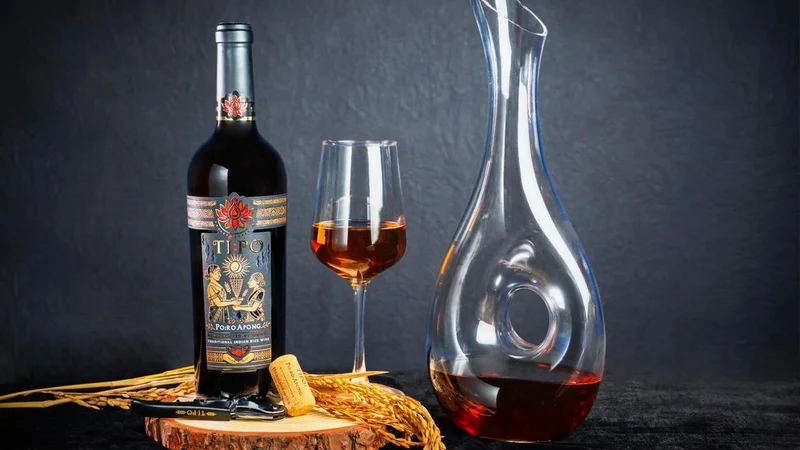
Japan has sake, Korea has makgeolli. India has Ti:Po, Po:Ro Apong. The traditional rice wine of the Mising community of Assam, apong is now a premium bottled drink. Apong, also popular in Assam as sai mod (ash liquor), is prepared from rice and uses foraged herbs. Ti:Po in Mising language means a satisfactory drink.
But unlike the cloudy makgeolli and crystal clear sake, Ti:Po is close to Bourbon whiskey in appearance. With 14% alcohol content, a sip of Ti:Po is closer to sake with two distinct ending notes — sweet and smoky. The other distinct notes are fruity and nutty.
The idea to present apong as a premium bottled drink (only available in Assam for now) lies with the founders Dipankar Kalita, Abhijit Pegu and singer and music composer, Joi Barua. However, it is common knowledge that bottling an indigenous drink to be sold in stores is not a simple task.
To be able to present Ti:Po as a premium beverage, the founders combined traditional Mising craftsmanship with patented modern technology. The company has patented the technology of removing microbes (that leads to spoilage) and multiple filtration.
All this while empowering local women with sustainable livelihoods.
Dipankar says, “Ti:Po stays true to the phrase ’it takes a village to raise a child’. Po:Ro Apong, the traditional, home-brewed rice beer, has cultural significance for the Mising people of Assam. So, we couldn’t think of brewing it without the experts who have honed brewing skills from their ancestors.”
As the idea was conceptualised, the team worked with local women to keep the taste, technique and process authentic. Since home-brewed rice alcohol, like food, varies from household to household, they identified a group of women who would work as a team.
Abhijit Pegu, one of the three co-founders said, “Over a span of two years, we tasted and tried Apong from several households repeatedly to track consistency. This also included testing for preservation, acidity, sweetness, colour and smokiness. As we tasted, we kept filtering the group of households that were able to maintain the pre-decided requirements. We further filtered down to form a group of 20 women. Once this was sorted, we moved to the next step.” A group of 20 women can approximately produced 5,000 bottles of apong.
To preserve the tradition, Ti:Po also partnered with two Self Help Groups — Polo SHG (Laimekuri) and Aaradha SHG (Memberchuk). The women brewmasters remain custodians of the craft while becoming part of the supply chain.
The drink is unique because it derives its flavour from the herbs of Assam. “The State, endowed with rich and varied flora and fauna, is a living library of flavour. Ladies, who are expert herb collectors, pick over 60 forest botanicals, according to the season. “In the forest, each season begins with different herbs. The forest decides what is available. The collectors decide what should be taken and what should be left behind,” explained Dipankar.
A slight variation is embraced as a natural expression rather than corrected. The gathered botanicals are handed to the women brewmasters. This starter also does not impose flavour. It invites fermentation — recruiting native yeasts and microbes specific to the place.
Abhijit added, “Ti:po is special because it is handcrafted only by the women of Mising community and undergoes possibly world’s only solid state fermentation combining over 60 herbs and burnt rice husk giving it a unique smoky nutty and fruity profile.”
Explaining the process, Dipankar added, “The semi-cooked rice grains are first coated with e-pob (the starter prepared from the herbs), then with finely burnt husk. Each grain of rice then turns into a micro chamber of fermentation. The delicate boundary where rice, starter and husk meet is where alcohol develops, giving the drink its depth, texture and character. Every grain becomes its own cellar.”
Fermentation takes place in small batches of five to seven kilograms. Brewmasters keep track of the process by sight, scent and time instead of relying on automation. It is this painstakingly long process that makes scaling production not so easy. Joi says, “Everything depends on human judgement rather than machines. We have to be on constant watch. We are fine with small batches of perfect products.”
Once the fermentation is over, the drawing of the wine is carried out.
Technology only aids
Ti:Po’s role is to preserve Po:ro Apong using hygienic production, scientific filtration and clean bottling while maintaining its traditional character. The brand has a chief winemaker, Ajoy Shaw (DipWSET), who oversees the process.
Now that Ti:Po is ready, what does one pair it with? “It complements any Indian chakna by balancing spice, lifting aromatics and cleansing the palate. It pairs especially well with tandoori dishes, kebabs, smoked meats, pepper-forward recipes and savoury snacks.”
Ti:Po is priced at ₹1,800 and is only available in Assam for now.
Published - July 31, 2026 08:00 am IST