- Click here to listen to this article
- In western Colorado, a retired surgeon and Sherpa couple have built a Himalayan-style outpost devoted to raising the charismatic, grunting yaks.
- Colorado has quietly become the U.S. epicenter of yak ranching, with thousands of animals thriving in the alpine climate.
RIDGWAY, Colorado — Namgyal Sherpa speaks yak.
So when a calf disappeared into the tall grass recently, he roamed among the herd making low, rumbling grunts.
Then a few higher-pitched calls.
There was a rustle and a flash of black. A youngster sprang from the grass, running toward its mother, draped in what looked like a roomy shag carpet. She nudged the anxious calf to her side and they trotted briskly away.
Namgyal followed closely behind.
Ruth Higdon watched from the pasture.
“Cows moo, yaks grunt,” she explained. “Their Latin name is Bos grunniens — grunting ox.”
1. A shrine in the entryway of Ruth Higdon’s home in Ridgway. 2. Higdon keeps an eye on the herd at Smiling Buddha Yaks in western Colorado’s San Juan Mountains.
Higdon has been chasing yaks for years. She’s worked with them, lived with them and, for the last decade, has been raising them on her ranch, Smiling Buddha Yaks.
It’s the grunting culmination of a love affair that began when Higdon, a retired cancer surgeon, encountered a line of yaks in Nepal not far from Mt. Everest.
“They were the most majestic animals I’d ever seen,” she said. “They had these big bells around their necks and were dressed up in a way that made them look very regal and a bit ferocious.”
The affair continued years later as she ran yak expeditions in Alaska, gleaned wisdom from weather-beaten yak herders in Tibet and studied the finer points of yak husbandry at India’s National Research Center on Yak — home of Norgyal, the first test tube yak baby.
Now she breeds her own yaks on 120 acres of pasture, foothills and mesa tops high in bucolic Ridgway, about 290 miles west of Denver. She owns the ranch and Namgyal manages it.
It’s a little sliver of Nepal in the San Juan Mountains. Jagged gray mountains frame the sky. Prayer flags snap in the wind. A gong and hammer function as a doorbell. Yak skulls, tails and hair hang in a barn overseen by a furtive gray cat.
And then there are the Sherpas — Namgyal and his wife, Pasang, a former Buddhist nun, who hail from the Khumbu region of Nepal and live on the property with Higdon. Sherpas are an ethnic group who live primarily in eastern Nepal and nearly all share the last name “Sherpa.” Many go by just their first name.
After his parents died in 1981, Namgyal, 56, and his two sisters were taken in by Higdon’s then-partner, a physician who ran a clinic in Nepal. The three siblings eventually settled in America. Namgyal worked in Alaska, New York City and finally Colorado, the place most resembling Nepal and the epicenter of yak ranching in the United States.
“There are no yaks in Queens,” he said.
As ranch manager, he cares for the yaks and maintains the sprawling property. He often sits with the herd, feeds them cookies and other treats and listens to their calls, adding to a language he’s been learning since childhood.
Higdon said he speaks “fluent yak,” while her own remains a work in progress.
Grunting may be the lingua franca of Bos grunniens, but they also harrumph, bellow and squeak, and calves occasionally meep. Sometimes they mix it up with a grunt-oink combo or “groink.” The sounds can indicate irritation, excitement, alarm or affection.
“My mother talked to the yaks when they were young,” Namgyal said. “We had five or six.”
Over the last decade, Namgyal and Higdon have created a small Himalayan outpost here, one based on hard work, mutual respect and above all, a devotion to yaks.
“When I first went to Nepal I fell in love with Sherpa culture and the yaks,” Higdon said. “The Sherpas are patient, kind and they take life in the moment.”
And the yaks?
“They have these long skirts. And when they run they stick their tail in the air and when they jump — oh, my gosh — they can easily jump a four-foot fence,” she said. “They are so entertaining.”
When she moved to rural Alaska to work in a clinic, Higdon bought a few yaks in the town of North Pole and started a trekking business. She led customers into remote wilderness while yaks hauled the baggage.
“It was a beautiful trip. The whole Alaska range, Denali. You would see every animal you could think of,” she said.
She later moved to Colorado, where she bought more yaks and now has about 30, including a new calf born last week, the first from a female named Inge.
Colorado is home to an estimated half of the yaks in the U.S.
“I would say there are at least 5,000 yaks, if not more, in Colorado,” said Daniele Garner, 37, owner of Pettee Ranch in Fairplay, one of the oldest and largest yak operations in the country with about 250 head.
Her ranch, about 130 miles northeast of Higdon’s spread, sits at 10,000 feet above sea level, ideal for yaks who thrive in the state’s cool, alpine climate.
Unlike cows, Garner said, yaks have not had all their wildness bred out of them. They are smart, curious and always on the move. And part of the family. Her 3-year-old daughter, Oaklee, rode their yak Tashi last month in Fairplay’s Burro Days festival.
“Yak ranching is growing, but it’s still a niche market,” she said. “It’s by no means a get-rich-quick scheme.”
Garner raises them primarily for meat and fiber, which is woven into all manner of snuggly garments — cardigans, parkas, scarves and more. Their milk has a high butterfat content that makes a much-coveted cheese.
Yak boosters say the animals leave a lighter hoof-print on the land because they eat one-third to one-half of what cows eat and produce less methane gas. Their manure creates less harmful agricultural runoff.
The World Heritage Yak Conservancy’s website touts the singular charm of the animal.
“If you’ve never met a smart, friendly, interesting yak — you must. Joyful, Cheerful, Intelligent and Sociable. You will fall in love,” it promises.
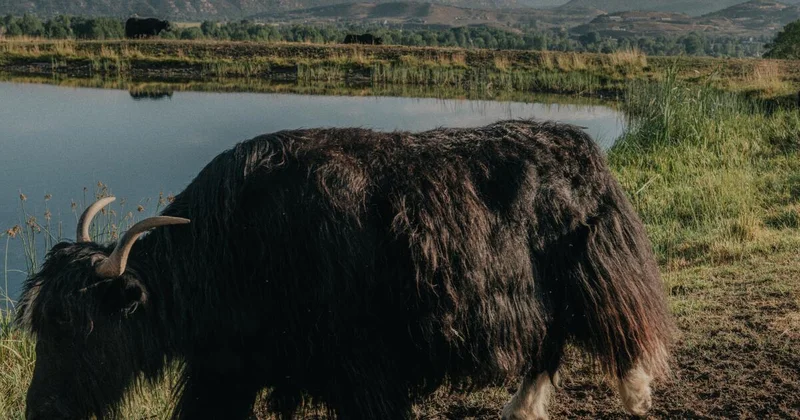
1. The herd at Smiling Buddha Yaks thrives in Colorado’s alpine climate. 2. Oaklee Garner, 3, and her grandmother Julie Pettee look at the yak bulls at the Pettee Ranch in Fairplay, Colo. 3. Daniele Garner brushes a yak at the Pettee Ranch. 4. Yak bulls at the Pettee Ranch, one of the largest yak operations in the country with about 250 head.
They’re also huge — females can exceed 800 pounds and males 1,500 or more — with pointy horns and protective instincts, especially around the young.
Higdon once had to pull a calf from the birth canal of its mother during a complex delivery. The next day, she opened the gate so the two could rejoin the herd.
Maya, the mother, glared at her.
“I could see in her eyes that she was going to hurt me,” Higdon recalled. “She threw me in the air, maybe 10 feet, and then just stomped me and stomped me. Finally, she ran off but then came back to stomp me again.”
Higdon rolled under a barbed wire fence to escape. She suffered five broken ribs and a collapsed lung.
“It was my fault, really,” she said. “I think she remembered I pulled her calf. I’m just lucky she didn’t get my head.”
Namgyal and his wife were raised with yaks.
Yaks lived on the ground floor of their homes, their body heat warming the rooms above. Yak dung fed the fires. Yak milk fed the family.
They often served as gigantic shopping carts.
“On market day, we would get up at 3 a.m. and walk the yak to Namche Bazaar to get groceries,” Pasang said. “It would take the entire day.”
Back in the pasture, Namgyal moved the herd down the fence line. He never shouted or raised a hand.
The calf, a little bull, vanished into the grass again.
Namgyal grunted.
The grass rustled.
There was a flash of black.
Kelly is a special correspondent.