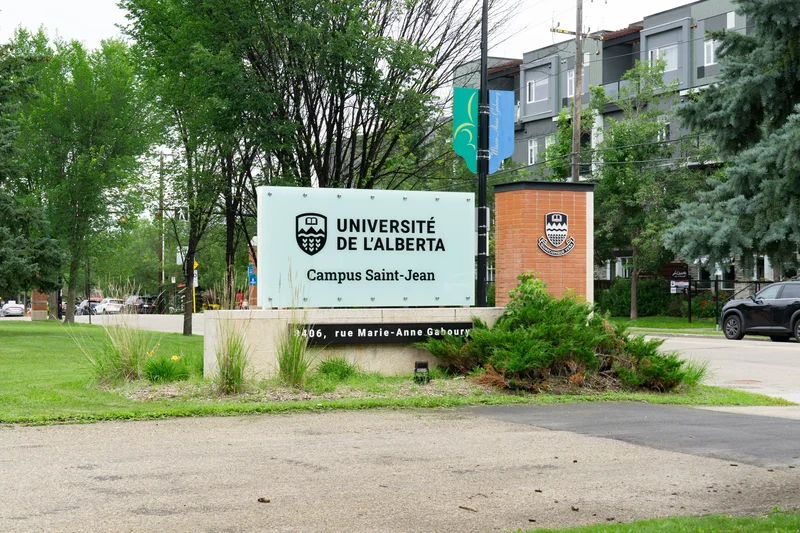
David Lachance Donald has warm memories of visiting the historical room at Campus Saint-Jean at the University of Alberta in Edmonton as a middle-school student.
The space was home to a trio of wooden altars, an antique grandfather clock, black-and-white photos of graduating classes, and French-language panels that detailed how, in 1908, the Missionary Oblates of Mary Immaculate founded what is now the largest francophone postsecondary institution west of Winnipeg.
“It was very nice because they showed off the history of the francophone community, how the university started,” said Mr. Lachance Donald, now 23 and a third-year political science student at Campus Saint-Jean. “And then when I started attending Campus Saint-Jean … I couldn’t find that room any more.”
Mr. Lachance Donald, who is Franco-Métis and runs the University of Alberta’s Powwow Dance Club, couldn’t find the historical room because it was refurbished during campus-wide renovations in 2023.
School administrators transformed it into a neutral community and classroom space, partly to meet the needs of the growing student body and partly as a gesture of reconciliation with the Indigenous community.
The Oblates, a Catholic missionary order, ran more than 40 per cent of Canada’s residential schools, the institutions notorious for assimilating and abusing generations of Indigenous children. Some of the priests who worked at Saint-Jean were named in allegations of abuse at residential schools.
Three years after the historical room’s makeover, it remains one of several sore spots in an escalating disagreement between Campus Saint-Jean’s dean, Jason Carey, and some former professors and representatives of Alberta’s francophone community.
The parties exchanged a series of open letters in June and July. The francophone groups accused Campus Saint-Jean of erasing their history without proper consultation, while Prof. Carey defended the changes as necessary acts of reconciliation and decolonization for a campus with an increasingly diverse population.
“Our institution has a responsibility to be a space of absolute openness, capable of welcoming every student, regardless of their background, origins, or identity, so that they feel fully respected and safe within our walls,” Prof. Carey wrote in a June 12 letter to the president of the Société historique francophone de l’Alberta, which a day earlier sent its own missive explaining why it wouldn’t participate in consultations for the campus’s next strategic plan.
The conflict at Campus Saint-Jean has been simmering during a period of enormous growth for the Edmonton school, and at a time when the federal government is trying to shore up francophone minority communities outside Quebec by encouraging more French-speaking international students to study at places like Campus Saint-Jean.
Last month, federal Immigration Minister Lena Metlege Diab announced the Liberal government would extend by a year a pilot project that offers a fast track to permanent residence for French-speaking students from countries where student-visa rejection rates have historically been high, most of them in Africa.
To qualify, students must enroll at a designated francophone postsecondary institution outside Quebec. Campus Saint-Jean, which also offers tuition discounts to international undergraduate students, is one of them.
Riley Tjosvold, a spokesman for the University of Alberta, told The Globe and Mail that Campus Saint-Jean expects to welcome at least 1,500 students this fall, up from nearly 1,240 last year and about 650 in 2022. Some will attend a satellite campus in Calgary.
He added that, in general, international students make up about 10 per cent of Campus Saint-Jean’s population and most are of African descent.
Recent changes at the historic Edmonton campus mean that new students, whether they arrive from Canada or abroad, are less likely to grasp the institution’s significance to the francophone community, according to Nathalie Lachance, president of the Association canadienne-française de l’Alberta, or ACFA.
(Mr. Lachance Donald, who last year was elected to serve as the undergraduate Faculty Saint-Jean student representative on the U of A’s General Faculties Council, is Ms. Lachance’s son.)
The ACFA, which published its own critical letter to Prof. Carey on July 8, is more than a concerned outside community group.
When the Oblates sold what was then Collège Saint-Jean to the University of Alberta in 1976, the religious order, the university and the provincial government signed an agreement promising to guard the francophone character of the school. The Oblates delegated their role in the agreement to the ACFA in 2019.** **
The ACFA and the SHFA, along with a collective of eight former Campus Saint-Jean professors and their supporters, disagree with several changes made at the campus since Prof. Carey became dean in 2022.
Besides the dismantling of the historical room, a carved brick mural from the 1990s was permanently covered. It depicted a missionary priest, as well as a fleur-de-lis, a wild rose, and students studying and playing hockey.
A separate graduation event for Campus Saint-Jean, known as the Ceremony of Light, was cancelled. The campus’s alumni chapter was closed. An English-only welcome sign was put up at a campus entrance. After an uproar, it was replaced with a French sign.
Paul Dubé, a retired literature professor who taught at Campus Saint-Jean from 2009 to 2014, said that since Prof. Carey was installed, “the rupture is very real, and basically kept on moving in the direction of total erasure of the French community.”
Prof. Carey did not respond to interview requests. The University of Alberta provided a statement on his behalf.
“It is important for us to state very clearly that in no way are we trying to erase history or forget the past. We continue to honour CSJ’s unique foundations, respecting those connections to the past and to the cultural fabric that exists today,” he said in the statement. “That does not mean that we forget the past, but it does mean we have a responsibility to acknowledge historical wrongs.”
The university has posted online a point-by-point refutation of some of the concerns raised by francophone groups. It said the brick mural was covered because, “upon analysis, it became apparent that certain visual elements of the mural did not represent the history of Saint-Jean in an adequate or pedagogically rigorous manner.”
It said the Saint-Jean alumni chapter was officially closed in 2023 because it only had three active members and hadn’t held an event or meeting in more than three years. The English-only welcome sign stemmed from a “logistical error” and was quickly replaced.
As for the historical room, the renovations in 2023 gave campus administrators an opportunity to reflect on its contents, the university’s post explained.
“Many of the objects and display panels were linked to the history of the Oblates of Mary Immaculate and their presence in Alberta, but were presented without any educational or explanatory framework to enable the public to situate them within a broader historical and socio-cultural context.”
Mr. Lachance Donald would have liked to see that context added to the historical room. “There’s no denying how much damage was done from the Oblates de Mary Immaculate,” he said. The Franco-Albertan community is keen to move forward with reconciliation, he added.
“But it feels like the university is kind of blocking that out by making unilateral decisions on the part of reconciliation.”