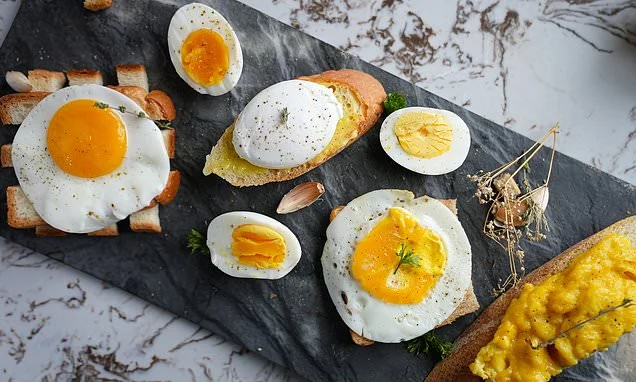
- A UK nutritionist has revealed the 'healthiest' way to cook eggs
- READ MORE: What does the colour of your egg yolk really mean?
- See more Daily Mail on Google - save us as a Preferred Source
Boiled, scrambled, fried and poached – there is no shortage of ways people enjoy tucking into their eggs.
But as much as we may all have our preferences for runny yolks or butter versus oil on the pan, is there one, ultimate way to eat the popular breakfast food?
Now, speaking to the Daily Mail, a nutritionist has given her verdict on the healthiest and most satiating cooking methods.
'Eggs are one of nature's most nutritious and versatile foods, providing high-quality protein along with important nutrients including vitamin B12, vitamin D, iodine and choline,' said Ann Garry, CEO and Director of Nutrition Training at Health Coaches Academy.
'They can be enjoyed at any meal and prepared in countless ways, but when it comes to supporting long-term health, it's not just how you cook your eggs that matters, it's also what you serve them with.'
She added that different cooking styles can 'influence the amount of added fat, calories and, to a lesser extent, the retention of certain nutrients, so some preparations are healthier than others'.
However, 'the biggest opportunity to increase the nutritional value of an egg-based meal is in the accompaniments. Because eggs contain very little carbohydrate, they have minimal direct impact on blood sugar levels.
'Their protein and healthy fats also help promote fullness and can slow the digestion of carbohydrates eaten alongside them.
'However, eggs contain virtually no fibre, making it important to pair them with fibre-rich foods that support gut health, heart health and more stable energy levels.'
Ranked from top to bottom, these are the top 14 healthiest ways to enjoy eggs...
Boiled, scrambled, fried and poached - there is no shortage of ways people enjoy tucking into their eggs. Stock image used
- Poached eggs
5/5
To the relief of brunch bistro enjoyers everywhere – this staple topped the list as the healthiest method.
'Poached eggs require no added fat, as they are cooked in water, so you get the protein and nutrients from the whole egg without adding extra calories or saturated fat,' Ann said.
'Sometimes, a small amount of vinegar is added to help the white set. This does not meaningfully alter the nutritional profile and no added fat is required.'
- Boiled eggs
5/5
In close second, it was poached eggs' cousin – boiled.
Ann explained that 'boiling also requires no added fat and gives you complete control over the final meal'.
She shared: 'Whether the egg is soft or hard boiled makes little meaningful difference nutritionally.
'A hard-boiled egg is particularly useful because it is portable, naturally portioned and easy to add to salads or lunchboxes.
'Its combination of protein and fat can make a meal more filling and help prevent the energy dip that comes from eating carbohydrates on their own.
'The cooking method itself is excellent.'
- Scrambled eggs without butter, milk or cream
5/5
While buttery scrambled eggs can feel indulgent, steering clear of fats puts this cooking method in the top three healthiest.
'Eggs can be scrambled slowly in a good non-stick pan without adding butter, milk or cream. This keeps the nutritional profile close to that of a boiled or poached egg,' Ann said.
'The key is to use a low heat and stir gently. People often add fat because they cook scrambled eggs too quickly and then need butter or cream to restore moisture.'
- Eggs cooked with water
5/5
'Cooking an egg in a pan with a splash of water and a lid is sometimes described as frying with water, although it is really closer to steaming or basting,' Ann shared.
'It gives you a fried-egg shape and texture without needing a pool of oil or butter, making it a useful compromise for people who enjoy fried eggs.
'A good non-stick pan is important, and the result may not have the crisp edges some people expect, but from a nutritional perspective, this is comparable with boiling or poaching. The main difference is texture rather than health value.'
- Baked eggs
4.5/5
Another popular brunch-time offering, baking eggs is becoming increasingly popular, and the expert said this 'can be extremely nutritious because they can be cooked with vegetables, tomatoes, beans and herbs, creating a balanced meal in one dish'.
She added: 'The cooking method itself does not require much additional fat. The rating depends heavily on the recipe, however. Baked eggs with tomatoes, spinach and peppers are very different from eggs baked with cream, cheese, butter or processed meat.
'Keep the base vegetable-rich and use cheese or oil as an accent rather than the main ingredient.'
- Coddled eggs
4.5/5
Ann explained that a coddled egg is one that is 'gently cooked in a small dish or ramekin using hot water'.
'If it is prepared without butter, it is nutritionally very similar to a poached egg,' she shared.
'The gentle method can produce a creamy texture without needing to add fat, which makes it a useful option for people who prefer softer eggs.
'It loses half a point because many recipes butter the dish or add cream and cheese. A plain coddled egg is an excellent choice, but the extras can quickly change this.'
- Scrambled eggs with milk
4.5/5
'A small splash of milk adds relatively few calories and provides a little extra protein, calcium and iodine,' Ann explained.
'Semi-skimmed milk will add less saturated fat than whole milk, while still contributing useful nutrients.
'Milk contains lactose, a naturally occurring sugar, but the small amount normally added to scrambled eggs is unlikely to have a significant effect on blood sugar. The protein and fat in the eggs remain the main factors supporting fullness.
'The important word is 'small'. Large amounts of milk are unnecessary and can dilute the eggs without adding much nutritionally.'
- Fried eggs with olive oil
4/5
Another classic staple, Ann said that frying eggs in olive oil is a popular pick that is filling because of the added calories, but may also have added nutrition benefits.
'Olive oil is rich in unsaturated fats, which are generally a better choice for heart health than saturated fats such as butter,' Ann said.
'Extra virgin olive oil may offer additional nutritional benefits because it is less refined and retains more naturally occurring plant compounds, including polyphenols.
'However, all oils are calorie-dense, so the amount used matters. A teaspoon of olive oil adds around 40 calories, while pouring it freely into the pan can add considerably more.
'The egg still provides useful protein, but the meal becomes higher in fat and calories as more oil is used.'
- Fried eggs with a low-calorie cooking spray
4/5
'There is technically no such thing as a low-fat oil because all oils are 100 per cent fat. What people usually mean is a low-calorie spray, which helps spread a very small amount across the pan,' Ann said.
'This can reduce the total fat and calorie content compared with pouring oil directly from the bottle, making it a useful option for people who struggle to judge portions.
'The rating depends on the product formulation and how it is used.
'Ten or fifteen sprays are not necessarily the tiny serving advertised on the front, so it is still worth checking the instructions.'
- Fried eggs with sunflower oil
3.5/5
'Sunflower oil is also predominantly unsaturated fat, so it is generally a better everyday choice than butter from a saturated-fat perspective. The NHS includes sunflower and olive oils among the unsaturated options to choose when oil is needed, however, olive oil ranks slightly higher because it contains a greater proportion of monounsaturated fat and retains naturally occurring plant compounds such as polyphenols.
'As with olive oil, quantity matters more than the mere presence of oil. All cooking oils are calorie-dense, and pouring freely from the bottle can turn one egg into a much heavier meal.
'I would measure a teaspoon rather than covering the base of the pan.'
- Egg whites
3.5/5
Going for egg whites only is a popular option for those 'protein-maxxing' – but Ann warned that they are not as nutritionally 'complete'.
'Egg whites are high in protein and contain very little fat, so they can be useful for someone who needs additional protein without many extra calories,' she explained.
'But removing the yolk also makes the meal less nutritionally complete, as you lose most of the egg's good stuff, including choline, vitamin B12 and selenium.
'For most people, it's much better to use one or two whole eggs than a large plate of egg whites.
'A useful compromise for someone who wants more protein is one whole egg combined with one or two additional whites.
'Egg yolks also contain dietary cholesterol, but most people do not need to avoid whole eggs solely for that reason.'
- Scrambled eggs with butter
3/5
Ann said: 'Eggs already contain fat, so adding butter increases both the total fat and saturated fat content. Saturated fat is the main reason this ranks below scrambled eggs made without added fat or with a small amount of milk.
'Fat can slow the blood sugar response, but slower does not automatically mean healthier.
'The type of fat, the quantity used and the fibre and carbohydrate elsewhere on the plate all matter.'
'Salted butter will also add sodium, although the amount depends on how much and what brand is used.'
- Fried eggs with butter
2.5/5
Frying eggs in butter 'combines the egg's natural fat with an added source of saturated fat. Butter can also brown or burn relatively quickly, encouraging people to use more than they need.'
'The occasional butter-fried egg is not a health disaster, but it is less suitable as an everyday method than poaching, boiling or frying with a small amount of unsaturated oil,' Ann explained.
'If flavour is the goal, use a small amount rather than allowing the egg to sit in a pool of melted butter.'
- Scrambled eggs with cream
2/5
The main drawback of this beloved recipe, Ann said, is that 'cream adds calories and saturated fat without meaningfully increasing the protein or fibre content of the meal'.
She said: 'Eggs are already rich in protein and contain fat, so cream makes them more energy-dense without filling an important nutritional gap.
'A small splash is very different from a generous pour, but for an everyday option, milk or no added dairy would provide a better balance.'