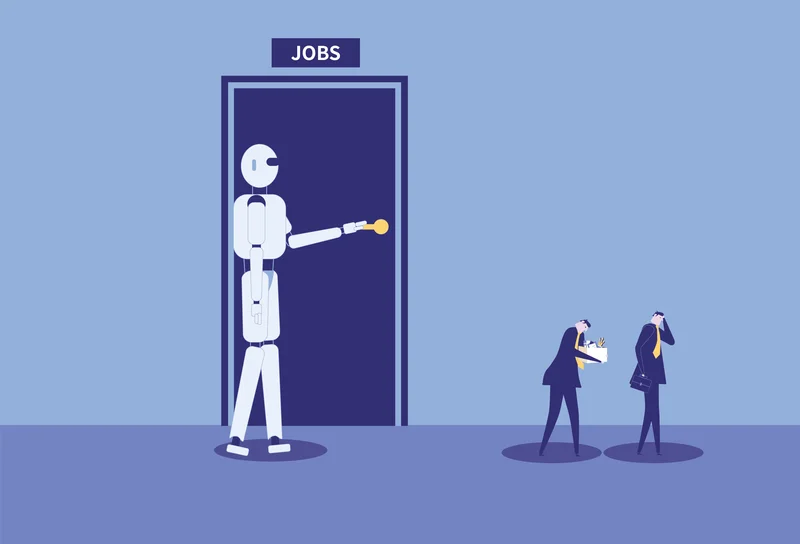
AI is moving up the career ladder and targeting cognitive, analytical and creative tasks. The jobs most at risk now are no longer on factory floors, but in offices, campuses and the innovation hubs that were once thought to be insulated from any tech disruption. A study earlier this year from the Digital Planet initiative at Tufts University shows how the wave of anticipated job losses in the next three to five years will look different from the past. The study's American AI Jobs Risk Index ranks 784 U.S. occupations in 20 industry sectors across metropolitan areas and states, assessing their vulnerability "based on the most current understanding of AI's evolving impact." The study shows why AI's advancement is not just about the speed of adoption, but its reach. Professor Bhaskar Chakravorti, dean of global business at Tufts' Fletcher School and one of the researchers behind the study, told CNBC that the findings reflect a labor market paradox. Most expendable The more AI helps you do your job, the more expendable you become. "The parts of the country or the jobs that are most helped by the technology are also the ones that are most hurt by it," Chakravorti said. "If you're in high tech, you are also doing exactly the kind of work that AI is getting better and better at doing," he said. "Many of those roles will be displaced. But then the people who remain in the jobs, including writers and authors, are going to become more productive, because technology is going to be a very powerful assistant." The Tufts study argues that AI risk to particular jobs doesn't mean such jobs are less valuable. Instead, the risk derives from AI becoming increasingly good at performing such core tasks as writing, coding, summarizing, researching, analyzing and even generating first drafts. Over the next two to five years, the study found that some of the most vulnerable occupations include writers and authors (57%), computer programmers (55%) and web and digital interface designers (55%). The largest total income loss is borne by software developers, management analysts, market research analysts and marketing specialists, reflecting their high salaries and the number of workers. Younger workers first Research performed at the Stanford Digital Economy Lab suggests the earliest labor-market effects may already be appearing among younger workers. Using ADP payroll data on millions of workers, the study late last year examined the employment effects of AI. "The clearest signal in our data: young workers who are in AI-exposed occupations" are the most vulnerable, Erik Brynjolfsson, director of the Stanford lab and co-author of the report, entitled " Canaries in the Coal Mine " told CNBC in an email. "It's the overlap, not one or the other." The study found that employment for early-career workers ages 22 to 25 in the most AI-exposed occupations had fallen 16% relative to their peers. "Older workers in those same occupations are largely holding steady," Brynjolfsson said. One possible reason is that AI can replace the kind of formal knowledge younger workers often bring to a job, while helping experienced workers apply judgment built over time. "AI is a substitute for book knowledge, which a new grad brings," Brynjolfsson said. "It's a complement to tacit knowledge, what experience builds." The declines, according to Brynjolfsson, are more concentrated where AI automates work or substitutes for what junior employees do. In jobs where AI assists workers, entry-level employment has held up and in some cases even grown. In a study of customer service agents published last year in The Quarterly Journal of Economics, Brynjolfsson and others found that the least experienced workers gained the most from AI assistance, improving productivity by 34%, compared to a wider average of 14%. Disruption not replacement The current wave of automation differs from previous eras because generative AI targets cognitive work. "Steam engines hit muscle work and earlier software hit routine clerical work," Brynjolfsson said. "But generative AI helps with many cognitive tasks — writing, coding, analysis — the bread and butter of well-paid knowledge work. That's new." Still, he warns against thinking that whole job categories will disappear. "No job is a single task," Brynjolfsson said. "Even the most exposed occupations have plenty of tasks that AI can't do. The key to understanding the changes is to focus on the task-based approach, not whole jobs." Neither the Tufts nor the Stanford study predicts millions of jobs will evaporate overnight. Instead, they identify where AI is most likely to reshape daily work. Health care is one example. The Tufts study shows that physicians, including cardiologists and psychiatrists, appear less exposed despite their higher salaries. "As far as healthcare professionals are concerned, there is a degree of augmentation of their work that is going to happen because of AI, as opposed to displacement," Chakravorti, the Tufts professor, said. "What you will see is that technology is potentially freeing up time for many healthcare professionals, and they can continue to basically serve more patients and do more work in the same time period," he said. Less demand, more productivity Overall, the research suggests AI will reduce demand for workers in some cases, while making employees more productive in others. Brynjolfsson said the lesson from history is not that labor-market disruption should be dismissed, but that outcomes are shaped by choices. "In the long run, industrialization made us vastly richer and created far more jobs than it destroyed," he said. "But the transition took decades, and for a generation ordinary workers' wages moved only slowly while output soared. This wave is moving much faster than the earlier waves did." "The key lesson from history isn't 'don't worry,'" Brynjolfsson said. "It's that outcomes depend on choices — by companies, policymakers, and workers. That's why we should think of the effects of technology on work as a design problem, not a prediction problem." For now, the full effects are still in their early stages. Brynjolfsson said most workers have not yet fully adopted generative AI at work. "Most workers still barely use these tools," he said. "The labor market effects we're measuring now are the leading edge, not the full wave."
AI and job losses: How the next automation wave will impact the workforce