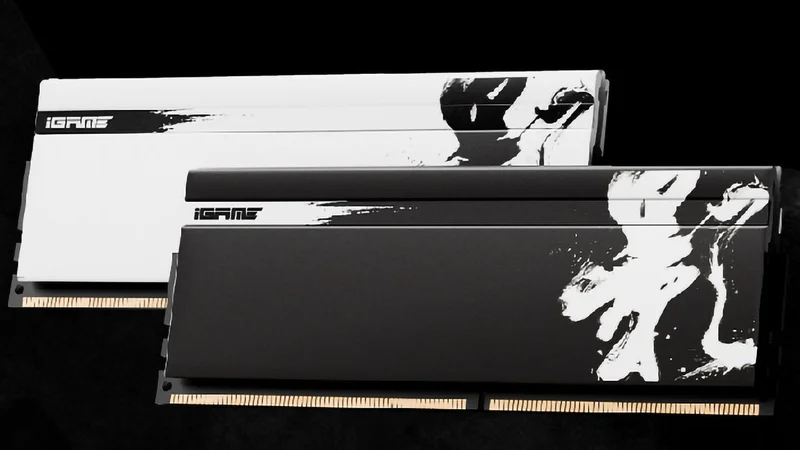
The best RAM on the market generally utilizes integrated circuits (ICs) from industry giants such as SK hynix, Samsung, or Micron. Recently, however, Chinese chipmaker ChangXin Memory Technologies (CXMT) has emerged as a strong competitor amid the ongoing global memory shortage. In Colorful's latest overclocking exhibition, CXMT's ICs achieved speeds up to DDR5-8800 on AMD's X870E platform, keeping pace with the best overclocking ICs, such as SK hynix's A-die and M-die.
Many often regard CXMT as an underdog in the memory industry, particularly when compared to the "Big Three." Founded only a decade ago, the ambitious Chinese chipmaker eventually became China's largest domestic memory manufacturer and is now the fourth-largest memory maker globally.
The recent memory shortage has accelerated CXMT’s rise to fame. The chipmaker has been silently gaining ground in the memory market. Its momentum has been especially evident in the DDR5 segment despite the company having only unveiled its first DDR5 ICs in November 2025. Many top Chinese memory brands, including Asgard, Colorful, Gloway, and KingBank, are widely using CXMT ICs, and even Corsair has done so to a certain extent.
Colorful showed off an incredible overclock with its iGame Shadow II DDR5-6000 C34 memory kits, pushing both the 32GB (2x16GB) and 48GB (2x24GB) configurations far beyond their rated speeds. These kits reached DDR5-8812 and DDR5-8817, respectively, on Colorful's iGame X870E Vulcan W OC motherboard. Unfortunately, the screenshots provided by Colorful were too blurry to discern detailed specifications such as memory timings or DRAM voltage. For context, some high-end DDR5-8800 memory kits typically operate at timings around 42-55-55-140 with a voltage of 1.45V.
The noteworthy aspect is that Colorful achieved the overclocking feat on 16GB memory modules. Most, if not all, DDR5-8600 and faster memory kits currently on the market come with 24GB memory modules. The reason is that many use SK hynix’s 24Gb (3GB) M-die ICs, produced on the chipmaker's advanced 1a-nm (~14nm) process node with Extreme Ultraviolet (EUV) lithography. These M-die ICs are the go-to choice for memory vendors thanks to their superior density, power efficiency, and ability to scale to higher frequencies.
In comparison, CXMT’s accomplishments are notable when considering the technological challenges. Due to U.S. export restrictions on China, CXMT does not have access to cutting-edge EUV equipment, so its 16nm node, which it uses for DDR5 ICs, leverages Deep Ultraviolet (DUV) machines instead. CXMT’s 16nm process is roughly in the same alley as the 1z nm (~14–15nm) nodes previously used by the Big Three, so CXMT is easily a few years behind the top-tier process nodes.
The reality is that CXMT will have to make do with what it has. The chipmaker is already developing a 1a-nm node but on DUV. It is far from prime time, though.
Get Tom's Hardware's best news and in-depth reviews, straight to your inbox.
In addition to seeing CXMT ICs in mainstream memory kits, companies such as HP, Asus, and Acer have already started selling consumer devices, such as laptops or desktops with CXMT memory. Even Apple reportedly wants to buy memory chips from CXMT.
CXMT recently went public via IPO and saw its stock price skyrocket by 466%, raising over $8.6 billion. Without access to EUV machinery, CXMT will focus primarily on memory production and is rapidly building factories across China. The ambitious Chinese chipmaker hopes to steal 30% of the market share from the Big Three by 2030. It is just a matter of time before we start seeing CXMT ICs in all the prominent consumer memory brands.
Zhiye Liu is a news editor, memory reviewer, and SSD tester at Tom’s Hardware. Although he loves everything that’s hardware, he has a soft spot for CPUs, GPUs, and RAM.