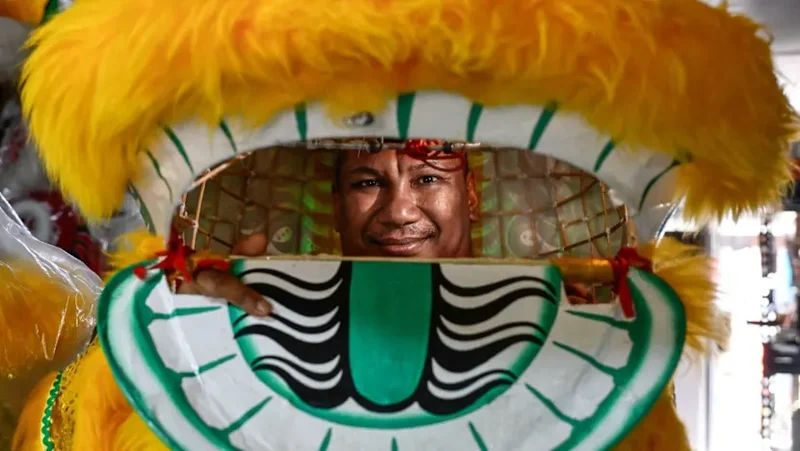
The Malay 'lion dance dad' who started his own troupe at 18
Mr Jamsairi "Bobby" Kamaruddin first fell in love with lion dance at the age of eight. Decades later, together with his children, he is running a successful troupe with mostly Malay members, in a performance art rooted in Chinese culture.
What comes to mind first when you think of lion dance?
For many Singaporeans, it's probably a sound – the loud clash of cymbals and the heavy pounding of drums, even before any images of brightly coloured costumes and heart-stopping stunts.
So it was definitely unusual when I watched, for the first time, a lion dance performed in near silence on a tranquil Monday afternoon.
At an open space at the foot of a Toa Payoh housing block, two dancers in red and white pants shuffled through a sequence mimicking a lion lowering a bridge, while another imitated the iconic drumbeats with his mouth.
Watching from the sidelines was 44-year-old Jamsairi Kamaruddin, better known as "Bobby" – a nickname his grandmother gave him when he was a baby.
He founded Kuo Chuan Arts & Cultural, a predominantly Malay lion and dragon dance troupe with around 20 active adults and children – an uncommon sight in an art form associated with the Chinese community and performed at special occasions such as Chinese New Year and business openings.
On the day of my visit, a small group of them was rehearsing quietly for an upcoming competition, careful not to disturb the neighbours.
Mr Jamsairi's ground-floor flat opens directly into the open space. At his back door were two hot-pink drums stacked atop an ornately designed black-and-gold drum, alongside a box teeming with colourful paraphernalia. It was as though the troupe had spilled out of his home.
He still remembers the first lion dances he ever saw.
More than 30 years ago, when he was eight, he would walk past the Kuo Chuan Police Boys Club near his home each day, captivated by the sight of lion dancers practising and performing their stunts there.
Before long, he had joined them, but the welcome was far from warm.
"I'm the smallest, I'm the only Malay guy down there. So (I got) bullied and so on," he recalled.
But the lion dance bug had already bitten him.
Undeterred that he stood out, he found himself falling deeper in love with the acrobatic feats set to cymbals, gongs and drums.
Most of all, he was fascinated by the storytelling, and how a lion head could come alive in a dancer's hands.
"I love to see the eyes clicking. It's so cute.
"I was curious. When the lion suddenly jumps up and has oranges ... how can this lion do these things?"
AN UNLIKELY PATH
As a child, Mr Jamsairi had little interest in school. He attained his highest academic qualification of a National Institute of Technical Education certificate "for the sake of (his) mum".
After school, he would rush home to train just below his flat around Toa Payoh Lorong 2.
"I would ... play lion dance until 8pm – until my mother (or) father would shout out the window, 'Bobby, come home'."
His mother had hoped he would pursue something more familiar.
"She asked me to learn silat, kompang (traditional Malay hand drum) ... I told her, 'My interest is lion dance, don't waste your money to put me in all these classes'."
When the Kuo Chuan Police Boys Club shut down during his teenage years, Mr Jamsairi joined several other troupes. As soon as he turned 18, he started his own troupe and incorporated it as a company.
He named it Kuo Chuan Arts & Cultural, after the club that had first sparked his love for lion dance. The troupe first started with around 10 members, all of whom were Mr Jamsairi's childhood friends.
It was not a roaring start for Mr Jamsairi's troupe, however. After paying for the rental costs of the lorry, costumes and instruments, they often had no wages to take home.
To make ends meet, Mr Jamsairi worked as a chef in a catering kitchen and picked up other odd jobs. At the same time, he was battling controversy about the group's makeup.
"A Malay guy wanting to go into a Chinese thing – some people wouldn't give us their full support. I needed to slowly, slowly build (others') trust in my team."
(My mum) asked me to learn silat, kompang ... I told her, "My interest is lion dance, don't waste your money to put me in all these classes".
Criticism also came from within the Malay community, with some thinking that performing a lion dance was akin to praying to Chinese gods.
"I educated them, (telling them) that the drum is not made of pig skin and I've never been involved in any prayers," Mr Jamsairi said.
"For me, lion dance is a sport. It's entertainment."
Finding somewhere to train was another challenge.
Even after they had obtained permission from the authorities, some people still called the police over concerns about noise and damage, complaining that the troupe was "spoiling" the grass between the public housing blocks, despite the team's use of a canvas sheet to protect the grass in the open area.
With limited options for rehearsal spaces, the troupe typically does "silent" training sessions around Toa Payoh. To practise with full percussion, the members travel to remote car parks in industrial areas after office hours.
THE LION DAD
As a father of 10 children between the ages of three and 26, Mr Jamsairi often finds himself led by his paternal instincts.
Over the course of our conversation, he spoke little about himself. His focus often diverted to his concerns for the troupe and its members, whose ages range from three to the early 40s.
"When they come back from school, it is better to meet at the club (instead of straying) here and there ... Rather than smoke, vape or (loiter) under the block, it's better that they make themselves sweat, finish their training and go to sleep."
Many of the troupe's current members are here because their parents had urged Mr Jamsairi to take them in. Some are his neighbours, and several more had heard of the troupe through word-of-mouth and reached out to him.
These requests come as no surprise to Mr Jamsairi. He knows the sport makes a good training ground, where young people pick up the small things – such as making sure one's shirt is tucked in for performances – to bigger values such as teamwork and discipline.
"Let's say everyone comes at seven o'clock. If you come at eight, that's not fair, right? Everyone is wasting time waiting for you."
Though he runs a tight ship, joining the troupe is no guarantee that children will "100 per cent stay out of trouble", he said.
One time, a member told the troupe that he could not attend training because of a tuition class, only for Mr Jamsairi to find out from the boy's mother that he had no such class.
Nevertheless, Mr Jamsairi tries his best to find out first what keeps some members away from training.
"We try to understand what's the problem. Why did you not come? We'll talk to your mum. You got no money, we will pay your Grab fare to come for training."
Even after leaving the troupe, many members recall Mr Jamsairi as a "second father" – including Mr Hafizuddin Jaffar.
When Mr Hafiz first joined the troupe in 2014 at the age of 24, he was struggling with his mental health but found solace in the community he found at Kuo Chuan Arts & Cultural.
"Even after hours of training, Bobby would call and check on me, to ask, 'Are you okay?'"
He was also won over by Mr Jamsairi's care for his troupe mates.
"There were team members who went in and out of prison, but Bobby was there with them, advising them to keep out of trouble. Certain team members who had financial difficulties, Bobby was always there to give moral and financial support."
Mr Hafiz, now a barber, left the group during the COVID-19 pandemic, but kept returning to watch performances.
This July, he rejoined the troupe after seeing Mr Jamsairi's son grow from a teenager into one of the troupe's leaders.
Now 36, Mr Hafiz confessed that it's a challenge readjusting to the rigours of lion dance.
"I have to keep up with the younger ones, catch up with the new songs and momentum," he said with a laugh.
"But it's still very exciting for me, because I have the passion for it – same as Bobby."
Above all, Mr Jamsairi's chief priority is the safety of his troupe.
For all his years in lion dance, he still gets uneasy during high-pole performances – an acrobatic variation of the sport where performers leap and balance on thin steel poles up to 2.5m high.
Having suffered injuries himself – including being kicked in the face by a teammate mid-performance and getting a swollen eye – he knows that even after hours of rehearsal and rigorous safety checks, accidents can still happen.
"I just don't want them to fall. I still get nervous. When the drums go 'tok tok', my heart is going to (jump out) already."
Even when his troupe performs in competitions, he will sometimes avert his gaze from certain stunts until they complete the landing.
Two of Mr Jamsairi's children are still active performers in the troupe, but he worries about everyone.
"Whoever's in my club, I treat as my family. I don't want any of my family members to get injured."
PASSING THE LION'S HEAD
In Mr Jamsairi's living room for this interview, we were seated in a small space. Had we not been there, he said, even those precious few square inches would probably have been filled with lion dance gear.
"If I open my room (door), you'd be shocked. I have around 40 to 50 lion heads (in there)."
The rest of the two-room flat was sparsely furnished. Until recently, there wasn't even a television – not that Mr Jamsairi's children mind.
Instead of Netflix or reality TV shows, they prefer to watch lion dance videos on their personal devices.
About half of Mr Jamsairi's 10 children have been part of Kuo Chuan Arts & Cultural at some point. One daughter, Natasha, 27, now a teacher, helps him with paperwork in Chinese, which is a second language she took in school.
One son, Jashairie, better known as Ayie, has begun to lead the troupe in recent years. The 22-year-old oversees training and choreography, and even orders customised costumes for the troupe from China.
"He is the main character now," Mr Jamsairi said, glowing with pride.
At the training I saw, Mr Jashairie drilled two members through a tricky sequence involving two wooden benches again and again. He gave strict instructions on the timing, the footwork, the precise movements of the lion head.
After a few failed attempts, Mr Jashairie and his older brother stepped in to demonstrate the manoeuvre. They executed it perfectly on the first go.
Having grown up with the troupe since the age of four, lion dance is "very close" to Mr Jashairie's heart. But it has been an eye-opening experience learning to manage the business side of things.
He is proud of what his father has achieved. At the same time, he hopes to compete in bigger arenas and focus on building a strong team culture.
"Taking over is a big responsibility ... I do want to continue the lion dance legacy, but not by copying (my father's) exact path. Hopefully, I can take the troupe further."
THE ROAR GOES ON
Watching his son take charge has not made Mr Jamsairi any less involved.
These days, he leaves most of the training and choreography to his son while taking care of the behind-the-scenes work – handling clients, arranging transport and sorting out performance schedules.
Some customers have been calling Mr Jamsairi every Chinese New Year for more than 15 years.
"'Die die' must go to their house," he said, laughing.
In good times, the business from the Chinese New Year season alone can cover the troupe's expenses for the rest of the year. Year-round, they stay busy with competitions and bookings such as business openings.
Of late, they've also been called upon to perform at Malay weddings, birthday celebrations and Hari Raya events. Such invitations signal to Mr Jamsairi that attitudes are changing.
When he first started, many people questioned why a Malay man wanted to perform lion dance.
Today, he still gets the occasional customer who calls, speaking only Mandarin. When that happens, he usually ropes in a Chinese friend to help or reaches for a translation app to communicate via text message.
He continues to be upfront with potential clients, asking: "We're a Malay troupe, you okay or not?"
The answer, more often than not, is: "We've seen you before. We want to try this."
Not everyone has been won over, of course.
"Till today, there are still people who say, 'Why is a Malay doing this?' But we don't care, because at the end of the day, if my customers are happy, I'm happy."
In recent years, the troupe has begun taking part in competitions in China, where they've found surprisingly warm welcomes despite being a predominantly non-Chinese group.
"We're (speaking with the hosts) like ducks and chickens, but they treat us marvellously. They know we don't eat pork, so they'll provide a cook just to prepare meals for us and buy new utensils. We even teach them to cook Malay food."
Even his mother, once apprehensive when he decided to make lion dance his career, eventually came around.
"After so long, she saw my passion. She said, 'Okay, your pasal (Malay for "matter"). Power, carry on.'"
Whoever's in my club, I treat as my family.
In his spare time, Mr Jamsairi moonlights as a livestreamer on social media, which he picked up during the COVID-19 pandemic. He is engaged by businesses to promote various items such as Malay desserts, and some of his streams have hit around 3,000 simultaneous viewers at a point in time.
Still, some of his most popular livestreams are the ones featuring his troupe.
Recently, online followers even came together to sponsor new competition attire for the troupe.
With such spirited supporters and a troupe family that's still growing, Mr Jamsairi can't bring himself to quit lion dance.
"I try to stop," he said, laughing. "I cannot."
Even after 36 years spent perfecting his craft and building his troupe family, there remains much for Mr Jamsairi to do.
He no longer spends much time beneath the lion's head, but he is committed to setting the stage for the next generation to take the spotlight.
"This team is not mine," he said.
"Kuo Chuan does not belong to me. It belongs to everyone in the club."