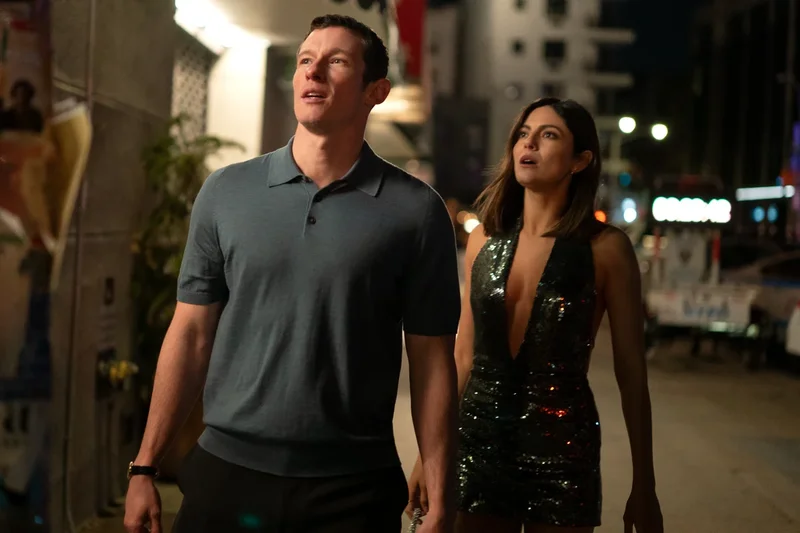
One Night Only director Will Gluck has revealed that he decided to scale back the amount of nudity in the romcom because he believes audiences are too uncomfortable with sex on screen.
The movie, starring Monica Barbaro and Callum Turner, is set in a bizarre world in which the U.S. has outlawed premarital sex for 364 days a year — leaving single people just 12 hours annually to hook up.
It has been widely compared to the horror franchise The Purge, in which violent crimes are legalised for one day per year.
In a new interview for Variety, Gluck, whose credits include Easy A and Anyone But You, said he studied empirical data about how Gen Z and Gen Alpha don’t want to see sex on screen, which informed how much intimacy was shown in the final cut of the movie.
“I cut out so much,” he said. “There was so much nudity in this movie that we shot on the streets.”
He decided to cut back on intimate scenes based on the audience’s reaction at test screenings for the movie.
“As we started to show it to audiences, we felt it takes you out of the movie. You’re engaged in the characters and what’s going on, and then you pan over and there’s two naked people having sex, and you watch the audience … it’s a physical thing,” he explained.
“So we just kept editing it out until we got a balance, and those comments went away.”
Gluck suggested that because people are constantly exposed to nudity and intimate scenes on their phones, it’s become “more of a private, intimate thing that people don’t want to see when they’re in a shared experience.”
“Whenever people now see nudity or very adult situations in a big theater, they get uncomfortable,” he reckoned.
The director added that he used an intimacy coordinator for romance scenes, and also cast real-life couples already familiar with each other to act in them.
“It was never like we met an extra and were like, ‘you guys are kissing.’ It was fun because there were married couples, people who broke up during the movie and people who became couples so they could do that,” he said.
Reviews for the movie have been polarized, with some critics describing the message of the film as being “strangely conservative” and even “fascist”.
In The Guardian, critic Benjamin Lee wrote that the film’s premise ought to be “the set-up for a grim Handmaid’s Tale-adjacent horror of a totalitarian state insisting extreme control over the body, but instead it’s used as the backdrop for a sunny meet-cute, screams of protest drowned out by a zippy Top 40 soundtrack”.
“If it sounds like far too much for a breezy summer romp to take on, then that’s because it most definitely is, an overstuffed yet undercooked soufflé that can’t quite, ahem, rise to the occasion…”
Others have been kinder to the film, with several outlets singling out the chemistry between the two leads for particular praise.
Variety’s Guy Lodge praised them as “two attractive, pleasingly grown-up leads whom you wouldn’t mind seeing get together; it’s set in New York City at its most invitingly balmy.”