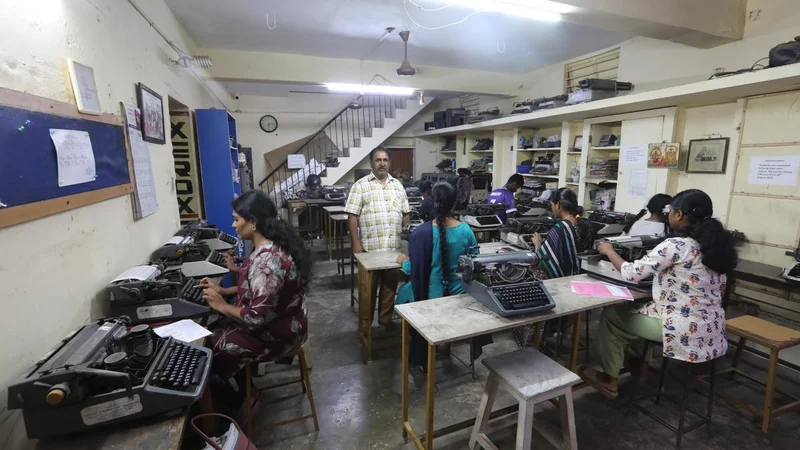
A chorus of clickety-clacks from manual typewriters drowns the bustle on Jaganathapuram First Street, which sits in a tract of Chetpet where every house leans into the next somewhat like books in a library shelf. Inside, as young fingers dance over ageing manual typewriters , kept sprightly by consistent maintenance, teacher-plus-owner of Chetpet Typewriting Institute (est. 1975) P. Padmanabhan is supervising yet another class, spelling out instructions to students.
Typing proficiency, whioh includes speed, opening doors to certain clerical positions in government and private settings, being an essential component in certain competitive government exams including TNPSC Group IV, some categories of Staff Selection Commission, institutes of this nature still thrive. Padmanabhan points out every class includes students who view the acquisition of typing skill as an end in itself. Just being able to type fast and error-free is good enough without the ability having to open up employment avenues. Therefore, also expect those training for careers in law, the corporate world and so on to walk in through those doors, says Padmanabhan, adding that he receives students from near and far and the institute's current strength is 50.
A plea to the Tamil Nadu Government
The Hindu Downtownthat typewriting exams in English and Tamil should be conducted only on typewriters. He points out, “Besides, the Computer on Office Automation (COA) exam should not be merged with the English and Tamil typewriting exams. Instead, the current system of conducing the three exams separately with a separate certificate given for each should continue. Every year, more than one lakh students take typing exams, conducted every six months. Clubbing them with COA will reduce the number of takers; and that will result in reduced revenue for the government.” Srinivasan adds that switching typing exams from manual typewriters to computers will affect the livelihoods of typewriting institutes and typewriter mechanics across Tamil Nadu, which he estimates at around 5000 and 2000 respectively. He states: “Associations and federations representing these institutes and mechanics want this GO cancelled.”
And these multiple needs keep these instruments going, refurbished from time to time. Chetpet Typewriting Institute is not the oldest, but is symbolic of typewriting institutes, continuing with unflagging enthusiasm despite challenges from technology.
Padmanabhan belabours manual typewriter-based institutes’ continuing relevance, citing numbers and benefits. “There are 4,500 government-approved typewriting institutes across Tamil Nadu,” he states. “Typewriting equips a person to type faster and more efficiently. Once you master it, operating a computer becomes effortless.”
This belief has had Padmanabhan, now aged 75, wearing a new hat post his retirement as medical photo officer (also known as ‘medical photographer’) from Rajiv Gandhi Government Hospital in 2006, taking the mantle from his father and running Chetpet Typewriting Institute. The institute operating from a space, quite an expansive space, in Padmanabhan house, makes the overheads of running it manageable. Without a soupcon of a regret, he points out he whittled down the number of institutes he ran from seven to one. “Unable to find teachers of the calibre I sought, I shut down the institutes.”
He notes with quiet pride, “I am a certified high-speed typewriting expert and an official government examiner,” recognised by the Tamil Nadu Directorate of Technical Education (DOTE). Padmanabhan personally teaches both Tamil and English typewriting; shorthand classes are also offered. His voice resonating with justifiable pride, he says: “Search my name online, you will find it.”
Decades ago, every street probably sported a typewriting institute. Those like Padmanabhan maintain their numbers would have dwindled but not their relevance. And this is why, 20 years after retirement, he continues to fill his house with a chorus of clickety-clacks.
A typewriter mechanic on wheels
The phone rings, and within minutes, 54-year-old S. Thyagarajan is on his way to ‘rescue’ another manual typewriter. There is no workshop, no colourful signboards announcing his trade. He is the workshop on the move; and his experience repairing manual typewriters since 1986 is the signboard. Owners of typewriting institutes across Chennai have his number saved as “ICE”. That is obviously hyperbole, but typewriter mechanics such as Thyagarajan are indeed indispensable in “emergency” situations involving these machines, as brands selling manual typewriters have long ceased production, and the old machines have to be kept in circulation.
Thyagarajan entered the profession in 1986 soon after completing Class 10, having been born into a family of typewriter mechanics, his grandfather and uncle particularly known in the trade. The clatter of these machines defines his earliest memories, and he is among a dedicated group of people who refuse to let manual typewriters become a memory.
While typewriter manufacturers have ceased production, he says, typewriters are far from extinction. “The spare parts still come from Delhi. A manufacturer who started the business when typewriters were in their heyday continues to supply them even today,” he explains.
He notes that around 40 regular customers, including several typewriting institutes continue to rely on his services. Thyagarajan once ran repair shops which he shut down as rents escalated. Today, he follows what can be called a more practical approach.
“ Every occupation evolves with time. One phone is enough to run the business now. Maintaining shops has become an unnecessary expense,” he says.
He is a a staunch believer not only in these machines, but also what they bring to the table, well sheet. He is emphatic that those trained on typewriters make fewer mistakes because their fingers develop greater speed and accuracy, whereas those who learn typing directly on computer keyboards are more error-prone, particularly while typing Indian languages such as Tamil.
“Even my name has been misspelt umpteen number of times,” he remarks bitterly, adding that such mistakes can create unnecessary complications in government records and other important documents.
And for that reason and also for the fact that livelihoods still depend on typewriting institutes, he wants these old machines to continue clicking away in classrooms and examination halls.
(Ahead of Madras Day, Resilience Series tracks institutions and industries that had their heyday when the city was Madras are up against difficult times now, but are soldiering on with inimitable poise.)
Published - August 08, 2026 07:42 pm IST