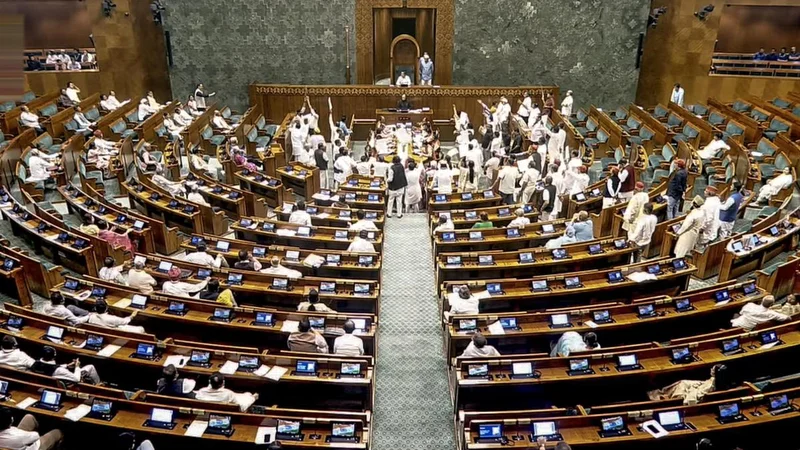
The story so far: The BJP is keen to kick off a fresh delimitation of Lok Sabha constituencies. It is trying to garner a two-thirds majority in Parliament to pass a Constitutional amendment for this purpose. In April 2026, it had moved the amendment but could not pass it. The Centre has not revealed its exact proposals. The proposals that the Centre placed before Parliament in the previous Session were the following:
1) Increase the size of the Lok Sabha up to a maximum of 850 seats; 2) distribute these seats among the States on the basis of the 2011 Census through a fresh, countrywide delimitation of constituencies; and 3) reserve one-third of the total seats for women.
According to the existing Constitutional provisions, a fresh delimitation is possible only after the data of the 2027 Census is published, and reservation for women can be rolled out only along with it.
What happens if there is no Constitutional amendment connected to delimitation?
For a fresh delimitation to happen, a Constitutional amendment is not required. A fresh delimitation will be triggered soon after the data of the 2027 census is published. The terms for the next delimitation are already written into the Constitution, principally in Articles 81 and 82. A Constitutional amendment is required only if the existing constitutional provisions relating to delimitation are to be changed.
Articles 81 and 82 mandate—not an optional choice of the executive—that after the data from the first Census conducted after 2026 is published, two things will happen.
The first is a reallocation of the existing strength of the Lok Sabha among the States and Union Territories on the basis of the population recorded in that Census, which would, in this case, be the 2027 Census. The second is the delimitation of individual constituencies within each State.
Therefore, if there is no Constitutional amendment at all, there will be a delimitation exercise that must begin after the data of the 2027 Census is published.
Q) Can a fresh delimitation triggered by the publication of the 2027 Census data be completed before the 2029 Lok Sabha elections?
May or may not. In the past, delimitation exercises took several years. The last one was set up on 12 July 2002, after the 2001 Census, with Justice Kuldip Singh, a retired Judge of the Supreme Court, as its chairperson. Its recommendations were implemented in 2008, and the 2009 Lok Sabha elections were held based on newly drawn constituencies.
The last delimitation did not involve a reallocation of seats of individual States; only the existing constituencies within each State were redrawn. The last time Lok Sabha seats were reallocated among States was in 1973, based on the 1971 Census. That ratio remains as of today.
The 2027 Census is the first time that data gathering has been completely digitalised. Theoretically, it is possible that Census data analysis and the delimitation process could be quicker than before. If the exercise is not completed before the 2029 Lok Sabha elections, it could continue into the term of the next Lok Sabha and the government.
The last Delimitation Commission was appointed during A. B. Vajpayee’s tenure as the Prime Minister, and its work was completed during the first term of the Manmohan Singh government, with a Lok Sabha election in 2004 in between. The same can happen with the next Delimitation Commission.
In the absence of a Constitutional amendment, what will be the mandate of the next Delimitation Commission?
If a fresh delimitation is triggered under the existing provisions of Articles 81 and 82, the following will happen.
At present, the distribution of the 543 Lok Sabha seats among the States is based on the population figures of the 1971 Census. When the benchmark changes from the 1971 population to the population recorded in the first Census after 2026, the distribution of seats is likely to change significantly.
Broadly speaking, the southern States are likely to face a reduction in their share of Lok Sabha seats, while the Hindi-speaking States, particularly Uttar Pradesh, Bihar and Rajasthan, are likely to gain seats. There could be an increase of up to 550 seats in the Lok Sabha. A third of the Lok Sabha seats nationally, and one-third of the seats within each State, will be reserved for women.
So, in the absence of any Constitutional amendment, the following sequence is envisaged: first, the reallocation of Lok Sabha seats among States; second, the delimitation of constituencies within States; and third, the implementation of women’s reservation—all tied to the Census 2027.
How is the allocation of seats to each State determined?
Think of India as one large joint family and the States as its constituent family units. Imagine that each individual across the joint family was entitled to one acre of land. A family with five members got five acres, another with seven members got seven acres, and so on. Each family then divided its share among its members. At that point, everyone got roughly the same share. In political terms, every vote had roughly the same value. But then time passed. Some families grew much faster than others. In the larger families, the same land had to be shared among many more people. In the smaller families, fewer people shared the same land. As a result, the value of each person’s share began to differ.
That is, in a sense, what has happened to votes in India. In 1967, an MP across most major States represented roughly four to five lakh electors. Today, a Member of Parliament from Kerala represents about 14 lakh electors, while in Uttar Pradesh and Bihar, the figure is around 19 lakh.
This variation is the result of a deliberate decision by all parties, taken on two occasions, in 1976 and 2001, not to punish States that had stabilised their populations. The Constitution gives that leeway. The size of Lok Sabha constituencies is not necessarily based on a national average, which today would be about 18 lakh voters per constituency. Article 81 requires seats to be allocated among States “so far as practicable”, on the basis of a national average.
This leeway for variation allows for a balance between two principles that can be in tension: federalism, or representation of States, and democracy, or one vote, one value.
And that is the central tension the debate on delimitation now needs to resolve.
What is gerrymandering and how that can impact the outcome?
When we discuss the democratic principle of One Person, One Vote, One Value, the first requirement is that every Lok Sabha constituency should have roughly the same number of voters. But equal numbers alone do not guarantee equal value for every vote. Why? Because even when constituencies contain the same number of voters, the way those voters are grouped can dramatically affect electoral outcomes.
Consider a simple example **(IMAGE 2)**. Imagine there are 50 voters. Party A has 20 supporters and Party B has 30 supporters. There are five constituencies, each with 10 voters and electing one representative.
In the first scenario, voters are distributed fairly across the five constituencies. The result broadly reflects the overall vote share. Party A and Party B win seats broadly in proportion to their support.
In the second scenario, Party A’s voters are spread thinly across constituencies. This is called cracking. Although Party A has 40% of all voters, it may not have enough support to win even one constituency. Thus, 40% of voters could end up with no representation at all.
In the third scenario, Party B’s voters are heavily concentrated in a few constituencies. This is known as packing. Party B wins those seats with huge margins but ends up wasting votes, allowing Party A to win more seats despite having fewer supporters overall.
The way constituency boundaries are drawn can profoundly shape democratic representation and electoral outcomes.
Extracted from the author’s introduction to ‘The Delimitation Debate: The Union and its Units,’ published by The Hindu. Order the book here
Published - August 08, 2026 08:03 pm IST