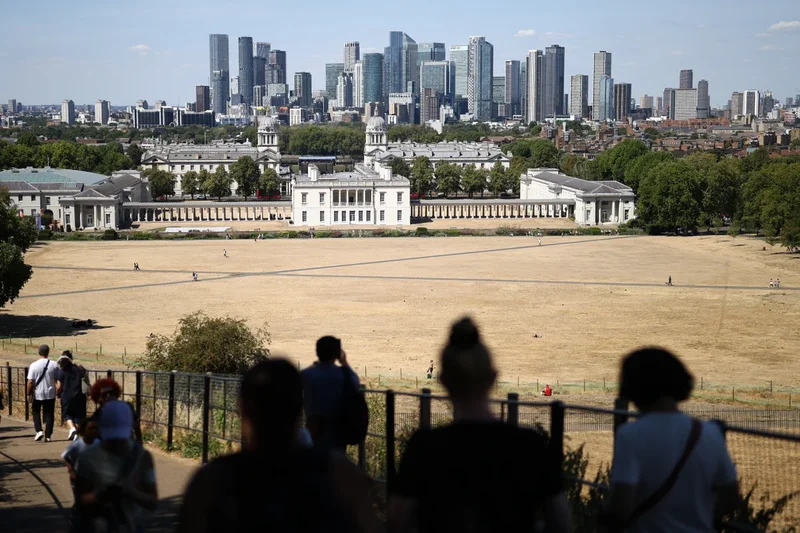
Britain’s record-breaking summer of heatwaves and life-threatening extreme temperatures could prove to be the coolest of our lifetime unless we double down on efforts to tackle the climate crisis, experts have warned.
Back-to-back hot spells, which saw the mercury peak at 37.7C (99.9F) in June, have so far led to nearly 3,000 deaths, half of England and the whole of Wales are in drought and a failure to heed decades of warnings to build climate resilience into our supply chains has left the UK facing food shortages.
The news overseas is even more alarming, with unprecedented wildfires burning thousands of square kilometres of land around holiday resorts in Spain and France, claiming 16 lives, while record-low water levels threaten Europe’s industrial heartlands on the Rhine and exposing lost Nazi warships on the Danube.
And the picture is only set to intensify in the coming months as a record-breaking El Nino – a periodic warming of the Pacific Ocean – wreaks havoc with global weather systems, resulting in extreme rainfall in some parts of the world and devastating drought expected in others.
Experts warn that recent temperatures are no anomaly with worse to come, unless we ramp up efforts to phase out fossil fuels and invest more heavily in renewable energy sources.
“Unfortunately, this will be the least extreme climate we will experience in our lifetimes, certainly until we reach net zero emissions,” warned Hayley Fowler, professor of climate change impacts at Newcastle University. “We need to pressure politicians to do more and faster: to both rapidly reduce emissions and rapidly adapt our infrastructure to cope with more extreme weather.”
Prof Fowler’s comments come as recent analysis from Carbon Brief suggests that the combination of climate change and the super El Niño mean that 2026 is set to be the warmest or second warmest year on record – continuing a pattern of global temperatures increasing year after year.
“What we're seeing now is exactly what climate scientists have been expecting for decades,” adds Dr Friederike Otto from Imperial College London. “But the future is not predetermined: every tonne of carbon dioxide we avoid emitting reduces future warming and limits the severity of impacts.”
Gareth Redmond-King, international lead at think tank the Energy and Climate and Intelligence, echoed the concerns, saying: “This extremely hot and dangerous summer risks being one of the coolest for the rest of our lives if we keep burning coal, oil, and gas and destroying nature.
“But we should by no means feel that hope is lost, because we have a scientific pathway forward in the form of net zero that we need to be pursuing as urgently as possible if we want to bring our climate back into balance.”
Zack Polanski, leader of the Green Party, * *criticised the government for not doing enough to address current climate, and urged new PM Andy Burnham to do more.
"This is the biggest threat to our country since the Second World War but Andy Burnham is silent on it,” he said. “Worse than that, he's considering restarting drilling in the North Sea – literally pouring fuel on the fire. Where is the action to meet the scale of the emergency?”
Fleur Anderson, Labour MP for Putney and chair of the All-Party Parliamentary Group (APPG) on climate change, added: “We need to remember this period when the hot weather goes away. It is important now to join up government thinking between different departments to address all the different areas of our lives that are affected by climate change.”
Her comments come as the latest Met Office data shows that rainfall in July was the lowest it has ever been in records stretching back more than 250 years.
Ms Anderson also criticised the weakening climate consensus among mainstream political parties – with Conservative leader Kemi Badenoch pledging to repeal the UK’s Climate Change Act – saying it was “extraordinary in the middle of these heatwaves for the parties to be differing on this”. She added: “I am so disappointed by the fact that the climate deniers seem to be winning the argument on the right in the face of not only scientific evidence, but also what is actually happening to our country.”
‘A new normal’ – that could get even worse
The Met Office has warned that the climate extremes of this summer are becoming “the new normal” for the UK – and the scientific evidence shows that things could get much worse unless the world global emissions continue to increase annually.
A report published by 160 scientists last year warned that even levels of global warming below 2C above the pre-industrial average could see climate systems that humans depend on for their survival – including the Amazon Rainforest, the Arctic permafrost, and the critical Atlantic Meridional Overturning Circulation (AMOC) – collapse. Scientists currently believe the world is at around 1.3C of warming.
In the UK, a report on climate-preparedness published this summer by the climate APPG warned that the country is woefully underprepared for coming climate impacts. Some 6.3 million homes and businesses are at risk of flooding, and the cost of annual coastal flood damage is projected to increase two to three times by the 2080s, the report found.
By 2050, 92 per cent of existing homes could be suffering from overheating, while climate change and ecosystem collapse could mean the UK will struggle to maintain its food supply as early as 2030. Farmers have already warned that drought and heatwaves are likely to result in shortages and they may have to stop growing some vegetables.
Some 46 per cent of roads and 54 per cent of railways will also be at risk of flooding by 2050, the report finds, while direct impact costs from heatwaves over the next 50 years is set to be £64bn.
The cost of heatwaves has been particularly apparent in the wake of record-breaking fires in France and Spain this year. The cost of these fires as well as those in other parts of Europe is currently estimated at more than €3bn (£2.6bn).
Members of the APPG are calling on the government to move responsibility for climate resilience from the Department for Environment, Food and Rural Affairs (Defra) directly to the Cabinet Office. “We have always planned historically for the cold in this country, but now we need to be worrying about the summer and overheating. We have to think differently about how we act to overcome these problems,” said Ms Anderson.
Speaking of wildfires that have also hit the UK this year, minister for climate transition Katie White said: “British firefighters are telling us they’ve never seen anything like this. With wildfires across Britain and Europe, we know we're not waiting for climate change, we're living through it.
“We must build our resilience, but critically, also cut the dirty emissions driving this.”
50 million people facing acute hunger
Over the next year, the world is set to experience a climate phenomenon known as a El Niño, which is when unusually warm sea surface temperatures in the Pacific Ocean lead to droughts or increased rainfall in different parts of the world.
This year’s “super” El Niño is set to be more severe due to a particularly high forecast temperature rise, as well as the climate crisis further exacerbating weather patterns. Analysis of El Niño forecasts from Carbon Brief suggests that the El Niño is set to be by far the strongest on record.
In the UK, it risks heightening food shortages, as millions of small-scale farmers around the world that supply the UK with tropical fruits, cocoa, coffee and tea will struggle due to the disrupted weather patterns.
The consequences overseas are set to be catastrophic, with warnings up to 50 million people could be pushed into acute hunger before the end of next year, the World Food Programme warned this week. It comes on top of geopolitical shocks, such as the war in Iran and aid cuts from wealthy countries, which are already piling immense pressure on the poorest parts of the world.
The past ten years has already seen the number of people facing a food crisis double, according to the United Nations, with data also showing that foreign aid has also fallen to a 10-year low.
As warnings about the climate crisis intensify, the impact of how Britons are feeling about the impacts are becoming clearer. A survey published by the think tank IPPR this year found that 81 per cent felt unprepared for the worst impacts of the climate crisis.
But experts stress that there remains every hope that the worst impacts can still be avoided, and the world’s climate can be stabilised, if we continue – as the vast majority of the world outside of the US is doing – to roll out renewables and pursue a goal of net zero emissions.
“There is still time for us to avoid the worst impacts of climate change, and every fraction of a degree of avoided warming matters,” said Professor Elizabeth Robinson, head of the Grantham Climate Institute at the London School of Economics. “But this requires governments not just to stick to their commitments to reducing emissions, but to close the gap between commitments and policies that they are delivering.”
Dr Otto added: “This is a problem that is solvable. We know how to replace fossil fuels with renewables, we know how to lower demand, we know how to redesign cities and landscapes to be much better adapted to increasing floods, extreme heat and drought.
“Climate change is one of the defining challenges of our time, but it is also one where clear, informed decisions and sustained action can shape a much better future for all.”
The UK Department for Energy Security and Net Zero has been approached for comment.