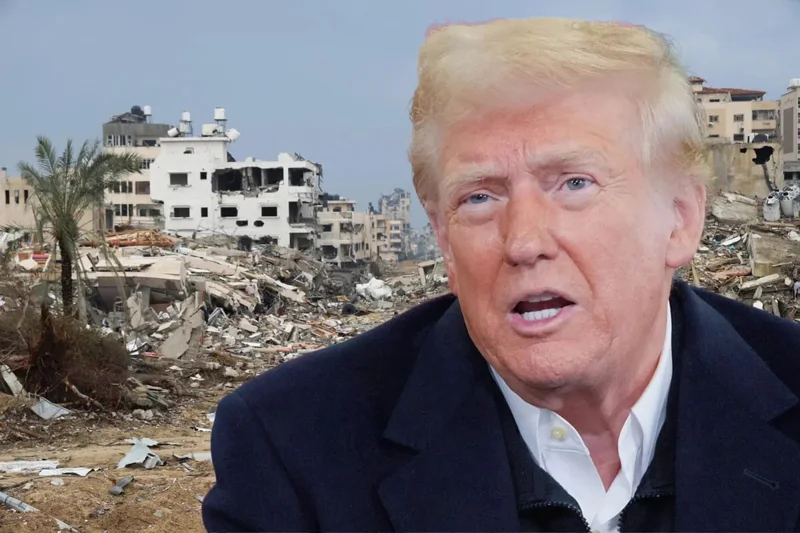
Why is Trump suddenly reviving his Gaza plan?
TEHRAN – Trump’s statement about an agreement to disarm Hamas raises questions about his real objectives and reflects the continuing U.S. bias toward Israel, casting doubt on the prospects of achieving lasting peace.
Suddenly and without warning, Trump issued a statement saying that the “Board of Peace” - the body he personally chairs and which is responsible for administering the transitional phase in the Gaza Strip - had reached a historic agreement.
Under the agreement, Hamas would be disarmed, Israeli Occupation Forces (IOF) would withdraw from the Strip, an international force would work to establish stability there in cooperation with a new Palestinian police force, a new Palestinian government would be formed, and the reconstruction of Gaza would begin.
This, he said, would constitute a historic step toward lasting peace.
To understand the significance of this announcement and its potential impact on the course of the U.S.-backed genocide in the coastal strip, it is important to revisit the substance of “Trump’s Comprehensive Plan to End the Gaza Conflict” whose implementation was entrusted to the “Board of Peace”, and to shed light on the obstacles that have stood in its way.
On September 29, 2025, Trump announced that the parties concerned had agreed to a ceasefire deal consisting of 20 provisions and Gaza was supposed to become “a safe area”.
As soon as the “ceasefire” agreement began to take effect, Trump presented his plan to the UN Security Council, which adopted it and issued Resolution 2803. This gave the impression of an international initiative to launch a genuine peace process.
Yet implementing the provisions of this plan encountered major obstacles, foremost among them Israeli intransigence and American bias.
With regards to ending the U.S.-backed aggression, the plan stipulated that all military operations, including aerial and artillery bombardment, would be suspended, and the lines of engagement would remain frozen until the conditions for a full withdrawal were met.
Hamas and the other Palestinian resistance forces complied with everything set out in this provision. The Zionist regime, however, adhered to it only during the period in which captives and bodies were exchanged. Once it had recovered them all, it resumed its aggression under various pretexts. The number of Palestinians killed by the IOF since the “Trump Plan” came into effect has reached approximately 1,300, while the number of wounded has reached around 5,000.
Regarding the prisoner exchange and despite the logistical difficulties surrounding the implementation of this process, owing to the devastation the IOF inflicted in the Strip and the lack of equipment needed to retrieve bodies, Hamas made extraordinary efforts to fulfill all of its obligations under the related provisions.
This enabled Israel to obtain the most important leverage that Hamas possessed, while Hamas received no serious guarantees in return that the regime would honor its own obligations.
As for the IOF withdrawal, the plan affirmed that Israel will not occupy or annex Gaza and will gradually withdraw its (occupying) forces in exchange for an “International Stabilization Force” to exercise effective control over the Strip.
It also stipulated that withdrawal to an “agreed-upon line” would take place in the first phase (Provision 3). However, the regime has not complied with these provisions at all. After withdrawing from 45 percent of the Strip’s territory, it gradually occupied additional areas. Today the IOF occupies more than 70 percent of the Gaza Strip.
Numerous provisions organized the flow of humanitarian aid. Provision 8 stated that entry of aid and distribution in the Gaza Strip will proceed “without interference” and the opening of the “Rafah crossing in both directions”.
This is while provision 7 stated “full aid will be immediately sent into the Gaza Strip”, including “rehabilitation of infrastructure (water, electricity, sewage), rehabilitation of hospitals and bakeries, and entry of necessary equipment to remove rubble and open roads.”
The occupying regime also failed to comply with this provision, allowing only a trickle of humanitarian aid to enter.
On the matter of disarmament, which Israel turned into a pretext for undermining the entire plan, several provisions addressed this issue. Provision 1 stated that Gaza will pose no threat to its neighbors. Provisions 13 and 14 affirmed that there would be a comprehensive disarmament process under the supervision of independent monitors.
Although the plan set no timetable for completing the disarmament process and did not link it to any other issue, Israel insisted and continues to insist that the process be conducted under its direct supervision and that it will not withdraw from the Strip before disarmament is completed.
This clearly revealed, from the outset, the regime’s true intentions and its unwillingness to comply with the plan in full.
Against this backdrop, it is only natural that serious doubts arise about Trump’s true intentions when he now announces that the “Board of Peace” has reached an agreement to disarm Hamas and insists that this is a historic agreement.
If Trump were genuinely serious about what he says, his policies would have been characterized by a greater degree of balance from the moment he began implementing his plan to end the Gaza genocide.
But to allow the Israeli regime to violate its obligations for an entire year, including its commitments on the ceasefire and the flow of humanitarian aid, and then come forward in a bid to convince the region that disarming Hamas will somehow solve everything is something that cannot reasonably be accepted. It borders on the absurd.
It is difficult to understand the reasons that prompted Trump to take this step without placing it within the broader context of his strategy toward the region as a whole, a strategy that does not differ in its objectives at all from the one pursued by Netanyahu.
Both believe that the region will not calm down or achieve stability unless all resistance forces confronting Israeli expansion are disarmed, particularly Hamas and Islamic Jihad in Palestine and Hezbollah in Lebanon, and unless all governments opposed to Zionist-American policies in the region are overthrown, particularly Iran.
Trump’s policies may sometimes differ from Netanyahu’s, given the role of the United States as a power with global interests and alliances. But this difference is confined to methods and means; it never touches the objectives, because those objectives are unified to the point of being virtually identical. Therefore, coordination between the two is permanent and continuous, and it will never cease, no matter how wide the disagreements between them become.
It Is worth noting that Trump had put forward his plan for a ceasefire in Gaza only a few months before the second illegal American-Israeli war on Iran, which began on February 28, 2026.
Because the war failed to achieve its objectives, it was only natural that Trump’s “Gaza plan” would become impaired and that Israel would be allowed to obstruct it by preventing the National Committee from entering the Strip, placing obstacles in the way of forming the multinational security force, and once again giving the regime a free hand, not only in the Gaza Strip, but in Lebanon as well.
It is by no means unlikely that Trump’s announcement that the parties concerned have reached an agreement on a plan to disarm Hamas could be a prelude to paving the way for a third war against Iran, one that Trump and Netanyahu hope will accomplish what the first and second wars failed to achieve.
Whether or not this possibility proves correct, one thing is certain: West Asia will not know peace and stability unless Israel is forced to abandon its expansionist ambitions in the region and the United States is forced to abandon its ambitions for hegemony over it.