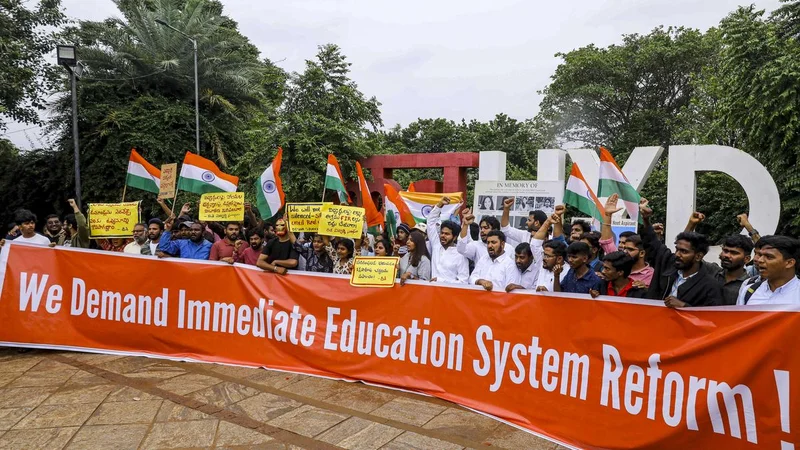
NEET is one of India’s highest-stakes examinations, where intense competition, immense social prestige, and the multi-crore value of a medical seat generate enormous academic, financial, and psychological pressure. Similar pressures surround other national admission, scholarship and recruitment examinations. In such an environment, paper leaks and other irregularities have repeatedly surfaced, though they are often collectively described simply as “paper leaks.”
The controversies surrounding NEET-2024, UGC-NET 2024, and NEET-2026 triggered unprecedented national concern. UGC-NET 2024 was canceled and held again, while NEET 2026 was also re-conducted. All three were conducted by the National Testing Agency (NTA), which attributed these decisions to specific external or intelligence inputs.
The CBI investigated the NEET-2024 and UGC-NET 2024 cases. Although the investigations initially led to arrests and extensive nationwide media coverage, the CBI has since submitted closure reports in both cases, reportedly finding no prosecutable evidence of a conventional paper leak under the Bharatiya Nyaya Sanhita (BNS), 2023, or the Public Examinations Act (PEA), 2024. The NEET-2026 investigation remains in progress, with a chargesheet already filed.
These developments raise a more fundamental question: if repeated examination crises ultimately yield no prosecutable evidence of a conventional paper leak, what exactly constitutes a “paper leak”? Where do such compromises originate, and who is responsible for detecting, preventing, and being held accountable for them?
Defining a ‘paper leak’
Traditionally, a “paper leak” refers to the unauthorised disclosure of a printed question paper before the examination, typically during printing, packaging, storage, or transportation. Investigation protocols, therefore, focus on tracing printed papers and recovering physical evidence. The recent Maharashtra Teachers Eligibility Test (TET) case is a classic example in which coded printed question papers were allegedly leaked from a compromised printing press.
High-stakes examinations, however, present a far more complex picture. Long before printing, questions pass through question-setting, moderation, translation, digitisation, and final compilation, where a limited number of individuals have privileged access. Compromises at any of these stages may never result in a leaked printed paper. Yet, it can selectively disclose questions or other confidential material, providing an unfair advantage to a few candidates before spreading through organised networks.
The NEET and UGC-NET controversies illustrate this distinction. Although investigations reportedly found no evidence of leaked printed papers in the 2024 cases, the examinations nevertheless led to arrests, cancellations, re-examinations, and a crisis of public confidence. Similarly, the circulation of highly targeted “guided papers” before NEET-2026 raised questions about whether confidential information had flowed through insider or informal networks despite the absence of any recovered printed paper.
Examination compromise may therefore involve far more than a printed paper: selected questions, question banks, recurring themes, high-probability question pools, examiner identities, confidential instructions, digital data, or administrative information may all be unlawfully disclosed through insider access, cyber intrusions, or coaching networks.
Restricting the definition of a “paper leak” to a leaked printed question paper overlooks these significant vulnerabilities. In this context, extraordinary measures such as transporting the re-NEET 2026 question papers by aircraft may secure the final logistical stage but do little to address vulnerabilities at the source. The real issue is whether confidential examination information was disclosed in any form that compromised the fairness, integrity, or credibility of the examination.
Other examination breaches
A leaked printed question paper is only one form of examination compromise. The integrity of an examination may be undermined equally by failures before, during, or after the examination, even when no printed paper is ever recovered.
NEET-2024 illustrates this broader spectrum. Reported irregularities included the distribution of an incorrect question paper, followed by its replacement; delayed collection or replacement of OMR sheets; exceptional grace marks; tie-breaking disputes; clustering of near-perfect scores; and unusually high scores from certain centres and coaching hubs. Collectively, these exposed weaknesses in examination management and institutional oversight.
Other breaches include cybersecurity failures, manipulation of candidate or examination data, disclosure of confidential information, compromised examination centres, impersonation, organised unfair means, and insider access or coaching-network access to privileged information.
Safeguarding public examinations, therefore, requires securing the entire examination lifecycle — from question development to result processing — rather than focusing solely on recovering leaked printed papers.
Failures in the transport of printed question papers alone cannot explain many examination breaches. Critical processes—including question selection, paper allocation, examination-centre management, OMR handling, grace marks, result processing, cybersecurity, and access to confidential data—are controlled by the examination authority and its associated agencies. Irregularities at these stages naturally raise questions about institutional controls and insider vulnerabilities.
The NEET-2024 controversy illustrates this broader picture. Distribution of an incorrect question paper, delayed OMR handling, exceptional grace marks, unusually high scores from certain centres, and the circulation of highly targeted “guided papers” all point to vulnerabilities that extend beyond conventional paper leaks. Such patterns warrant scrutiny of repeated expert engagement, conflicts of interest, links to coaching ecosystems, and other insider risks. This does not imply that every irregularity results from insider misconduct. However, securing examinations requires protecting confidential information, institutional processes, and printed question papers alike.
Primary accountability
Preventing examination breaches cannot be left to the CBI, police, or courts, which act only after a crisis. Primary responsibility lies with the examination authority, supported by the Ministry of Education, intelligence, and cybersecurity agencies, and independent oversight.
Accountability should extend across the entire examination lifecycle — from the selection of question setters and translators to examination centres, digital systems, evaluation, and result processing. It requires rigorous antecedent verification, conflict-of-interest scrutiny, periodic rotation of experts, cybersecurity audits, intelligence-based monitoring, and clear audit trails.
Ultimately, the credibility of a public examination depends not on post-facto arrests or the recovery of a leaked printed paper, but on the ability of institutions to prevent breaches before they occur and sustain public confidence in the integrity of the entire process.
Official narrative and unanswered questions
The official response to the NEET-2024, UGC-NET 2024, and NEET-2026 controversies has largely rested on the absence of conclusive evidence of a conventional paper leak. Before the Supreme Court, the NTA attributed the cancellation and re-conduct of NEET-2026 to specific intelligence inputs, while the High-Powered Steering Committee emphasised compliance with its recommendations and SOPs. The CBI’s investigations into NEET-2024 and UGC-NET 2024 resulted in closure reports, reportedly finding no prosecutable evidence of a paper leak and no basis to prosecute NTA officials. The NEET-2026 investigation, however, remains ongoing.
These official positions contrast sharply with the ground reality. Cancelled or re-conducted examinations, arrests, allegations of widely circulated “guided papers”, cyber-security incidents, operational lapses, and disruptions affecting millions of candidates. In NEET-2026, official action reportedly followed a whistleblower’s FIR rather than detection through the examination’s own security or intelligence systems.
This raises an obvious question: if no credible abnormality was detected, what justified cancelling NEET-2026? Conversely, if credible intelligence existed, why did institutional safeguards fail to detect or prevent the compromise beforehand?
Until these questions are answered transparently, stronger logistics or harsher penal laws alone are unlikely to restore public confidence. The priority must shift from post-crisis response to institutional prevention.
The way forward
As its first task, the newly constituted committee headed by former UIDAI chairman Nandan Nilekani should prepare a comprehensive White Paper documenting the full spectrum of breaches in NEET-2024, UGC-NET 2024, and NEET-2026—covering leakages, operational failures, cybersecurity incidents, centre-level irregularities, investigations, judicial outcomes, and lessons learned. Honest diagnosis must precede meaningful reform.
The White Paper should underpin a Public Examination Integrity Framework (PEIF) for all major examination bodies. The Framework should prescribe standardised end-to-end SOPs covering the entire examination lifecycle, with an emphasis on conflict-of-interest management, expert selection, cybersecurity, examination administration, audit, and institutional accountability.
Ultimately, public confidence will be restored not by tougher laws or more post-facto investigations, but by an examination system that detects risks early, prevents breaches before they occur, and ensures institutional accountability.
(Rajeev Kumar is a former Computer Science Professor at IIT Kharagpur, IIT Kanpur, BITS Pilani, and JNU, and a former scientist at DRDO and DST.)
Published - August 05, 2026 08:00 am IST