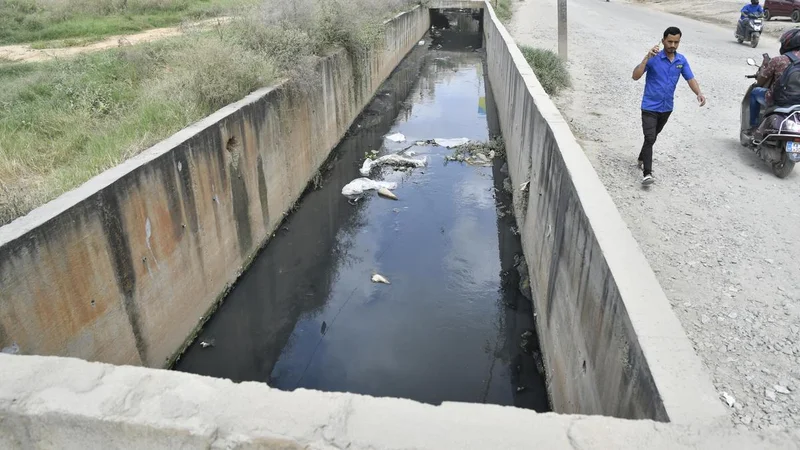
Did you know that Vrishabhavathi Valley has more unauthorised drain inlets than the other valley systems in Bengaluru?
In Shivajinagar, 88% of surface area near drains is impermeable, despite ₹15-20 crore a year being spent on drains.
While areas in the city with lakes, open drains and green cover functioned as heat sinks, dense built-up areas, closed drains and dry drain beds contributed to urban heat islands.
These were some of the findings of the ‘Stormwater Drain Data Jam’ held as part of the Building Resilient Bangalore campaign, an initiative by MOD Foundation in collaboration with Oorvani Foundation and OpenCity, to build public awareness, engagement and shared responsibility for stormwater drains in the city.
As the initiative, planned as a long-term and ongoing journey, completed a year, a report was launched to document the beginning of it.
“The project set out to make Bengaluru’s stormwater infrastructure more observable, understandable and actionable. Its objective was not simply to document drains, but to create an open knowledge ecosystem where citizens, researchers, designers, practitioners and government agencies could collectively contribute to understanding the city’s stormwater systems and use this knowledge to support better planning and stewardship,” the report noted.
Since the inception of the campaign, several initiatives have been launched to build greater public awareness and participation in the city’s 840-km-long rajakaluve network.
These include a research and knowledge framework for understanding Bengaluru’s stormwater system, a citizen science methodology and audit toolkit, an interactive ecology map and audit dashboard, public programmes such as the data jam, masterclasses, guided citizen audits and typology workshops, and an open-access repository that brings together spatial information and on-ground observations, among others.
As part of the guided citizen audits, so far, 235 auditors have collectively conducted 17 audits covering 40.8 km of stormwater drains.
Considerable variation in the physical condition of stormwater drains, visible indicators of poor water quality, solid waste accumulation, overlapping infrastructure — including electricity poles, pipelines, manholes and other utilities — located within or immediately adjacent to stormwater corridors, were some of the observations documented during the audits.
“Severe climatic events are increasing in frequency, particularly rain. Eventually, Bengaluru has to come up with blue-green infrastructure where we move away from our disposal mentality to a reuse and recycle mentality, including water. We have too much water; we just have poor management and optimisation,” said Naresh Narasimhan, cofounder of MOD Foundation.
Published - August 08, 2026 11:40 pm IST