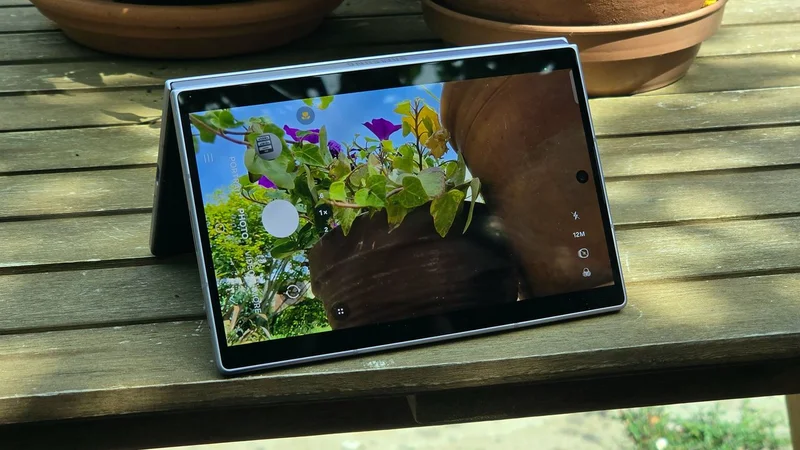
Since they were announced last month, I've been dual-wielding the Samsung Galaxy Z Fold 8 and Z Fold 8 Ultra, the two new premium folding phones from the world's foremost foldable maker.
In the two weeks since the phones showed up at my door, I've taken hundreds of pictures on them (349 on the Fold 8 and 307 on the Ultra, to be precise). They've come with me on multiple holidays, been used for product photography for reviews I've published, and even accompanied me on a film location scout day, which saw them get a lot of use.
You'd expect that the Samsung Galaxy Z Fold 8 Ultra would be my default photography foldable. As I'll explain a little later, it's simply a better camera phone, offering better-looking photos thanks to having more cameras.
However, that's not been the case. When I need to grab a shot, I've found myself reaching for whichever pocket the 'standard' Galaxy Z Fold 8 is in. And the reason has little to do with its photography chops.
Size matters more than sensors
The benefit of the best camera phone over a DSLR or mirrorless camera is convenience. You don't have to sling them over your neck or tote them around in a carry case; they fit in your pocket and, more importantly, come out of your pocket in a pinch.
The Galaxy Z Fold 8 Ultra is a long, thin phone; we're talking 158.4mm tall and just 72.8mm wide when it's folded (8.9mm thick and 215g heavy, if we're trying to get all the dimensions). When I put it in my trouser pocket, it digs its way right into the bottom, yet still sticks out the top a fair way.
Yet removing it can be quite a faff due to its frame. I have to angle and adjust it, feeling like Ross, Rachel and Chandler trying to pivot it to remove it.
Sign up for breaking news, reviews, opinion, top tech deals, and more.
By contrast, removing the Galaxy Z Fold 8 from my pocket is a breeze because of how small and stumpy it is when folded (123.9 x 81.9 x 9.7mm, 201g, just so we've got everything). It comes out easier than an average, non-folding smartphone.
Quite a vapid reason to prefer one phone over the other, right? But try to imagine this removing process 50, 60, 70 times in one day, when I'm on holiday or a recce; the Z Fold 8 Ultra becomes more effort than it's worth.
In fact, most of the Z Fold 8 Ultra's shots are from specific shoots or sessions, when I knew I'd be using the phone lots, and so didn't put it in my pocket at all.
One is clearly a better camera phone
Despite the Samsung Galaxy Z Fold 8 being my preferred photography phone, I'm under no illusions about which takes better pictures.
Both phones have a 50MP f/1.9 ultra-wide camera, and two 10MP f/2.2 selfie cameras. But from here, the Ultra is, as you'd imagine, better.
For starters, its main sensor is more powerful, packing in 200 megapixels and an f/1.7 focal length, compared to the Z Fold 8's 50MP f/1.8. As photographers know, though, it's not all about megapixels, and I found it's the zoom lens that made the Ultra better.
The Galaxy Z Fold 8 Ultra has a 10MP telephoto camera which supports a 3x zoom. On paper, it's the same unit the Samsung Galaxy S26 Ultra packs.
A zoom lens gives the Z Fold 8 Ultra much, much more versatility for photography; in fact, I'd wager at least half of my pictures on the phone use this snapper. Its 67mm lens gives much nicer, softer depth of field than the main camera, even if the app keeps jumping between optical and digital zoom when you're using it.
When you zoom in on the Galaxy Z Fold 8, you're just getting digital zoom. The flower pictures above will show you how this looks in comparison to optical; it's fine, but to camera phone photographers, it won't compete.
As you'll notice when you look at the above pictures too, the Z Fold 8 Ultra offers some extra bokeh on the 1x zoom picture, likely thanks to the extra information presented from all those excess pixels it's capturing. However, for the most part, I've found them pretty matched when it comes to these 'standard' pictures taken on the wide camera.
Want some more Z Fold 8 Ultra camera samples? Every shot of the Z Fold 8 in this article was taken on the Ultra phone, using the 3x camera (hence why you're not seeing the Ultra in the shots).
Photography is only part of the process
Despite its lesser camera performance, I'm still using the Galaxy Z Fold 8 as my go-to photography phone. And the convenience of pulling it out of my pocket is only one reason. Another is what happens once I've captured the picture.
The inner, or main, screen of the Z Fold 8 has a 4:3 aspect ratio. For some comparison, the Z Fold 8 Ultra is 0.9:1, which is close enough to square that I feel comfortable referring to it as such for the rest of this article.
I don't know about you, but I don't capture or use square photos. I imagine you're in the same boat, given that Instagram basically single-handedly killed them off several years ago. No: for me, it's 16:9. Not only is this the required aspect ratio for every single website I write for, but it's a wide-screen aspect ratio which is appropriate for film reference shots, all-encompassing panoramas, or dramatic action shots. But the point I'm about to make would stand even more if you shoot in the camera app's default 4:3.
A wider display is much better for editing pictures. If you look at a wide snap on the Z Fold 8 Ultra's square display, you're given loads of black bars (or dead space) at the top and bottom. These are still present on the Z Fold 8, but much smaller, offering just enough space to house the edit controls.
When I'm holding an open Z Fold 8, I also find that my hands are in the perfect spot to easily manipulate the picture. Thanks to its display edges being taller, I have to move them around much more on the Ultra phone.
Based on coverage of the phones, both by critics and online users who've grabbed an early purchase of the phones, the aspect ratio is proving pretty divisive for the new phones. Some prefer the older shape of the Z Fold 8 Ultra; others like the 'passport'-style Z Fold 8. And for tasks like photo editing, I much, much prefer the latter.
Good, better, best
People who've read this article after glimpsing through the specs list of these new folding phones might find my preference for the worse one a little baffling. But those who've had hands-on time with the Z Fold 8 might understand my stance.
But if you're looking for a great camera phone, I'd be remiss not to mention something. Neither of these phones, not even the triple-camera Z Fold 8 Ultra, is actually a dedicated camera phone. They're fine for photography, but they won't hold a candle to the best mobiles on the market.
The Samsung Galaxy S26 Ultra would be a much better pick for people who want a camera phone, and don't need something that folds.
Don't just stick to Samsung, either. I've found most Galaxy phones have below-average battery lives — it's actually pretty poor on the Z Fold 8, at least compared to a non-folding phone, which cut some of my photo shoots short.
But if your main priority is a bending mobile, and the camera chops are a secondary consideration, don't rely on the specs list: the form factor is just as important.
Tom Bedford is a freelance contributor covering tech, entertainment and gaming. Beyond TechRadar, he has bylines on sites including GamesRadar, Digital Trends, Android Police, TechAdvisor, WhattoWatch and BGR. From 2019 to 2022 he was on the TechRadar team as the staff writer and then deputy editor for the mobile team.