“Why don’t they just leave?” Every time a calamity strikes a community, some version of that incredulous question always seems to rear its ugly head. I heard it as a kid when news broadcasts showed images of hurricane survivors floating around their flooded neighborhoods, and when the death tolls started rising in major cities amid COVID-19 outbreaks. Why would they stick around in the face of life-threatening danger? Why don’t they just leave?
Ambrosia Sky, developer Soft Rains’ now-complete debut, following its initial Part One release in 2025, does its best to approach that question with the care and nuance it begs for. The first-person sci-fi game puts you in control of a woman tasked with cleaning the aftermath of a fungal contamination, dubbed the Cluster, that has wreaked havoc across an asteroid colony. Abandoned spaceships are filled with the bodies of those who didn’t leave in time, or chose not to. The only way to solve the crisis is to see it through the eyes of those people, rather than casting judgment on the dead. The empathetic premise makes for a tender exploration of humanity’s response to crises, even if it gets tangled up in one too many sci-fi threads along the way.
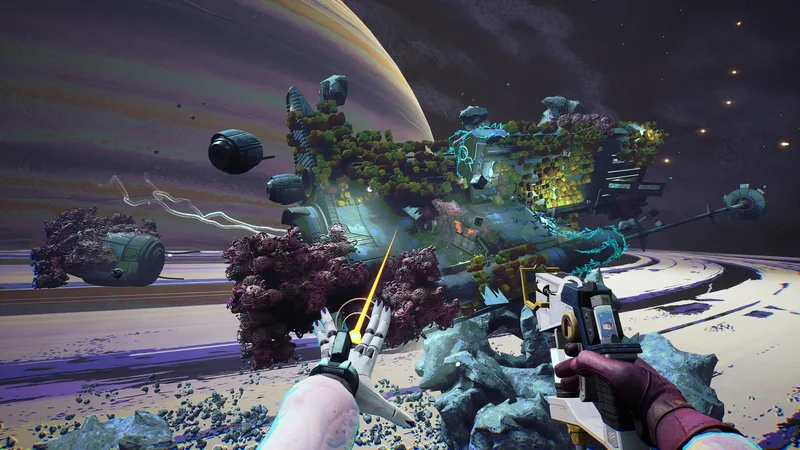
Initially conceived as a three-part game released in episodes, Ambrosia Sky’s Part Two update cuts that ill-conceived launch strategy short to complete the game’s story. If you didn’t try it when Part One launched last year, you’re better off; though I played the first chapter last year, I ended up restarting it from the top to reacquaint myself with its hard sci-fi story and creative gameplay, and found the complete package a sharper experience, albeit with some faults. Ambrosia Sky is a surprising fusion of Metroid Prime and Powerwash Simulator, where your task is to board ships covered in fungus and blast the growth away with your high-powered spray gun. A tether helps you get around, and you occasionally find yourself in zero-gravity situations that have you floating around cavernous ships.
Everything that worked about that creative idea in Part One still holds up in Part Two. The satisfaction comes from carving a path through hallways covered in poisonous fungi, carefully cleaning up ships that have been overtaken by the infection. There’s some great tension to be found in cutting seeds off of growth to get valuable suit upgrade parts, or to avoid accidentally blowing up an explosive plant that sets everything around you on fire. Part Two even adds some clever twists of its own, like corrupted vines that can only be removed by finding the source of the rot.
The best levels play like interconnected puzzles. One standout has me clearing the outside of a ship that’s wrapped up in fungus as I float around it in zero gravity. Clearing enough gunk so that I can reroute power through the ship takes me back to the tense, ship-deconstructing thrills of Hardspace: Shipbreaker, the 2020 physics sim that attained popularity in the COVID era. (That game’s developer, Blackbird Interactive, assisted Soft Rains on the final release.) A later level sends me roaming around a labyrinthian vessel filled with specimens to find and collect. Those are the moments where the clean-’em-up gameplay reaches its full potential, whereas it’s a bit thin in more linear levels.
Less compelling is Ambrosia Sky’s upgrade system, which still doesn’t come together even in the expanded Part Two. You can get various add-ons to your chemical powerwasher, outfitting it with electrical and flammable sprays, but I struggled to find a situation where those tools were useful. Ambrosia Sky presents itself as an immersive sim that gives you a bit of agency in how you clean ships, but it never gives you obstacles that can’t be easily cleared with your basic spray. Also strange is that it introduces a single enemy type for you to deal with, but that’s about the extent of its shoehorned stab at combat.
I’m not too broken up about that, because the real focus of Ambrosia Sky is its thoughtful storytelling. Your job is to untangle the mystery of the infection, uncovering clues left behind on abandoned ships and extracting DNA from the victims who lie dead under the fungus. At first, I found myself tempted to judge the dead who refused to evacuate. Why didn’t they just leave? But every new email, data log, or memory you uncover answers that question with care. Some stayed to research the disease and look for a cure. Others stayed because they couldn’t bear to abandon their homes. Each new detail pulls back the cold science behind a crisis and finds the humanity buried underneath. The more you seek to understand why people stayed, the more you learn about the problem you’re trying to solve.
Ambrosia Sky is about clearing away the mess, and keeping those we lost at the forefront of our memory.
That strong core occasionally gets a bit too complicated by the story threads orbiting around it. The real crux of the narrative, as explored deeper in Part Two, is around the main character, Dalia. It’s ultimately her guilt about leaving home as a kid that becomes the focal point, all while the story of the Cluster pushes deeper into cosmic surrealism. Lingering threads about religious cults and shady companies drift in and out of focus, struggling to capitalize on some of Part One’s juiciest cliffhangers. I was left wondering if some crucial story tidbits got the axe in Soft Rains’ decision to scale back its three-part release plan.
Though I’m not sure that I grasped every piece of the fragmented story by the end, Ambrosia Sky still lands as a timely, fascinating slice of sci-fi. It’s one that has only become more relevant in the year since Part One released; we’re still sorting through the aftermath of the COVID-19 pandemic. The health crisis has gradually been dehumanized, as history is rewritten in the name of cold political theater. Ambrosia Sky is about clearing away the mess, and keeping those we lost at the forefront of our memory. We cannot let their complex lives be reduced to manipulated statistics.
Ambrosia Sky is out now on Windows PC. The game was reviewed on Windows PC using a prerelease download code provided by Soft Rains. You can find additional information about Polygon’s ethics policy here.