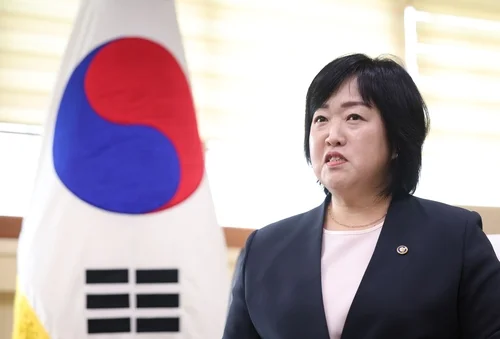
By Kim Seung-yeon
SEOUL, Aug. 9 (Yonhap) -- A "fundamental" overhaul of South Korea's military service system is vital for national security and survival, the head of the military manpower agency has said, in the face of a shrinking pool of conscripts amid a demographic cliff.
Military Manpower Administration (MMA) Commissioner Hong So-young made the remarks in an interview with Yonhap News Agency on Thursday, noting the government is in the final stage of reviewing reform measures of the "alternative" military service system as part of such an overhaul drive.
"Fundamental reform of the overall military service system is not a choice, but an indispensable task for South Korea's national security and survival," said Hong, who has spent her entire 38-year career at the agency.
"Since reforming the military service system directly impacts the lives of the younger generation, it is crucial that we craft measures that can earn broad consensus and the trust of the public," she said.
The MMA oversees military conscription in South Korea, where all able-bodied men must complete 18 to 21 months of service under a mandatory draft system primarily aimed at maintaining force readiness against North Korea.
Coupled with a declining birthrate, South Korea has seen growing conscript shortages in recent decades. Data by the Ministry of the Interior and Safety show that the number of men in their 20s stood at around 224,000 in 2025, compared with 371,000 in 2015. The government predicts the number will plummet to as low as 120,000 by 2043.
Seoul launched a task force last year to upgrade the basic plan for defense reform, including troop modernization and a rethink of the conscription system dating back to the 1950s. The plan is expected to be announced this fall.
Integral to the MMA's reform is boosting active-duty personnel by overhauling the alternative service system, which accounts for about 10 percent of all conscripts.
The mandatory conscription system in Korea requires every 19-year-old male to undergo a physical and psychological examination to determine their fitness to serve.
Based on the examination results, about 80 percent of them serve combat roles in the Army, Navy, Air Force and Marine Corps, while around 10 percent, who qualify for lower fitness grades or receive other considerations, are assigned to "supplemental" roles -- an alternative track serving as social service workers in public institutions or technical staff in designated industries, among others.
The government is considering allowing those assigned to non-combat alternative roles to be able to apply for a "full-time reserve" post, one of the active-duty categories where soldiers serve their mandatory duty by commuting from home, as opposed to staying in base barracks full time.
"The basic plan for defense reform will outline how we are going to scale back or abolish the supplemental service system amid the demographic cliff," Hong said. "We are at the final stage of reviewing the measures."
Relevant government agencies have also reached a general consensus on reforming the alternative track for arts and sports figures.
Under the current rules, they can substitute their military duties with roughly three years of community service by winning top awards at domestic or international competitions designated by the government.
It was first adopted back in the 1970s as a way to promote national status, contrary to how much the world knows about South Korea today, Hong noted.
"We agree on the direction to gradually reform the program by focusing on prestigious competitions, possibly tightening entry requirements," she said. "Given the diverse stakeholders involved, we are consulting experts and intend to address this incrementally rather than scrapping it all at once."
Though at an early stage and less pressing, the MMA is also taking a closer look at mandatory service exemptions granted to North Korean defectors and naturalized citizens, the commissioner said.
The MMA has commissioned a study on such cases, examining factors such as their settlement timing, upbringing and adaptation to Korean culture, and their adaptability in the military.
"We are reviewing whether to adjust the level of military service exemptions or adjustments by age group in that regard," she said.
Hong noted that all of these efforts boil down to one thing: ensuring the military service system is implemented in a "fair and equitable" manner.
"In truth, we have witnessed a decline in the eligible military population, and this was a completely predetermined future, but there has been no comprehensive response to it," she said.
"Military manpower is precious. I believe the MMA should play a role in properly managing and securing those resources, and I feel so rewarded that we are finally overhauling the policies and systems that have been in place for decades," Hong added.
elly@yna.co.kr
(END)
- Gemini, BTS collaboration on display at Las Vegas Sphere
- U.S. Marines stage live-fire drills involving FPV drones for 1st time in S. Korea
- Galaxy Z series logs 1.44 mln preorders in S. Korea, highest on record
- Singer-actor Cha Eun-woo files appeal after paying 13 bln won in taxes
-
(2nd LD) Temperatures soar to record 42.5 C in southeast
-
U.S. Marines stage live-fire drills involving FPV drones for 1st time in S. Korea
- (LEAD) Police raid Starbucks Korea over controversial promotional event
- Singer-actor Cha Eun-woo files appeal after paying 13 bln won in taxes
- Navy's ROKS Daejeon awarded 'top gun' honor at RIMPAC
-
(3rd LD) Temperatures soar to record 42.5 C in southeast
-
Gemini, BTS collaboration on display at Las Vegas Sphere
- Football association apologizes amid allegations over providing sexual entertainment for foreign referees
- Scorching heat continues across nation; heavy rains forecast on eastern coast
- (LEAD) Lee orders bold push for large-scale housing supply
- Heat-related illness patients in late summer up threefold over past decade: data