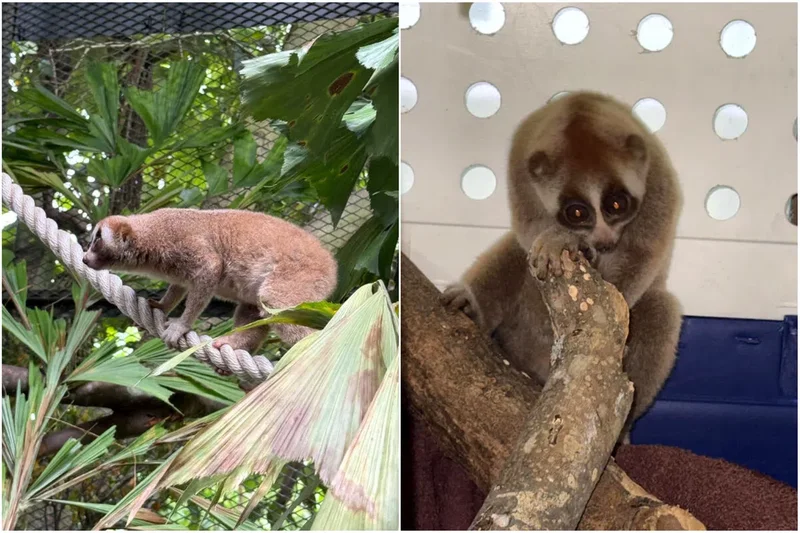
Sunda slow loris found in industrial estate near Tuas released after 2 months
AI generated
SINGAPORE - Workers were surprised to discover a young slow loris peering at them inside an industrial building near Tuas in May.
The fuzzy creature was eventually rescued by the Animal Concerns Research and Education Society (ACRES), which identified it as the Sunda slow loris, an endangered venomous primate native to Singapore.
This has been the second Sunda slow loris rescued by ACRES so far in 2026. The first was found in an HDB corridor in Sin Ming in January.
The case was unusual, as the species’ wild population is confined to the Central Catchment Nature Reserve, said ACRES chief executive Kalaivanan Balakrishnan, adding that the slow loris was first spotted on a tree before it entered the premises.
He guessed that the tree-dwelling primate could have accidentally hitched a lift in a lorry or was an abandoned illegal pet.
Fortunately, the animal was only mildly dehydrated upon discovery.
Kalaivanan declined to reveal further details about its location, due to the species’ rarity and its popularity in the illegal wildlife trade.
“Slow lorises are prominent in the illegal wildlife trade. They are also sadly mistreated and used as photo props in other countries,” he said.
It is rare to come across cases involving wild slow lorises due to their shy and elusive nature, said ACRES’ wildlife rescue and rehabilitation manager Karina Lim.
However, Lim added: “As more habitat loss occurs, it may result in animals venturing out in search of other suitable green spaces to inhabit.”
Notwithstanding the slow loris’ mysterious origins, it was deemed suitable for release, as it did not display any captive behaviours or physical modifications common among illegally kept pets.
With bulbous eyes and furry bodies, these slow-moving primates may look like stuffed toys, but their venom-filled bites can rot flesh and cause anaphylactic shock in humans. In the exotic pet trade, poachers typically cut or pull out the animal’s sharp teeth to prevent it from biting its owner.
To prepare for the slow loris’ release, a customised rehabilitation plan was developed from reviewing scientific literature and consulting an overseas wildlife rescue organisation with expertise in slow lorises, said Lim.
The nocturnal animal was monitored almost nightly and fed a diet including insects, bird eggs and tree sap, much of which had to be sourced naturally, she added.
Fluid was also given to resolve signs of stress detected in its blood, possibly the result of being stranded outside of its natural environment, said ACRES’ veterinary department manager Tan Hui Min.
Once the staff saw that the slow loris could climb, forage and demonstrate a healthy aversion to humans, they knew that it was time to say goodbye.
Said Lim: “We have been rooting for his release from the very start, and we are glad that after two months of rehabilitation efforts he was able to return and be free in the wild again.”
On Aug 3, the primate was released in a forested area populated by fellow wild slow lorises.
As Singapore continues to clear its forested areas for developments, ACRES is looking to help wildlife and improve their welfare, said Kalaivanan.
“With expansion plans taking shape at ACRES, we are able to do a lot more advanced rehabilitation work which will give both our native and non-native wild animals a better chance back in the wild,” he said.
The Sunda slow loris is the only known venomous primate. It produces a yellow secretion from glands on its inner arm, which combines with saliva to deliver a painful bite.
Due to illegal demand for slow lorises as pets, all nine of its species are currently threatened with extinction.