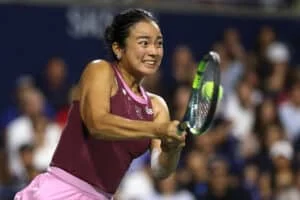
Eala: Beyond the fairy tale
It was a Monday afternoon in Washington, DC, but the loudest cheers came from half a world away.
Philippine flags fluttered in the stands. Chants of “Let’s go, Alex!” echoed through the stadium, and tournament officials marveled at a Monday final unlike anything they had seen before.
Jessica Pegula, one of the world’s best players, thanked the Filipino fans even though they had rooted against her. Tournament owner Mark Ein called it one of the greatest Monday final crowds ever.
Article continues after this advertisement
When Alex Eala lifted the biggest trophy of her career, the first Filipino to win a WTA title, many were quick to describe her run as a “Cinderella story.”
It is not.
Fairy tales begin with wishes. Eala’s story began with calluses.
Born into a family of athletes, Eala was fortunate to have a background that could send her to the Rafa Nadal Academy in Spain at the tender age of 13, an opportunity beyond the reach of the average Filipino athlete.
Article continues after this advertisement
But that privilege purchased only a chance.
‘An amazing player’
It did not earn victories over Olympic champion Zheng Qinwen, defending champion Leylah Fernandez, former world No. 3 Elina Svitolina, erstwhile world No. 1 Naomi Osaka, or the top-seeded world No. 3 Pegula. Those wins belonged entirely to the young woman who spent years away from home and sharpened one of the finest return games in women’s tennis.
The women she defeated offered the finest measure of what the tennis world sees now in Eala.
Article continues after this advertisement
Osaka, the four-time Grand Slam champion, said: “She’s incredible. I think she’s a star. And it’s just really cool to have someone like her that people can look up to.”
Pegula was equally generous. “You’re an amazing player,” she told Eala, before reflecting on how much her opponent had grown since they first met.
“Just to see how far you’ve come over the last couple of years … to see the amazing fans that follow you every single place you go,” she said.
Then Pegula turned to the boisterous crowd that had transformed Washington into something that looked and sounded almost like Manila: “To all the Filipino fans that came out and have supported, you guys are still helping grow tennis around the world … We love to see that grow.”
Champions recognize champions. Their words carried the respect of athletes who know what it takes to reach the summit.
Filipino champs
Tennis has long been associated with restrained applause and quiet decorum. Into that world has barged a Filipino following that cheers every point with contagious joy. Philippine flags now ripple through the galleries of Wimbledon, Miami, and Washington. Homemade banners appear in the stands. Chants erupt between serves.
For years, Filipinos traveled abroad hoping to witness greatness on the tennis court. Today they travel expecting one of their own to produce it.
Eala joins a distinguished line of Filipino champions who carved their own path to greatness. Manny Pacquiao’s fists first earned the world’s respect before they earned the nation’s adulation. Hidilyn Diaz found steadfast support in family, coaches, and private benefactors as she chased an Olympic dream that once seemed impossible. Carlos Yulo crossed seas to train in Japan because excellence required opportunities unavailable locally.
None waited for perfect conditions to reach far. Their triumphs inspire pride but prompt a deeper question: Why must so many of our best athletes succeed despite the system and not because of it?
Eala’s rise reminds us why athletes like her are so rare. She has spoken about growing up without anyone from the Philippines to “pave the way” and having to train abroad because the opportunities she needed simply did not exist at home.
Paving the way
At 21, she has begun to fulfill that role of paving the way for others. Even in the glow of her biggest triumph, the humble, eloquent Eala was looking beyond herself. “I hope this inspires people in the Philippines to pick up a tennis racket,” she said.
President Marcos has applauded Eala and pledged the government’s support. That is to be expected.
One hopes, however, that this promise will extend beyond an athlete who has conquered the international stage to the girls and boys whose names nobody yet knows.
The government has an unfortunate habit of discovering athletes long after the rest of the world has acknowledged them. By then, their feats have become national achievements, though the hardest years were largely borne by their families, coaches, sponsors, or the athletes themselves.
No, Eala’s story is no fairy tale, because fairy tales celebrate the chosen. Eala’s story celebrates the earned.
Somewhere in the Philippines today, another girl is picking up a racket because of Eala. Whether she follows the same path should depend on talent, sacrifice and perseverance, not just the good fortune to overcome similar obstacles in her way.
Today, we salute Eala. Tomorrow’s work begins: how to make Eala’s story a little less exceptional and a little more possible.