- See more Daily Mail on Google - save us as a Preferred Source
Head east from the palm tree-fringed beaches and shiny glass towers where influencers like to flaunt their bodies and their good fortune, and you will reach another side to the Dubai dream.
It is only a 45-minute drive out into the desert, but Al Awir is a world away from the glittering metropolis and is unlikely to feature on the social media channels of Instagrammers and celebrities.
For this is the home of the Gulf state's forbidding central prison, described by human rights groups as a grim, high-security 'hell-hole' where conditions are harsh and overcrowding common.
It has been dubbed Dubai's Alcatraz. Unlike the notorious island prison in San Francisco Bay, however, it is surrounded by mile upon mile of desert wilderness.
And for 18 years it has held British citizen Ryan Cornelius in a cell the size of a shipping container -which he shares with six other inmates – and who, belatedly, is now the focus of international efforts to win his freedom – though little of this has come from our own supine Foreign Office.
Last week we reported how the United Nations is demanding his release and had accused the United Arab Emirates of 'serious judicial irregularities' in the sentencing of the business leader, who was convicted of defrauding a Dubai bank.
The human rights campaigner, Sir William Browder, added his voice in a powerful the Daily Mail article in which he warned that unless Mr Cornelius, now 72, was freed soon, 'his detention will become a death sentence'.
In Sir William's estimation, the respected former property developer and much-loved family man is 'yet another victim of a draconian and corrupt Middle Eastern legal system in which the courts are used to pursue vendettas, settle scores or raid assets'.
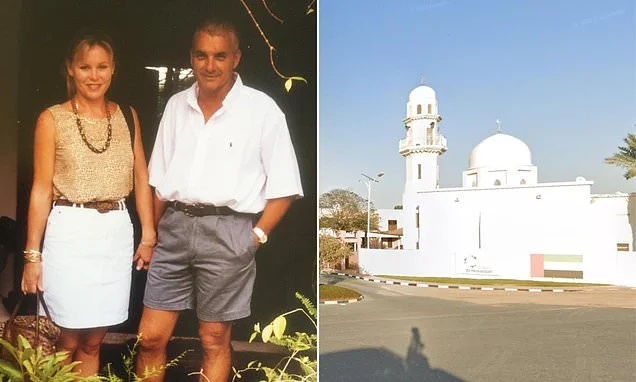
British businessman Ryan Cornelius (now 72) was arrested in Dubai 18 years ago over a $500M bank loan used to fund a luxury development project. Ryan is pictured with wife Heather
Prosecutors accused him of fraud, a charge his family and supporters maintain stems from a technical issue exploited by a draconian legal system. Ryan pictured with his family
Ryan is held at Al Awir Central Prison (pictured), a overcrowded, high-security facility in the desert. He shares a cell the size of a shipping container with six other inmates.
In Mr Cornelius's case, all three have been weaponised against him. His bank accounts were drained, his homes – a house and two flats in London – seized and sold by court order and a prized leisure development, part-funded by the Dubai Islamic Bank, confiscated... in other words stolen.
It is little wonder that his family, too, fear that he will not survive his jail term. He has contracted tuberculosis, Covid twice, has borderline diabetes, high blood pressure, raised cholesterol and is forced to self-medicate chronic dental problems by rinsing his mouth with disinfectant.
The story of Ryan Cornelius's incarceration is not just about injustice, though that is bad enough. For three years he languished in prison without trial, he has been kept in solitary confinement and, just as he neared his sentence's completion, it was arbitrarily extended by 20 years, which will keep him behind bars until, if he survives, he is 84.
It is also about the life that was extinguished outside his cell, not just the theft of his assets and money. He has had his self-respect crushed and, crucially, lost forever the landmarks of family life.
For his imprisonment has included almost the entire childhood of his youngest son who was six when he was arrested.
He never saw him put on his school uniform for the first time, nor watched from the touchline as he took up his own love of rugby. Exams and the excitement of university plans were similarly robbed from him.
Then there were the deaths and funerals of both his parents, which he was forbidden to attend – the bleakest of many dark days.
This week, one more milestone, albeit a happier one but no less heartbreaking, was added to the tally – his eldest son's partner, whom he has never met, gave birth to his first grandchild, a boy.
Absence from all these events might have broken him if he hadn't been able to rely on the unceasing love of his wife Heather, whose steadfast support is the other side of this tragic story.
Theirs is a remarkable relationship that has been strengthened by the nearly two decades of separation, sustained by nothing more than a daily telephone call never lasting more than five minutes.
Last week, Heather was on a camping holiday in the west of Ireland with her daughter, who along with her two sons she prefers not to name.
'They have lives of their own to lead, involving them in the campaign for their father inevitably draws attention, not all of it welcome,' she says.
What she doesn't say – doesn't need to say – are the unforeseen consequences of aligning with criticism of a Gulf country that is at the hub of many international air routes.
In his article, Sir William, who is the driving force behind the Global Magnitsky Justice Campaign, which seeks to impose visa bans and asset freezes on human rights abusers, applauded the UN for doing something 'successive British governments have failed to do: it stood up for a British citizen'.
Inmates wearing protective gear read in seats respecting distancing measures amid the COVID-19 pandemic, at the library of Dubai's Al-Awir central prison in the United Arab Emirates
Ryan's wife Heather, now living in penury in Gloucestershire, maintains contact solely through brief, daily five-minute phone calls
Heather Cornelius has lost track of how many foreign secretaries she has petitioned since 2008, the year of her husband's arrest on trumped-up charges.
Of those politicians, she gives credit to only one – Lord (David) Cameron, the former Conservative prime minister. 'He did what he promised to do,' she says. 'He got involved and wrote a personal letter to Dubai's ruler appealing for Ryan's release.'
Most, she says, offered tea and hand-wringing sympathy but nothing else. One foreign minister's opening remark to her was: 'I can offer you no hope.' On the day before the 2024 general election – and knowing that the Conservatives were heading for defeat – Lord Cameron took time to write to Mrs Cornelius setting out what steps he had taken. 'I was very touched,' she says.
The autocratic Sheikh Mohammed bin Rashid al Maktoum, the UAE's vice president and prime minister, however, didn't bother replying to Lord Cameron, whom he had met on many occasions. And the appeal, along with multiple others for clemency, fell on deaf ears.
Nothing, however, has been allowed to interrupt their marital lifeline – those phone calls.
When I contacted Mrs Cornelius at a campsite in County Kerry last week, she had already had her morning call from her husband and was hopeful for a second later in the day.
His daily routine remains as it has done for years. Along with all inmates he is awoken by a blaring siren at dawn, breakfast – black tea and a bowl of dal – follows at 5am and then begins the queue for the telephone.
'He tries to call me twice a day and one of the children once a day,' Heather says.
'Always, he is positive. He wants to be strong for all of us, and he never once lets me worry about him, though of course I do.
'Telling him about our grandson was of course emotional because we should be making plans of what we will do with this new little one, but we can't. So, the news was wonderful but also not wonderful. He did manage to get a call to our son too and was able to hear the news from him.'
In earlier years, Ryan's calls would come when she was watching the children's sports matches and for a brief few minutes she would provide a running commentary of the action. 'It allowed him to think he was there.'
The chats are invariably short, given the demand for the phone from other prisoners. Skype and other privileges such as regular outdoor exercise were withdrawn some time ago.
The shadow cast over the Corneliuses is a long one. With no home and no money, Heather was reduced to near penury and lives in Gloucestershire with her sister and brother-in-law. 'I would be lost without them,' she tells me.
The day of Ryan's arrest in May 2008 is seared on her memory. It is the moment that their lives as prosperous expats collapsed and the start of a torment that still has no end.
'At the beginning I thought he would get justice and that he would be home soon,' she says. 'I had great faith that this country, which was such a great ally of Britain, would realise its mistake and let him go, that it was all a big misunderstanding.'
Her husband had stopped over in Dubai on his way home to Bahrain, where the family had settled.
Walking out of the airport, he was arrested by three plain-clothes police officers, who said they suspected he was carrying drugs. A search revealed nothing but he was still detained.
He was taken in an unmarked car, his hands bound with zip ties, to Dubai's police headquarters. As he entered the building a hood was placed over his head.
He was interrogated for hours in a padded windowless room, without a lawyer present, and then thrown into a bare cell. For ten days he was held incommunicado with no access to his family, legal advisers or the British Embassy.
Over his 18-year detention, he has contracted tuberculosis (left untreated for 18 months), COVID-19 twice, borderline diabetes, high blood pressure, and severe dental problems
Cornelius has missed his youngest son growing up, as well as the deaths and funerals of both his parents. Pictured is a family photo
The accusation against him had moved on from drugs to fraud.
Ryan had made his money after selling his precision tunnelling company in Saudi Arabia during the infrastructure construction boom of the 1980s.
But in 2008, amid the fallout of the global financial crash, the Dubai authorities were concerned about a $500million bank loan he and another Briton were using to fund investment programmes in the Gulf.
Specifically, prosecutors would later allege that he forged invoices for the construction of The Plantation, a luxury development in Dubai featuring an equestrian centre and polo club which would include a 200-room hotel and 100 villas.
Lord Clement-Jones, a lawyer and Lib Dem peer who has taken up Ryan's case, says the original problem with the loan and receipts was 'technical' rather than fraud.
But that was all to come. In 2008, having been ordered to sign a statement in Arabic, a language he neither speaks nor reads, he knew nothing of the case against him.
'I didn't know what was going on,' recalls Heather. 'Even now those ten days before I could speak to him are a nightmare.
'I have blocked out so much of it, but even today they keep me awake at night.'
For three years her husband was left to rot in jail without charge while Heather tried to focus on raising their children, then six, 16 and 19.
'Watching them grow knowing what Ryan was missing was heartbreaking, all that learning and life. Every year I would promise the children he would be home for Christmas - I believed it too,' she adds.
In 2011, his case was finally heard in a Dubai court, which imposed a ten-year jail sentence and demanded he and his three co-defendants repay the loan as well as a $500million fine.
At first, Heather made regular trips to Al Awir. Each was more shattering than the last. For her first visit he was in handcuffs, unkempt, his skin a shade of grey.
'You go through endless security, and I remember to this day the cold concrete floor, strip lighting and steel chairs attached to the floor. If I cried the guards would ask: 'What are you crying for?'
Prison life is stripped of humanity and privacy. Ryan sleeps on a thin rubber mattress with a heavy woollen blanket. The temperature in his cell is kept low, and the air conditioning runs noisily and continuously.
There are few windows and lighting remains on 24 hours a day. According to one former prisoner the sound of dripping taps and constantly running toilets are a form of mental torture.
In the early days he was permitted daily exercise in the prison yard where he organised games of touch rugby with fellow inmates but over the years this has become increasingly infrequent. Instead, he now does sit-ups and press-ups and has manufactured weights for lifting from plastic water bottles.
He can occasionally jog up and down the corridor. He has also taught himself Pilates, which keeps his muscles in alignment.
Every penny his family can get to him he uses to pay for those precious phone calls. And food. He can buy a small range of items from outside the prison by placing an order through the police kitchen.
His purchases include cereal, biscuits, coffee, chocolate bars and bottled water. The prison menu is bleak, usually chicken and rice in a yellowish gravy like gruel. 'There is no fresh fruit, no fresh anything,' says Heather.
Unsurprisingly, his health has deteriorated. Medical care is almost non-existent - a single doctor covers all 4,000 inmates.
Ryan's TB was untreated for 18 months and he has been prevented from seeing a dentist throughout his incarceration. At night, prisoners have no access to a guard, no way to contact anyone in the event of an emergency.
During the Covid pandemic a prisoner in the neighbouring cell died of the virus and his body lay there for eight hours before being removed. Ryan fears another bout of Covid could trigger his tuberculosis again.
How he must have longed for the life he had with Heather. The couple had been largely inseparable since meeting when she was 17.
They were both born to British parents in Zambia - then Northern Rhodesia - and met at a local rugby club where Ryan was a keen player.
They married in 1985 and moved to Saudi where Ryan established his business. When he sold up, he was wealthy enough to retire but was still only in his early 40s, and the quiet life didn't suit him.
He embarked on several new projects, including The Plantation. Back then the Emirates were still booming.
'We had a lovely house, gardens, a pool and a boat,' says Heather. 'We'd moved to Bahrain because it was better for family life. Every Friday we'd go to an island, fish, barbecue and swim.'
But by 2016, with her finances exhausted, Heather had to leave Bahrain for London. A flat near Tower Bridge became the family home until that was expropriated by the Dubai bank that had provided the loan.
Their ordeal seemed to be nearing its end in 2018, when Ryan was scheduled for release. But just before he was due to walk free, the authorities claimed he had 'failed to repay the creditor' and outrageously added another 20 years to his tariff.
This, says Lord Clement-Jones, was a breach of natural justice.
Ryan tried to appeal the second sentence but was not allowed to board a bus from prison to the court house for the hearing because his paperwork was not in order.
In his absence, the court dismissed the appeal. His ordeal was increasingly Kafkaesque.
His building development – worth $1billion at the time of his arrest – was seized by authorities who said it was worthless.
Today, glowing online sales videos tell a different story, renamed The Acres, it has been turned into a multi-billion dollar landscaped villa development.
In most Western countries debt is considered a civil matter. In the UAE it is a crime. A UAE official insisted to The Mail on Sunday that Ryan had 'a fair trial in which all due processes were followed'.
The Foreign Office was approached for comment.
Whatever the ins and outs of his case, Ryan Cornelius has paid a huge price for his ambition. He has lost his parents, his health, 18 years of his life and his future.
He is bankrupt and his family are impoverished.
But worst of all for Heather and his children is the fear that they may never see him again.