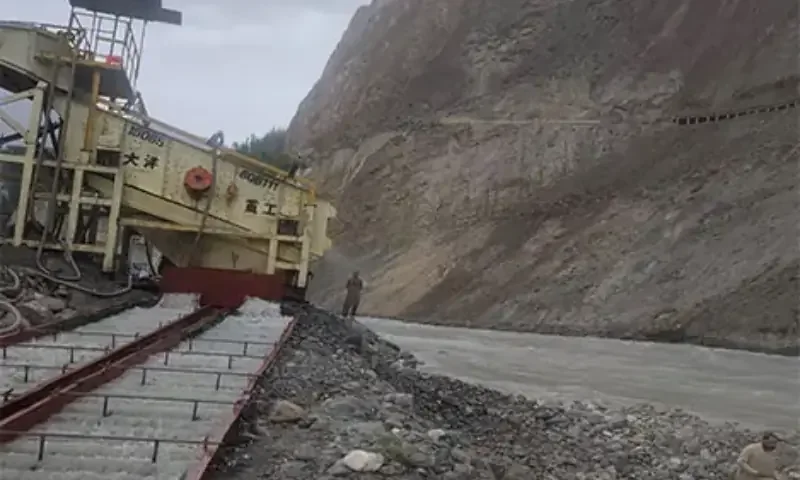
A recently sealed placer gold extraction site in Hunza. —Photo by Gilgit-Baltistan Environmental Protection Agency • Authorities warn of risks to Diamer-Bhasha Dam, roads, bridges and settlements• Untreated wash water, debris and oil from machinery areas of concern GILGIT: Increasing placer gold mining activities in streams and rivers are threatening the fragile ecosystem of Gilgit-Baltistan (GB), with authorities describing them as a serious risk to dams, including the Diamer-Bhasha Dam, as well as roads, bridges, important infrastructure and human settlements along riverbanks. Currently, a large number of local companies, in joint ventures with national and multinational companies, are engaged in extracting gold from rivers and streams across GB. Sources said placer gold mining activities in rivers and streams had increased across the region in violation of environmental laws, causing environmental degradation and putting roads, bridges, government and private infrastructure, human settlements and agricultural land at risk of river erosion. The activities were also causing water, air and land pollution. Speaking to Dawn, Gilgit-Baltistan Environmental Protection Agency (GBEPA) Director Khadim Hussain said the issue had become more serious in recent years as placer gold mining companies were not complying with environmental laws. According to the GBEPA, it had been observed that heavy machinery was being used for gold extraction from riverbeds and streams, mostly near bridges, roads, government and private infrastructure, human settlements and agricultural land. Oil and other materials leaking from generators and other machinery used in the extraction process were also mixing with river and stream water. It had also been observed that untreated wash water generated from gold-washing activities, along with debris, was being discharged into rivers without any sedimentation or settling mechanism. The polluted river water was being used by people in many areas for drinking and other daily needs. The GBEPA said the construction of protection walls along riverbanks for gold extraction and the use of excavated material altered the natural flow of rivers and streams, diverting water towards roads, bridges, human settlements, infrastructure and agricultural land. The diversion of natural watercourses posed a serious risk of erosion and destabilisation of steep slopes adjoining roads, bridges, infrastructure, human settlements and agricultural land situated near riverbanks and streams. Such damage could be particularly severe during periods of high river discharge. Furthermore, the dumping of excavated material could cause serious and irreversible damage to sensitive infrastructure. No proper campsites had been established at the project sites, while no appropriate mechanisms had been provided for the safe collection and disposal of solid waste. Adequate sanitation and restroom facilities had also not been provided for workers at the sites, resulting in improper waste management. “These actions constitute a breach of the environmental conditions of approval and endanger public health and safety,” the GBEPA said, adding that they had also caused environmental degradation. Operations suspended According to a notification issued after a visit by GBEPA officials, a fine of Rs1 million had been imposed on a placer gold mining company and its operations suspended for allegedly violating environmental protection laws in Nasirabad, Hunza. The notification ordered that all project operations cease with immediate effect. The project premises had already been sealed by the competent authority. The notification also directed the company to immediately comply with environmental laws. Mr Hussain said the GBEPA and the minerals department lacked sufficient human resources to monitor mining activities and enforce environmental protection laws at gold extraction sites across GB. In a recent letter to the Director General of the GBEPA, the general manager of the Water and Power Development Authority (Wapda) Diamer-Bhasha Dam Project requested measures to control sediment erosion caused by mining activities in the dam project area. The letter said extensive gold extraction from the Indus River bed was being carried out inside the proposed Diamer-Bhasha Dam project reservoir area, from Basri to Raikot near Chilas in Diamer. In another letter sent to the Astore deputy commissioner, the executive engineer of the Communication and Works Department in Astore requested a ban on excavation activities near bridges over the Indus River. Published in Dawn, August 9th, 2026
Unregulated placer gold mining raises concerns in GB