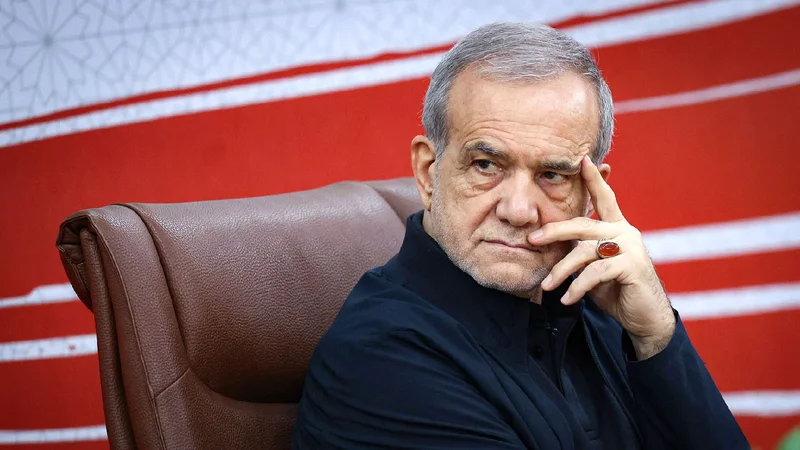
Iranian President Masoud Pezeshkian attends a press conference in Tehran, Iran, August 8, 2026. /VCG
Iran will continue pursuing a "path of peace" with the United States under the recently signed memorandum of understanding (MoU), Iranian President Masoud Pezeshkian said on Saturday, but stressed that Tehran's participation in negotiations would depend on Washington creating an atmosphere of trust.
Iran is trying to move on the "path of peace" based on the "paragraphs" in the MoU, Pezeshkian said at a press conference, adding, "Now is the best time to reach an agreement, as there is solidarity, power and unity in the country."
"We are determined to ... use the MoU as the basis provided that the United States lets go of the atmosphere of distrust it has created, and an atmosphere of trust is formed," he said.
Pezeshkian also noted that Iran would not yield to any attempt by the other side to use force, adding that Tehran's actions would ultimately be guided by decisions made by Supreme Leader Mojtaba Khamenei.
Strait of Hormuz still a focus of US-Iran talks
Iran's Fars News Agency reported on the same day that Foreign Minister Abbas Araghchi said Iran and Oman were "close" to reaching an agreement, but that this did not mean the Strait of Hormuz would be reopened.
Araghchi said reopening the strait would depend on other conditions, including "compensation" from the United States for "violating" the MoU.
Iran has repeatedly denied that it is negotiating with the United States, while US President Donald Trump has insisted that talks between the two countries have resumed. Secretary of State Marco Rubio said on August 4 that Washington was involved in dialogue and negotiations between Oman and Iran.
US Vice President JD Vance said on Saturday that Washington and Tehran were in dialogue, adding that "we're really in the middle of the game here" and that the conflict was not over but no longer in its opening stage.
In an interview with Fox News, Vance said Washington's priority was to maximize the amount of oil and natural gas flowing through the Strait of Hormuz. He said the United States was working to ensure safe passage for vessels, including through mine-clearing operations and an Iranian commitment not to fire on commercial ships.
Lebanon-Israel ceasefire faces setback
The developments came as a separate ceasefire arrangement between Lebanon and Israel suffered another setback in southern Lebanon.
Three Lebanese soldiers were injured on Saturday while dismantling unexploded ordnance in Zawtar al-Gharbiyah, the same southern Lebanese town where Israeli forces erected a new earth berm overnight in what residents called a violation of a "pilot-area" arrangement.
Lebanon's official National News Agency reported that an Israeli military force entered the town shortly after midnight, accompanied by several vehicles and a bulldozer, and erected an earth berm about 100 meters from the town square.
It also reported intermittent Israeli artillery shelling on wooded areas and elevated positions on the outskirts of the nearby town of Nabatieh al-Fawqa from midnight until Saturday morning.
The incidents followed the seventh round of Lebanon-Israel talks in Rome earlier this week. The talks focused on implementing a framework agreement signed in late June that provides for Lebanese army deployment in two "pilot areas" in southern Lebanon.
The army deployed in the town on July 21 as part of arrangements for "pilot areas" under a Lebanon-Israel framework agreement.
(With input from Xinhua)