Sign in. It’s quick, free and it’s up to you.
An account is an optional way to support the work we do. Find out more.
AN EXCEPTIONALLY RARE celestial event will be visible across Ireland on 12 August: a near-total eclipse of the sun.
A solar eclipse happens when the moon moves directly between the earth and the sun, blocking its light. From the ground, people can see the sky turn dark and a bright ring of the sun’s atmosphere appear in the sky.
In the southwest of Ireland, up to 97% obscuration of the sun is predicted, which is extremely high.
Director of Kerry Dark Sky Tourism Aoibheann Lambe said that this month’s eclipse is very unusual.
It is only a small percentage away from a total eclipse, which Ireland is not expected to see until 2090, Lambe told The Journal.
“Depending on where you all are in the world, you get a different view of an eclipse; some places will have a partial eclipse, and some places will have a total eclipse.
“But for us, without having to go anywhere, 97% plus is brilliant,” she said.
**What time will it happen? **
The eclipse is predicted to begin at around 6.10pm and will last for two hours.
The eclipse will reach its maximum peak about hour after it starts.
Niall Smith, head of the Blackrock Castle Observatory in Cork, said this timing will make it especially visible across the island.
“It’s happening at around 7.15 in the evening and is closest to the horizon. That means you have this lovely counterpoint between the eclipse and the horizon itself. So very often eclipses are maybe very high overhead, but this is beautifully framed”, he told The Journal.
Peter Gallagher, astrophysicist and director of the Dunsink observatory, said that when the eclipse happens we can expect to see “a little bite taken out of the sun, and that little bite will progressively get bigger and bigger”.
“It will be like dusk or dawn and go noticeably dark just after 7pm”, he told The Journal.
He also noted that eclipses can have effects on birds and animals, who can get confused when they think it’s suddenly dusk or dawn.
“That’s going to be interesting to listen out to see if birds start singing,” he said.
Spectators have also reported a noticeable cooling of the air during an eclipse.
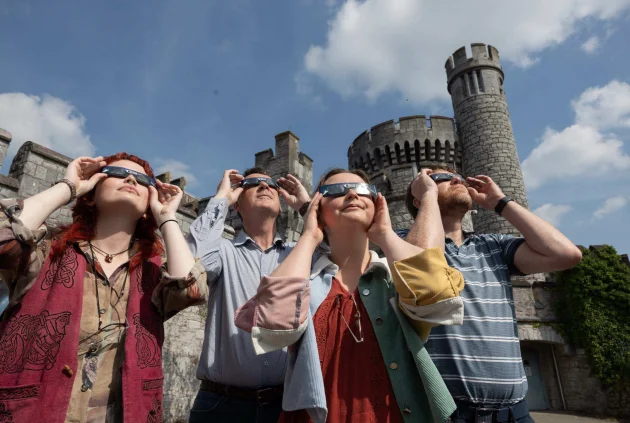
However, Gallagher stressed the importance of not looking directly at the sun without using solar glasses or other protection such as cardboard projectors which can be made at home.
If there are clouds in the sky, people may be tempted to remove glasses for a better view, but this should be avoided.
In some parts of the island the obstruction of the sun is expected to be slightly lower than in the southwest.
For example, Dublin is expected to see 96% coverage and Belfast less at 93%.
However, Smith maintained that this will only make a modest difference in the effect of the eclipse.
“We’re encouraging people to just go out in your locality, and it’ll be amazing in your locality. It’s one of these great events because to the average viewer, they would be hard-pressed to see a real difference between Cork and Dublin,” he said.
For scientists and astronomers, a solar eclipse presents a unique opportunity for further discovery.
Gallagher is part of a team of scientists to fly a specially equipped Irish Air Corps aircraft off Ireland’s west coast during the solar eclipse.
By flying three hours west of the island, the team can observe and photograph a total eclipse.
The sun’s outer atmosphere, known as the corona, is to be studied using a new airborne telescope called E-CorMag.
These observations will help scientists better understand the sun’s magnetic activity and its effects throughout the solar system.
Gallagher noted that this mission has taken a year to plan and involves teams from Ireland and Italy.
Astronomical observatories nationwide have been preparing for the eclipse with viewing events organised for the public.
At Blackrock, Smith noted that the observatory has already distributed six and a half thousand solar glasses for free.
There are viewings taking place at three different locations in Cork including Bells’ Field in the city.
If you cannot make it to these events, there are some recommended tips for the most effective viewing experience.
“Because the eclipse is happening close to sunset the sun will be low and therefore hills, trees or buildings could obscure it, so your viewing location will be all important,” Emma Whelan, Experimental Physic’s lecturer at Maynooth University, told The Journal.
A good view of the western horizon is required, but Smith ensured it should not be difficult.
“If you can see the sun, you can see the eclipse”, he said.
He would also encourage people to document and photograph the significant event.
“So many people alive today will not have an opportunity to see an event like this from Ireland again in their lifetime,” Whelan believed.
More information on the eclipse, including guides and events, can be found here.
To embed this post, copy the code below on your site