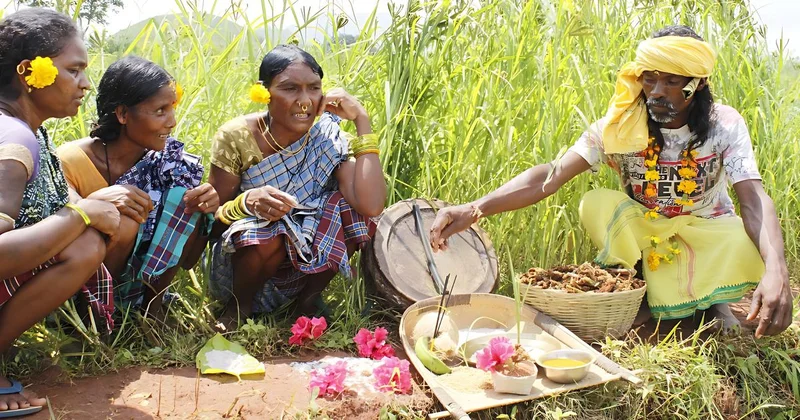
The first pot of rice newly harvested during October-November is never eaten straight away in Koraput. Before families gather around the meal, a portion is offered to the village deity. Around five to six months later, the next farming season begins with prayers for rain, while wooden ploughs, cattle and seeds are honoured in their own ceremonies.
In Koraput, in the Eastern Ghats of southern Odisha, every stage of cultivation has its own festival. The region is home to the Paroja, Gadaba, Kondh, Bhumia, Bhottada, Durua and Saura Adivasi communities. Here, agriculture is intrinsically linked with culinary heritage and faith.
Koraput is among India’s richest centres of crop diversity. It harbours hundreds of locally adapted crop varieties, including indigenous paddy, finger millet, little millet, pigeon pea, black gram, horse gram, niger, sesame, traditional vegetables, tubers and wild edible plants.
Unlike monoculture farming, fields here are planted with a diverse mix of crops that support one another, reduce farming risks and provide food throughout the year. Farmers cultivate varieties of rice that mature at different times, ensuring that all crops do not ripen at once. This helps spread the risk when rainfall is delayed or uneven.
Many indigenous varieties are valued not only for their taste and cultural importance but also for traits such as drought tolerance, flood resilience, pest resistance and adaptability to local conditions. Families save, exchange and replant seeds, ensuring that these locally adapted varieties remain part of everyday cultivation.
This diversity has also become increasingly important as the climate changes. While no farming system is immune to these changes, cultivating a wide range of crops and varieties has long helped communities reduce risk and strengthen household food security.
Many of these crops survive because they are woven into festivals, rituals and family traditions – everyday cultural practices help preserve biodiversity. The agricultural calendar closely follows the life cycle of rice – from selecting seeds and preparing fields to welcoming the harvest and storing grain for the next season.
On International Day of the World’s Indigenous Peoples, Koraput offers an important reminder that conserving agricultural biodiversity means protecting the communities that nurture traditional crops and carry forward the knowledge embedded in every harvest.
A year begins with seeds
With the arrival of the month of Chaita (usually in March), villages celebrate Chaithi Parab, marking the beginning of a new farming season. Fresh mangoes arrive with the changing weather, while stored paddy, black gram and pigeon pea are cooked into festive meals and traditional pithas or dumplings.
The food is first offered to village deities and ancestors as a prayer for timely rains and a good harvest. The festival expresses gratitude for the previous season while looking ahead to the next.
As dark monsoon clouds gather over the Eastern Ghats in July, there is the Asadha Jatra ceremony. Farmers prepare rice cakes from locally grown paddy, while leaves collected from nearby forests are burnt as a purification ritual before cultivation begins.
The ceremony reflects an enduring belief that forests, water and farms are deeply interconnected, and that healthy ecosystems are essential for healthy harvests.
Soon afterwards is Puni Parab, when wooden ploughs, farming implements and agricultural fields are cleaned, decorated and worshipped. Puni Parab honours the labour behind every harvest, but it also serves another purpose.
Farmers identify healthy rice plants that will provide seed for the following season, carefully selecting varieties that have performed well under local conditions. In this way, Puni Parab keeps indigenous seeds in cultivation.
Harvest celebrations
By September, the fields begin to turn golden and the first signs of harvest appear. In Dussehra, freshly harvested rice, often the heritage Bodikaburi variety, is cooked for the first time and offered to the cow. The festival celebrates the close relationship of people with their livestock and land.
Rice garlands are hung at the entrances of homes, while cattle are washed, decorated and worshipped for their role in cultivation.
During Diali Parab in November, villages use harvested for festive dishes prepared from cherished varieties such as umriachudi, machhakanta and tiki chudi. Before families gather to eat, the food is offered to village deities in gratitude for a successful harvest.
Panicles are woven into decorative garlands, while rice flour is used to create ceremonial motifs, reflecting the ways agriculture is part of everyday life. During Pandu Parab, communities also honour niger, a traditional oilseed crop that has long contributed to household nutrition.
Weddings and life
In winter months, during Pusha and Magha Parab, households prepare nourishing pancakes using finger millet, sesame, niger and jaggery, accompanied by curries made from pigeon pea, broad beans and locally grown vegetables.
Agriculture is also part of weddings, during which heritage rice varieties such as Pathanguda, Karkoli, Kandulakathi and Machhakanta are served. These grains are valued for prosperity, fertility and blessings for the newly married couple. Some of these varieties are cultivated because they are indispensable for such ceremonies.
Women are at the centre of many of these traditions, preparing ritual foods, organising offerings, preserving recipes and passing on knowledge to younger generations. Along with seed-saving practices within households, their role ensures that Indigenous food traditions continue across generations.
A living heritage under pressure
Together, these festivals have created a living system of conservation. But there are challenges.
Farmers across Koraput are grappling with erratic rainfall and extreme temperature that make sowing and harvesting less predictable than before. Hybrid and high-yielding crop varieties are gradually replacing traditional seeds as farmers respond to changing food and grain markets, government programmes and the pressures of higher yield.
Indigenous rice varieties that were once widely cultivated are now grown by only a small number of households. Younger generations are also now widely exposed to changing food habits and commercial agriculture.
Some indigenous varieties have survived largely because they are essential to festivals, weddings and other community ceremonies. Without these cultural traditions, locally adapted varieties could disappear much faster from farmers’ fields.
Susanta Sekhar Choudhury. Pritesh Sundar Roy, Abhijit Mohanty and Pulak Ranjan Nayak work for the Watershed Support Services and Activities Network, Bhubaneswar.
World Indigenous Peoples Day is observed on August 9.
We welcome your comments at letters@scroll.in.