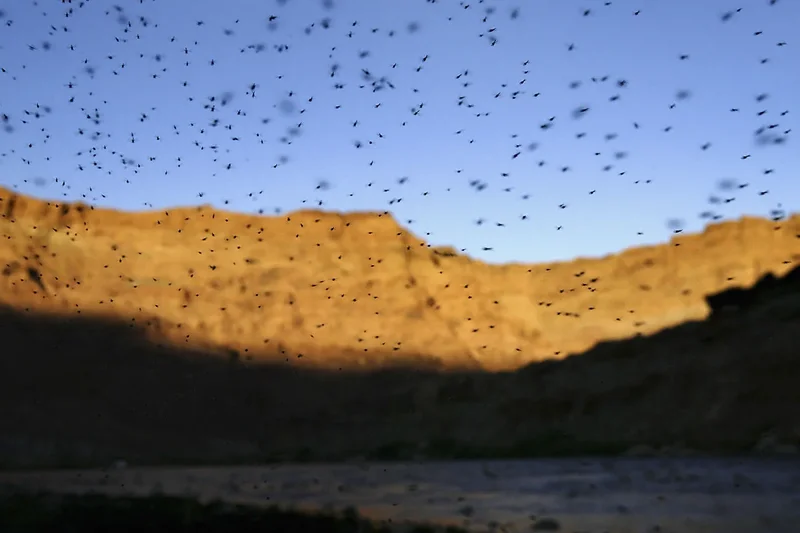
Pesky mosquitoes seem unavoidable in summer but maybe not for long - in parts of the United States, at least.
Mosquito levels are down 50 percent across Western and Midwest states including Minnesota and North Dakota this year. In Colorado, experts say levels could have plunged up to 70 percent.
“Coming from out of state, the mosquitoes here are worse than I’ve ever seen them,” Minnesota resident Kahiti Stierley-Nunez, who moved from California four years ago, told The Minneapolis Tribune. “But this year, I haven’t had to put on bug spray at all this whole summer.”
The reason is a historic drought, powered by climate change, which has also led to a destructive wildfire season.
But while some states are getting a reprieve in mosquito numbers, this doesn’t actually mean a lesser chance of contracting viruses they can carry like zika, chikungunya and dengue. Scientists are particularly worried about West Nile - a potentially deadly virus with case numbers at a 22-year high in the U.S.
West Nile virus has been a problem since it was introduced to the U.S. from the Middle East in 1999 by migrating white storks, finally spreading to all contiguous U.S. states in 2004.
There have been some 32,000 U.S. cases since the virus reached the U.S.
The virus, which is most commonly contracted through a mosquito bite, causes more than 130 deaths in the contiguous U.S. every year.
Severe cases can lead to a high fever, coma, tremors, vision loss, paralysis and brain and spinal inflammation, the Centers for Disease Control and Prevention says.
“These are horrible, horrible symptoms, and they're the tip of the iceberg in terms of the virus activity,” Kathleen Walker, an extension specialist and professor at the University of Arizona, told The Independent.
So far this year, 143 West Nile cases have been reported in the U.S. Five deaths have been reported in Arizona, which also accounts for roughly half of the cases. High numbers of West Nile virus have also been reported in nearby Colorado and Utah.
Fewer mosquitoes and rising disease rates may seem paradoxical, but experts say that’s not the case. Drought means that mosquitoes breed around smaller bodies of water, giving more opportunity for the virus to spread between them.
“Drought conditions can paradoxically increase West Nile virus transmission because it concentrates mosquitoes and birds (West Nile virus is a bird virus, first) around shrinking water sources, increasing transmission risk,” Matthew Aliota, a professor at the University of Minnesota, who specializes in these kinds of viruses, told The Independent.
The West Nile cases are how scientists have been tracking major changes to mosquito populations. While numbers have dropped, there are still likely trillions of the insects in the U.S.
“One blood meal can give them upwards of 180 eggs, so they reproduce explosively,” Robert Hancock, a professor at Metropolitan State University Denver who specializes in mosquito behavior, said.
Mosquito species also matter when it comes to the spread of populations. There are more than 200 different types in the U.S. and some do better than others in drought conditions.
That was the case in Utah, where mosquitoes have been abundant around the Great Salt Lake.
“Some surveillance traps have reported nearly 30,000 mosquitoes caught in a single night,” Neil Vickers, a professor emeritus at the University of Utah, who studies mosquitoes and moths, told The Independent.
But drought does not last forever, and the climate crisis is also causing more extreme rainfall and drought events.
Mosquito populations can rebound when conditions change, potentially to even larger levels.
In the U.S., there are now 18 more days each year with temperature conditions suitable for mosquito breeding than 50 years ago, according to non-profit Climate Central.
Scientists are preparing for future, elevated swarms by biohacking their reproductive abilities in an attempt to reduce populations. There are also community initiatives to trap mosquitoes and treat water with insecticide to ensure it doesn't become a breeding ground.
But mosquitoes are here to stay, Hancock said. They have been biting humans for over one million years, after all.
“I think that respect for mosquitoes is the most important thing that we can do because I don't think we can completely defeat them, but we can certainly continue to try,” he added.